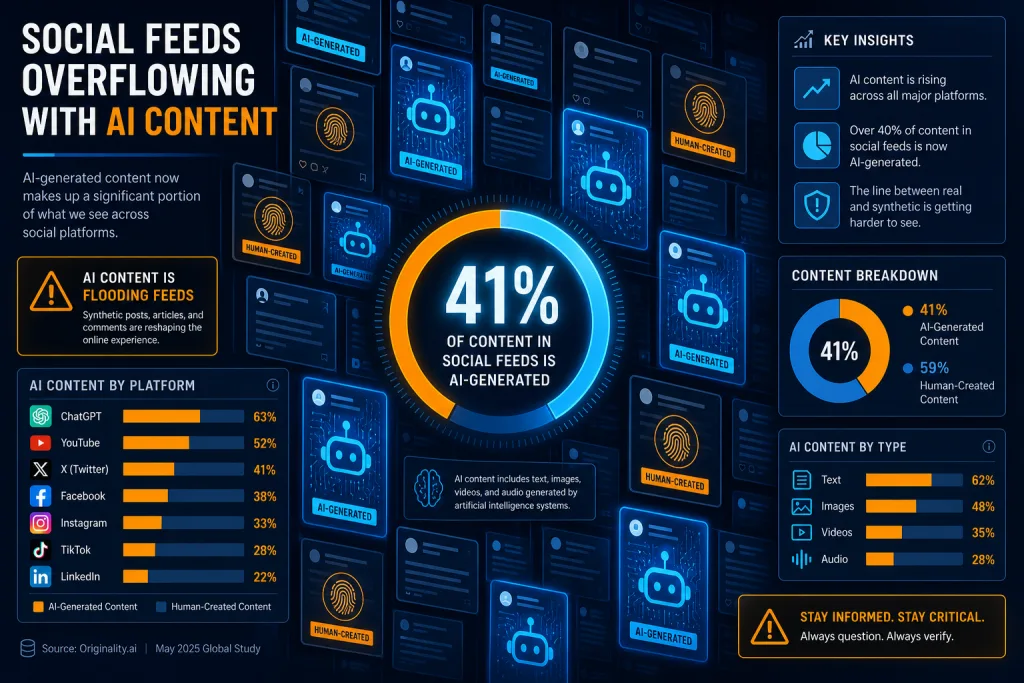
According to AI detection company Pangram, 41% of long posts and 30% of short posts on LinkedIn between April and June 2026 were likely generated by artificial intelligence. Among all the platforms the company tracked — X, Reddit, Substack, and Medium — LinkedIn showed the highest level of AI saturation.
For editorial teams publishing long-form content on external platforms as part of their distribution strategy, this isn’t just a statistical curiosity. It’s a signal that platforms actively promoting AI content creation tools are rapidly losing informational value for readers. When four out of ten long texts on a platform are machine-generated, ranking algorithms and human attention begin to work against synthetic content.
In this article, we’ll break down what platform saturation data means for editorial teams, how AI detection metrics work, why the “publish everywhere” strategy no longer works, and what originality systems to build to keep long-form content valuable.
What the Pangram Study Revealed
Pangram, a company specializing in detecting AI-generated text, analyzed content across five platforms from April to June 2026. The results:
- LinkedIn: 41% of long posts and 30% of short posts were likely AI-generated
- X, Reddit, Substack, Medium — lower rates (exact figures weren’t disclosed, but LinkedIn was named the leader by a significant margin)
- LinkedIn is also actively integrating AI: when creating a post, users are offered an “improve with AI” button
One notable case is Steven Bartlett, host of “The Diary of a CEO” podcast. His company FlightStory stopped using AI to write LinkedIn posts after noticing how quickly the platform was filling up with machine-generated content. This was a strategic decision: when a platform is oversaturated with AI text, even high-quality AI content loses distinctiveness.
Why LinkedIn Became the First Victim of AI Saturation
Three factors made LinkedIn vulnerable:
1. Low barrier to entry. LinkedIn itself offers AI tools for “polishing” text. Users don’t need to look for ChatGPT — the button is right in the editor. This lowers the psychological barrier: “I’m not generating content, I’m just improving it.”
2. “Thought leadership” culture. LinkedIn’s format encourages short insights framed as expert opinions. LLMs excel at this genre: generating confident statements, rhetorical questions, and “lessons” that sound meaningful but often lack unique experience.
3. Lack of strict moderation. Unlike Reddit, where communities vote on quality, or Substack, where subscribers pay for specific authors, LinkedIn algorithmically rewards engagement. AI posts optimized for reactions can get more reach than human ones.
For editorial teams, this means: a platform that seemed like an attractive channel for distributing long-form content is rapidly losing its value as a source of trust.
How AI Detection Metrics Work and What They Miss
Detectors like Pangram, GPTZero, and Originality.ai analyze text based on statistical features: perplexity (unpredictability of word choice), burstiness (variation in sentence length), and token distribution. High perplexity and burstiness indicate human authorship; low values suggest machine generation.
But detection metrics have critical limitations:
- False positives. Technical texts, legal documents, and academic papers with predictable structures are often flagged as AI, even when written by humans.
- Prompt engineering bypasses detectors. Prompts with instructions like “write with varied sentence lengths, use unconventional phrasing” reduce detection accuracy to the level of random guessing.
- No paragraph-level probability. Most detectors provide an assessment at the level of the entire text, without showing which parts are generated and which are not.
For editorial teams, the takeaway is: AI detection is a monitoring tool, not a final verdict. Use it to track the proportion of AI content in the flow, but not as the sole criterion for publication.
Distribution Strategy: When to Publish on a Platform vs. Your Own Site
LinkedIn saturation data raises the question: should editorial teams publish long-form content on external platforms if they’re filled with AI text?
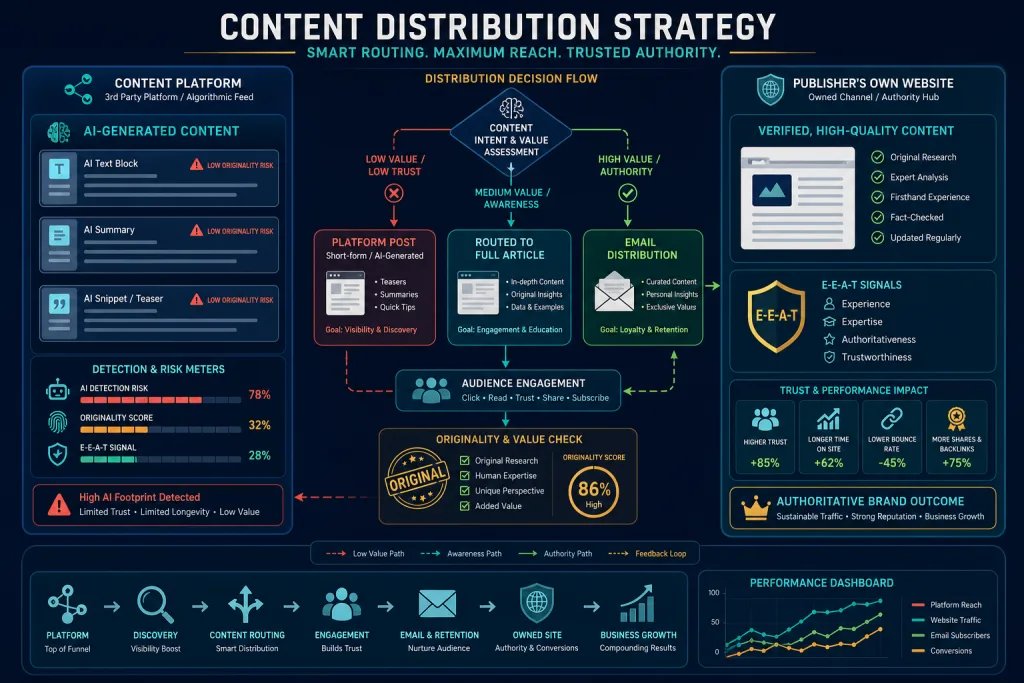
The decision depends on the publication’s goal:
Platform for Reach and Acquisition
If the goal is to attract a new audience, a platform with high AI saturation can still work, but with conditions:
- Publish platform-unique content, not a copy of an article from your site. AI posts usually replicate general talking points; specific experience and data stand out against them.
- Use a strong first paragraph with a specific story or number. AI texts often start with rhetorical questions or general statements — contrast works in your favor.
- Add a link to the full version on your own site. The platform post is a teaser, not the final product.
Platform as an Endpoint
If the goal is monetization or direct conversion, publish on your own site. Platform saturation with AI content reduces reader trust in all texts on the platform, including yours. Your own site with a clear editorial policy and author attribution preserves E-E-A-T signals.
Hybrid Model
Editorial teams working with long-form content increasingly use a hybrid approach:
- Full article — on your own site
- Adapted version (not a copy!) — on the platform
- Key insight — in an email newsletter
Critically, the adapted version must be written or substantially reworked by a human, not generated with a “shorten this article” prompt.
Originality Systems: How to Maintain Distinctiveness When Using AI Assistants
Completely abandoning AI tools isn’t the only or always the optimal answer. Editorial teams that use AI for drafts, research, and structuring can maintain originality if they build the right systems.
Prompt Systems with Experience Injection
A basic “write an article about X” prompt gives an average result that detectors flag as AI. Instead, use prompt systems that require specificity:
Write a section about [topic].
Use the following data from our research: [insert].
Rely on this expert comment: [insert].
Do not use rhetorical questions and generalizing conclusions.
Length: 300-400 words.
The more unique data and quotes you inject into the prompt, the higher the perplexity and distinctiveness of the result.
Layered Editing
Instead of generating a finished text, use AI for individual layers:
- Structure layer — AI proposes an article outline, the editor approves or changes it
- Factual layer — AI collects and groups data, the editor verifies it
- Phrasing layer — AI suggests phrasing options for specific paragraphs, the editor chooses and rewrites
At each layer, the human decision leaves a trace that detectors read as a sign of authorship.
Editorial AI Personas with Constraints
If the editorial team uses saved system prompts (AI personas), add explicit constraints to them:
- Ban on clichés: “in today’s world,” “it’s important to note,” “let’s consider”
- Sentence structure requirement: no more than two sentences of the same length in a row
- Mandatory inclusion of specific examples in each paragraph
What to Do with Content Already Flagged as AI
If a detector flags your published content as AI-generated, it’s not a disaster, but a reason to act:
- Check for false positives. Compare with other detectors. If one flags it and two others don’t, it’s likely a false positive.
- Identify problematic sections. If the detector supports word-by-word or paragraph-by-paragraph analysis, find which parts raise suspicion.
- Rewrite with experience injection. Add specific cases, numbers, quotes. Don’t “tweak” the text to fool the detector — add real value.
- Update your editorial process. If the same pattern repeats across multiple articles, the problem is in the prompt system, not the specific text.
Platform Dynamics: What the Data Says About the Trend
The 41% figure on LinkedIn isn’t a static picture. Platforms are reacting to saturation:
- LinkedIn announced measures against “slop” — low-quality AI content. The platform is trying to balance promoting its own AI tools with maintaining the value of the feed.
- Reddit uses LLMs to solve problems that LLMs themselves created — for example, moderating AI spam.
- Google removed 50,000 AI networks aimed at manipulating search.
For editorial teams, this means platforms will strengthen filters against AI content. Content that passes today may be downgraded in ranking tomorrow. The strategy of “publishing AI text while the platform doesn’t catch it” is a strategy with an expiration date.
Practical Takeaway for Editorial Teams
Platform saturation with AI content isn’t a problem you can solve with a detector. It’s a structural shift that changes the value of distribution. Editorial teams that treat external platforms as free reach channels need to rethink their approach:
- Measure not only reach but also the proportion of AI content on the platform where you publish
- Separate platform content and proprietary content — these are different products with different goals
- Invest in originality systems (prompt systems, layered editing, data injection) rather than bypassing detectors
- Shift focus to your own site as the endpoint for conversion
Checklist: Auditing Your Editorial Strategy on Platforms
- Run 5-10 recent platform posts through 2 different AI detectors. Record the rate of false positives.
- Compare the reach and engagement of posts written by humans with posts where AI was used. Is there a difference?
- Ensure every platform post contains at least one element AI cannot generate: a specific number, a quote, personal experience.
- Check if your prompt system has explicit constraints on clichés and banal phrasing.
- Make sure the full version of the content is published on your own site, and the platform version is adapted, not copied.
- Add regular monitoring of the AI content share on the platforms where you publish to your editorial calendar.
FAQ
Does 41% AI posts on LinkedIn mean the platform is useless for editorial teams?
No. LinkedIn remains a powerful channel for B2B audiences. But the strategy needs to change: publish unique content with specific experience and data, not AI drafts. Use the platform for acquisition, and your own site for conversion.
How accurate are AI detectors like Pangram?
Detector accuracy ranges from 70% to 90% depending on the text type. Technical and academic texts are more likely to produce false positives. Use 2-3 detectors in parallel and don’t rely on a single tool as the final verdict.
Do we need to completely abandon AI when writing posts for platforms?
Not necessarily. AI is useful for structuring, gathering facts, and suggesting phrasing options. The key is final human editing and the injection of unique experience. The problem isn’t using AI, but publishing raw AI drafts without editorial processing.
How will platforms fight AI saturation in the future?
Platforms are already introducing algorithmic filters: LinkedIn announced measures against “slop,” Reddit uses LLMs for spam moderation, and Google removes AI networks. The trend is toward increased filtering, so content that passes today may be downgraded in ranking tomorrow.
What is “experience injection” in prompt systems?
It’s the addition to a prompt of specific data, expert quotes, case studies, and personal observations that aren’t in the LLM’s training data. The more unique factual material you insert into the prompt, the higher the originality and distinctiveness of the result.