In July 2026, Google expanded its requirements for disclosing AI-generated content in advertising. Advertisers using Google’s generative tools receive automatic labeling; those creating content in third-party tools must manually indicate AI involvement. Google is already embedding SynthID—an invisible watermark—into all outputs of its generative models. About 30 U.S. states have passed laws requiring disclaimers in political advertising, and federal regulation is inevitable.
For newsrooms, this is a signal: technical transparency of AI content is no longer a voluntary option. What is mandatory for advertising today will become the standard for all published content tomorrow—including editorial articles, knowledge bases, corporate blogs, and partner publications. Content teams that start building a transparency system now will gain an advantage: established processes, audit logs, and policies before platforms and regulators make them mandatory.
What is AI Content Transparency and Why It Has Become Mandatory
AI content transparency is a combination of technical, editorial, and legal mechanisms that allow platforms, readers, and partners to understand how content was created and what role artificial intelligence played in it.
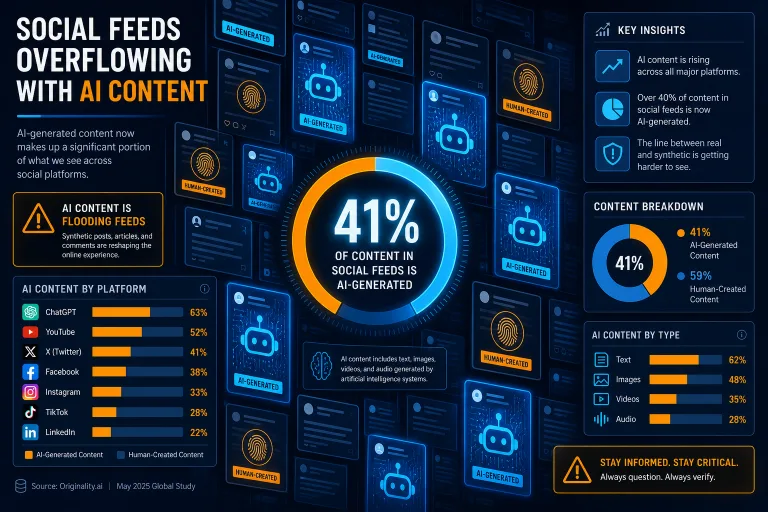
Three factors have made transparency mandatory. First, scale: according to Panggram, 41% of long posts on LinkedIn are already AI-generated, and platforms cannot ignore this volume. Second, risk: AI-generated content is used for phishing, impersonation, and disinformation, forcing platforms to build detection systems. Third, regulation: AI disclosure laws are already in effect for political advertising and are expanding to other categories.
Google operates on two levels. The first is technical: SynthID and metadata embedded in the outputs of generative models. The second is policy: requirements for advertisers to explicitly indicate AI involvement. Both levels directly affect newsrooms, even if you don’t buy advertising.
SynthID: How Invisible Watermarks Work
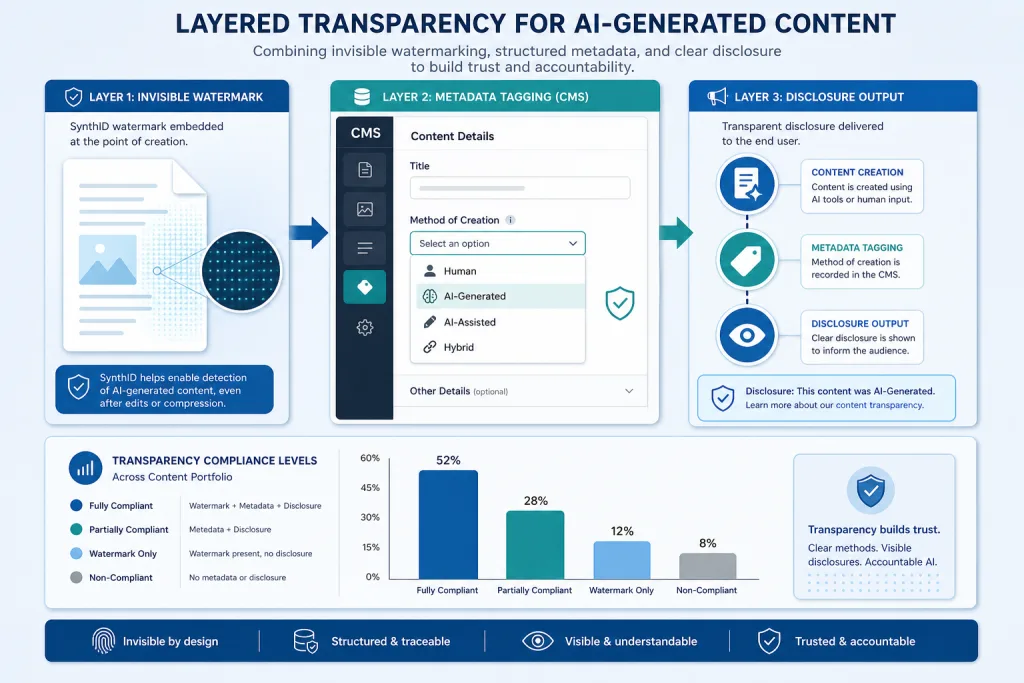
SynthID is a Google technology that embeds a statistical watermark into the outputs of generative models. For text, this is a specific distribution of token probabilities that is invisible to the reader but recognized by a special detector. For images, it uses pixel patterns; for audio, frequency characteristics. The mark survives compression, cropping, and partial editing.
For newsrooms, it is important to understand the limitations of SynthID. First, the technology only works on outputs from Google models—Gemini and related products. Content generated in GPT, Claude, Llama, or open-source models like GLM does not carry this marker. Second, with significant human editing, the watermark may weaken or disappear. Third, the SynthID detector is not available to newsrooms—it is used only within Google.
This means that SynthID is not a solution for newsrooms, but rather part of the platform’s infrastructure. Your task is to build your own transparency layer that works independently of which model you use.
C2PA and Other Labeling Standards
In addition to SynthID, there is the open C2PA standard (Coalition for Content Provenance and Authenticity), supported by Adobe, Microsoft, and the BBC. C2PA embeds cryptographic metadata into a file—information about the author, tool, creation time, and edits made. Unlike SynthID, C2PA is not tied to a specific model and can be used by any newsroom.
For long-form editorial content, C2PA currently has limited application: the standard works better with images and video than with text. However, newsrooms should track the development of the standard, as platforms may start requiring C2PA-compatible labeling for all types of content.
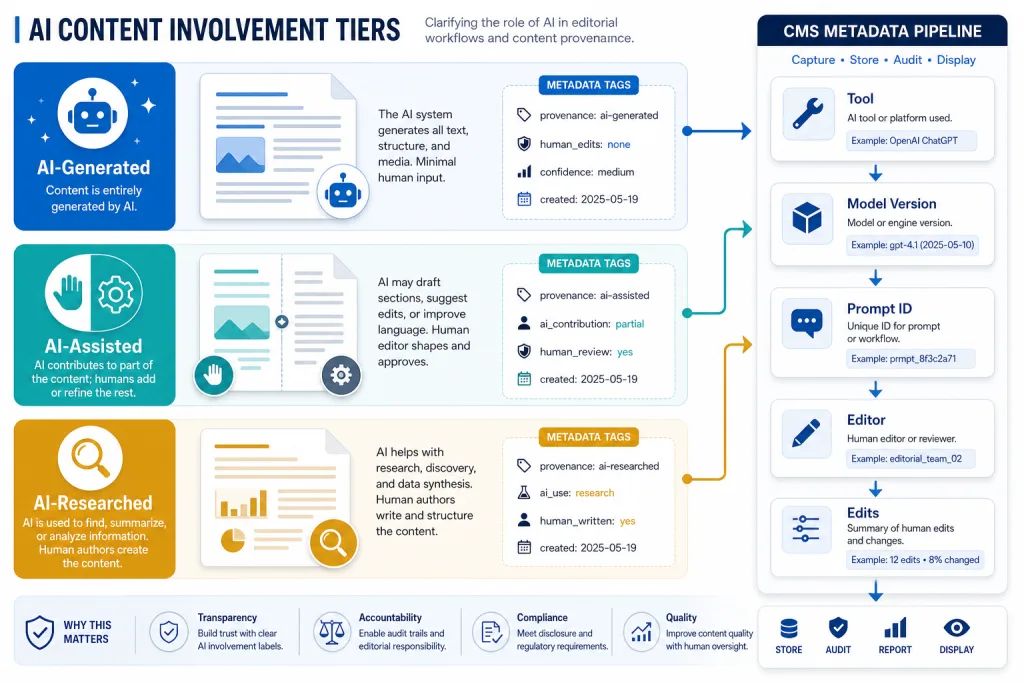
Practical step: check if your CMS supports exporting metadata in C2PA format or a similar one. If not, add custom fields that capture the same information: tool, model version, generation date, prompt identifier, editor name.
How Google Requires AI Disclosure in Advertising—and What It Means for Newsrooms
Google has introduced two disclosure mechanisms. For advertisers using Google’s generative tools, the disclaimer is included automatically. For those creating content in third-party tools, a new control has been introduced: the advertiser must manually indicate whether AI was used to create the ad.
For newsrooms, this sets a precedent. If Google requires disclosure for advertising—content that is by definition labeled as paid—then requirements for organic content may be stricter. Newsrooms should expect that in the next 12–18 months, platforms will introduce similar requirements for organic content: either through metadata or through explicit disclaimers.
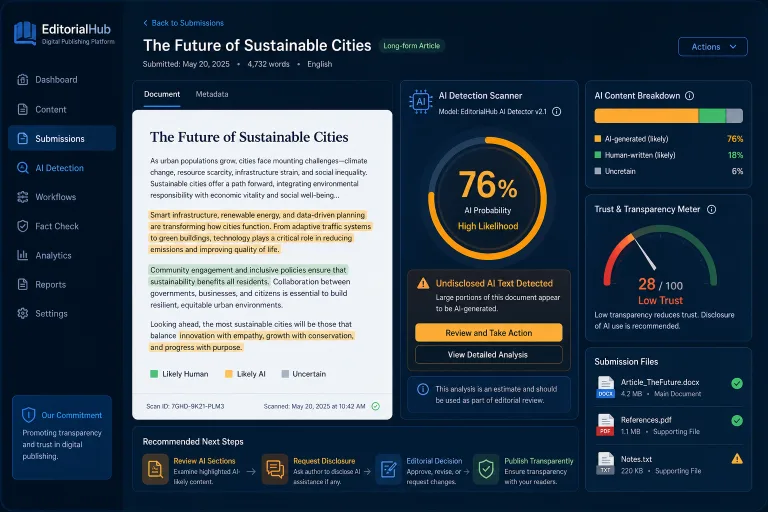
Additionally, Google uses AI scanners that look for physical and file anomalies: lighting discrepancies, background and foreground mismatch, statistical text patterns. These scanners operate independently of voluntary disclosure—they look for hidden AI content.
Three Levels of AI Involvement: How to Classify Content
Newsrooms need to distinguish three levels of AI involvement, each of which may require different labeling and verification processes.
AI-generated content—the text is created by a model from start to finish. A human provided the prompt and published the result without significant editing. This is the highest risk level: the content may contain hallucinations, banalities, and synthetic patterns. It requires full disclosure and mandatory fact-checking.
AI-assisted content—a human wrote the draft or structure, and AI was used for expansion, editing, rephrasing, or checking. This is the most common scenario in professional newsrooms. Disclosure may be partial: an internal audit log is mandatory, a public disclaimer is optional.
AI-researched content—AI was used for data collection, source analysis, idea generation, or outlining, but the text was written by a human. This is the lowest level of involvement. Disclosure may be limited to internal audit.
Key principle: the level of disclosure should match the level of involvement. There is no need to publicly disclose that AI helped find sources—but you must disclose if AI wrote half the text.
Metadata and Structured Data: The Technical Layer
Beyond watermarks, there is a metadata layer that newsrooms can control directly. Schema.org includes properties related to authorship and creation method. Newsrooms can use:
article:authorandarticle:modified_timeto track the creation chaincopyrightNoticeto indicate content status- Custom JSON-LD fields to specify the creation method
robotsmeta tags indicating AI status (if platforms introduce such a standard)
Practical step: add a mandatory “Creation Method” field to your CMS with values: “Human,” “AI Generation,” “AI Assistance,” “Hybrid.” Make this field visible in the editorial interface and required for publication. This creates an editorial audit log without complex technical infrastructure.
If your CMS supports webhooks or an API, set up automatic logging: which tool was called, which prompt was used, which model, which version. This is not only transparency—it’s the foundation for systematically improving prompts.
Synthetic Content Detectors: How Scanners Work and Why They Fail
Google and other platforms use AI scanners that look for statistical patterns characteristic of generative models. For text, this is perplexity (how predictable the word distribution is), burstiness (variability in sentence length), and n-gram distribution. For images—lighting discrepancies, generation artifacts, perspective mismatch.
The problem for newsrooms: detectors produce false positives and false negatives. Content edited by a human may be flagged as AI. Content written by a human in a style that the detector associates with AI may be mistakenly flagged. And vice versa: well-written AI content may pass detection as human.
Therefore, technical detection should not be the only transparency mechanism. An editorial audit log is needed: a history of drafts, prompts, edits, and checks that confirms the content creation chain regardless of what the detector shows.
How to Build an AI Disclosure Policy in the Newsroom
A disclosure policy must answer four specific questions.
What do we disclose? Define the threshold: do you use AI for text generation, editing, research, translation? Each case may require a different level of disclosure. Fix the threshold in a written policy accessible to the entire team.
To whom do we disclose? To readers—through a public disclaimer or note at the end of the article. To platforms—through metadata and structured data. To internal stakeholders—through an audit log in the CMS. To partners and distributors—through a separate document when distributing content.
How do we disclose? A public note at the end of the article (“This material was created using AI tools and reviewed by an editor”), a meta tag, structured data, a separate AI usage policy page. Choose a format that fits your brand and doesn’t create unnecessary noise for the reader.
When do we disclose? Upon publication, upon update, upon distribution through partners, upon reuse of content in other formats. Define disclosure points in the content pipeline.
The Impact of Transparency on Search and AI Engine Visibility
Disclosing AI involvement does not reduce visibility—provided the content retains value. Google has repeatedly stated that it evaluates the quality of content, not the method of its creation. However, a lack of transparency in the presence of explicit AI signals may be perceived as deception and lead to algorithmic penalties.
For AI-powered answer engines—ChatGPT, Perplexity, Gemini—transparency works differently. These engines cite sources and evaluate E-E-A-T (Experience, Expertise, Authoritativeness, Trustworthiness). Newsrooms with a clear disclosure policy and strong authorship may gain an advantage: AI engines prefer sources with a clear content creation chain and explicit authorship.
Practical observation: newsrooms that publish an AI usage policy and label content do not lose traffic. They lose traffic when they publish low-quality AI content without review—regardless of disclosure.
Risks of Non-Disclosure: Sanctions, Trust, Reputation
New laws already provide for sanctions for non-disclosure of AI in political advertising. In editorial content, there are no direct sanctions yet, but the risks are multi-level.
Algorithmic: ranking demotion upon detection of hidden AI content. Google has already removed 50,000 AI networks, and the algorithms are getting more accurate.
Reputational: loss of reader trust upon discovery of hidden AI use. If a reader learns about AI involvement not from the newsroom, but from a detector or journalistic investigation, the damage to trust is significantly higher.
Partner: distributors, aggregators, and platforms may require AI disclosure as a condition of cooperation. Google already requires this from advertisers—the next step is requirements for organic content.
Legal: in regulated industries—medicine, finance, law—non-disclosure of AI may violate industry standards. Recent cases of sanctions against lawyers for AI hallucinations in court documents show that courts take non-disclosure seriously.
Checklist: Preparing the Newsroom for AI Content Transparency
- Add a mandatory “Creation Method” field to the CMS with values: human, AI generation, AI assistance, hybrid
- Define a disclosure threshold: for which types of content AI involvement is disclosed publicly, and for which—only in internal audit
- Create an AI usage policy page describing tools, processes, and quality criteria
- Maintain an editorial audit log: tool, model version, prompt, editor, edits
- Check if your AI tools support technical labeling (SynthID, C2PA), and document the limitations
FAQ
Is a newsroom required to disclose the use of AI for editing?
There is no direct legal obligation yet, but platforms may require it in their rules. It is better to disclose AI assistance in internal documentation and on the policy page, even if a public disclaimer is not mandatory.
Does AI disclosure reduce visibility in Google search?
No. Google evaluates the quality and usefulness of content, not the method of creation. The risk of reduced visibility arises from hidden AI use and low quality, not from honest disclosure.
What to do if a detector mistakenly flags human text as AI?
Use detection as a signal, not as a final verdict. Keep drafts, versions, and edit history in the CMS—this is an editorial audit log that confirms human authorship regardless of the detector.
How does SynthID work when localizing content?
SynthID is tied to the output of a specific Google model. When translating text by another model or human, the original watermark may be lost. For localized content, keep a separate translation audit log indicating the tool and reviewing editor.
Do I need to disclose AI if the content went through full human editing?
It depends on your policy. If AI generated the draft and a human completely rewrote the text, the involvement level is AI-researched. Many newsrooms disclose this in internal audit but not publicly. Fix the threshold in your policy.