What Happened: The Mass Purge of 50,000 AI Networks
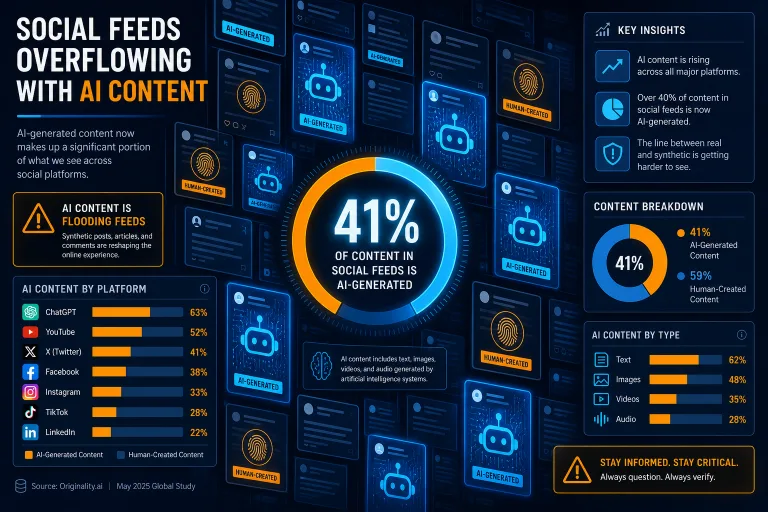
In July 2026, Google announced the removal of over 50,000 networks producing mass AI content—so-called “AI slop.” This isn’t a routine cleanup: the scale and methodology signal a fundamental shift in how platforms detect and classify unwanted content. The key takeaway from Google’s research is that platforms are no longer trying to detect only synthetic media—individual texts generated by neural networks. They are trying to detect synthetic systems: entire production pipelines, publishing patterns, site network structures, and behavioral signals that give away automated mass production.
For editorial and content teams using AI in their workflows, this means a new ballgame. It used to be enough to ensure that each individual text was “good enough”—unique, readable, and free of obvious AI markers. Now, the risk comes not from the quality of an individual article, but from how your entire content operation looks from the outside: how your domains are connected, how publications are synchronized, how uniform your topic clusters are, and how backlinks and internal links are distributed.
Synthetic Content vs. Synthetic Systems: What’s the Difference?
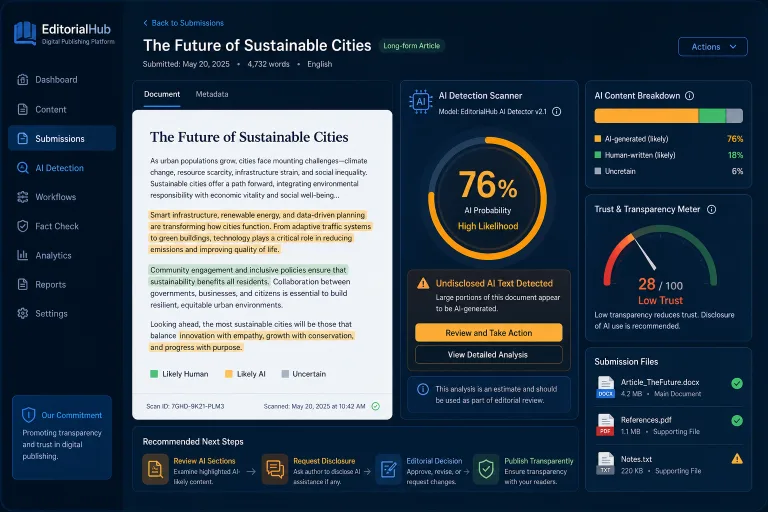
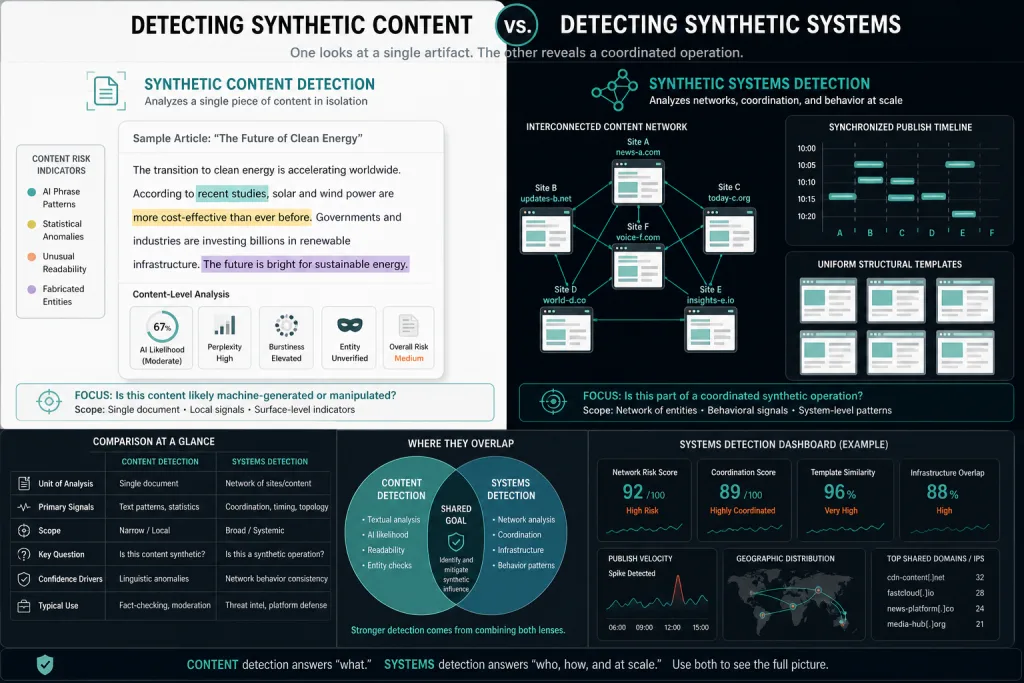
Synthetic content is an individual artifact: an article generated or significantly rewritten by AI. Detection at this level works through linguistic markers: perplexity, burstiness, repetitive syntactic constructions, and characteristic phrasing of specific models.
A synthetic system is a pattern of production and distribution. Google isn’t looking for “ChatGPT wrote this text.” It’s looking for “these 200 sites publish on the same schedule, link to each other in the same proportions, generate articles in the same structural templates, and update synchronously.” This is network, graph-based analysis, not text analysis.
The practical implication: even if every single text you produce passes AI detection, your content operation can be classified as a synthetic network if it demonstrates systemic patterns of mass automated production.
Patterns That Make a Content Operation Suspicious
Analyzing public Google data and industry reports reveals several categories of signals that algorithms use to identify AI-slop networks.
1. Structural Uniformity of Content
If hundreds of articles across different domains follow an identical structural template—the same H2 length, the same number of list items, the same heading nesting depth—this is a strong systemic signal. The format diversity of natural editorial teams is hard to fake: different authors write differently, and different topics require different structures.
2. Topic Isolation Without Expert Justification
AI-slop networks often create topic clusters that look semantically logical but show no signs of real expertise: no author profiles with publication histories, no links to primary sources, no unique data or case studies. Topics are chosen based on search demand volume, not the team’s competence.
3. Synchronous Publishing Patterns
If 15 sites publish articles within the same hour, with the same frequency and the same pauses—that’s a pattern that can’t be explained by natural editorial work. Algorithms analyze publication time series and identify correlations unattainable with manual work.
4. Artificial Link Ecosystems
Internal and external links placed according to a predictable scheme: every new post links to N previous ones, anchor texts are chosen from a limited set, and the link graph forms a regular structure instead of an organic one.
5. Lack of Behavioral Diversity
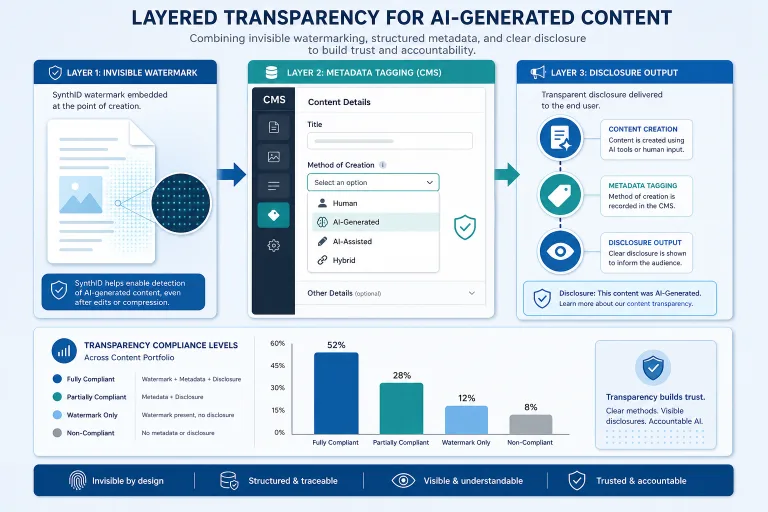
Natural editorial teams leave digital footprints: editors open drafts, return to them, make edits at different times, and publish with delays. AI pipelines work linearly: generation → publication, with no traces of editorial fuss. Platforms can analyze version metadata, edit timestamps, and behavioral patterns in the CMS.
Why “AI Should Not Be the Strategy” Is a Practical Rule
One of the key theses voiced in connection with Google’s purge: AI can support a workflow, but it shouldn’t be the strategy. This isn’t a philosophical statement—it’s a practical rule for survival in the new algorithmic reality.
When AI becomes the strategy, the content operation inevitably acquires the characteristics of a synthetic system. Scaling through AI without a strong editorial overlay creates exactly the patterns Google has learned to detect: uniformity, predictability, and the absence of an expert layer.
The strategy must be built on editorial value: what unique knowledge, data, or perspectives do you bring? AI is a tool for accelerating production, structuring, and localization, but not the source of value. If you remove AI from your process and the content loses its meaning—you’re vulnerable. If AI removes the routine, but the value remains—you’re resilient.
How to Rebuild Content Operations: From Pipeline to Hybrid Newsroom
Rebuilding doesn’t mean abandoning AI. It means changing the architecture of processes so that AI-assisted production doesn’t look like a synthetic network.
Diversity of Formats and Templates
Use several structural templates for different types of content. Not all articles should be “10 ways + conclusion.” Vary the length, section depth, number of examples, and list format. Create 5-7 editorial templates and alternate between them. AI can generate using different templates if the prompts specify different structural constraints.
Expert Layer as a Systemic Element
Every article should have traces of real expertise: an author with a verified profile, unique data (surveys, analytics, internal metrics), and links to primary sources that aren’t found in other AI articles on the same topic. This isn’t about “adding a paragraph from an expert”—it’s about embedding expertise into the structure of topic selection and production.
Desynchronization of Publications
If you publish across multiple domains or clusters, intentionally vary the timing and frequency. Don’t use a single cron schedule for all platforms. Introduce random delays, different intervals, and different days of the week. This isn’t paranoia—it’s basic operational hygiene.
Editorial Noise as a Signal of Authenticity
Preserve traces of the editorial process: draft versions, editor notes, and multiple rounds of edits. This is not only useful for quality—it’s metadata that distinguishes a living newsroom from a pipeline. If your CMS allows it, enable versioning and don’t delete intermediate versions.
Diversity in Linking Strategy
Don’t use a single link placement algorithm. Different editors should make different decisions about links. If AI places links, introduce randomization: a different number of links per article, different types of anchors, and different target pages. An organic link graph is irregular—your internal linking should be irregular too.
The Role of E-E-A-T in the Era of System Detection
E-E-A-T (Experience, Expertise, Authoritativeness, Trustworthiness) isn’t just a checklist for individual articles. In the context of detecting synthetic systems, E-E-A-T becomes a systemic signal of authenticity for the entire content operation.
Google evaluates E-E-A-T not only at the page level but also at the site and author level. If you have 500 articles signed by one “author” with no digital footprint, no publication history, and no presence in the professional community—that’s a systemic signal. If you have 10 authors with real profiles, different publication histories, and different areas of competence—that’s a signal of a living newsroom.
Practical steps:
- Create and maintain author pages with real bios and histories
- Publish not only AI-assisted content but also fully manually written materials
- Engage external experts for quoting and co-authorship
- Include unique data: internal research, audience surveys, analysis of your own metrics
- Demonstrate editorial processes publicly: methodology, standards, fact-checking policy
Scaling Without a “Network”: How to Grow Without Becoming a Target
Scaling is the main reason teams turn to AI. But scaling itself creates the greatest risk of falling into the synthetic systems category. How do you grow without becoming a target?
Principle of Limited Automation. Don’t automate the entire pipeline. Automate the research phase, structuring, the first draft, and localization. Keep manual: final editing, topic selection, fact-checking, and the decision to publish. The more points of human decision in the process, the less the system looks synthetic.
Principle of Qualitative Diversity. Instead of 100 cookie-cutter 800-word articles, create 30 articles of varying length, depth, and format. 5 detailed 3000-word guides, 10 analytical breakdowns with unique data, 15 short news notes with editorial commentary. Format diversity is an anti-signal for network detection.
Principle of Niche Concentration. Instead of covering 50 topic clusters, choose 3-5 where you have real expertise. Depth in a niche creates an organic content density that looks natural. Breadth without depth is a pattern of AI-slop networks.
Principle of Time Distribution. Don’t publish everything at once. Stretch the publication of prepared content over weeks and months. Introduce seasonality and reaction to events. Natural newsrooms react to news, update old articles, and return to topics—all this creates a temporal pattern distinct from a pipeline.
Tools and Metrics for Self-Diagnostics
To understand whether your content operation looks like a synthetic network, use the following self-diagnostic approaches.
Structural Uniformity Analysis. Export the structure of all articles (number of H2s, H3s, section length, number of lists) and calculate the standard deviation. If it’s abnormally low—your articles are too similar in structure. Introduce template variability.
Temporal Pattern Analysis. Plot a graph of publications by time over the last 6 months. If you see regular peaks, identical intervals, and an absence of “pauses” and “spikes”—the pattern looks automated.
Link Graph Analysis. Visualize internal linking. If the graph looks like a regular grid—that’s suspicious. Organic link graphs have hubs, clusters, and isolated nodes.
Author Distribution Analysis. Calculate what percentage of content is signed by real authors with profiles. If it’s less than 30%—that’s a systemic signal.
Checklist: How to Ensure Your Content Operation Doesn’t Look Like an AI-Slop Network
- You use at least 5 different structural templates for articles and alternate them
- Every author has a filled-out profile with a bio, photo, and publication history
- At least 20% of content contains unique data, case studies, or research
- Publication times vary—there’s no single cron schedule for all domains
- Internal linking is irregular: different numbers of links, different anchors, different target pages
- You preserve editorial process metadata: draft versions, notes, edits
- There are at least 3 points of human decision in the content operation between generation and publication
What to Do If You’ve Already Been Penalized
If your domains have already received manual actions or algorithmic devaluations related to AI content, the action plan is as follows.
First, conduct a scale audit: how many domains, articles, and authors are involved. Identify which patterns might have triggered detection—structural uniformity, publication synchrony, or the absence of an expert layer.
Second, divide the domains into “salvageable” and “discardable.” Not all sites are worth restoring: sometimes it’s easier to focus on 2-3 quality projects than to try to resuscitate 50 cookie-cutter ones.
Third, for salvageable domains: diversify the content, add real author profiles, update old articles with new data, and remove predictable linking patterns. Submit a reconsideration request in Search Console with a specific description of the changes made.
Fourth, rebuild the processes so the problem doesn’t recur. This means changing not individual articles, but the architecture of the content operation.
A Practitioner’s View: What This Means for Content Teams on the Ground
From a practical standpoint, the purge of 50,000 networks isn’t a theoretical threat—it’s a signal that the threshold for sanctions has lowered. In the past, obvious spam farms with hundreds of sites were hit. Now, algorithms are accurate enough to identify and penalize more “respectable” operations if they demonstrate systemic patterns.
For content teams using AI in production mode, this means revising KPIs. If your metric is “articles per month,” you’re creating an incentive for pipeline production that looks like a synthetic system. If your metric is “unique insights per quarter” or “share of content with primary data,” you’re stimulating diversity and expertise.
It’s also worth considering that system detection isn’t a static process. Google will improve its detection models, and patterns that pass today may become triggers tomorrow. The only sustainable strategy is to make your content operation look as much like a living newsroom as possible, without abandoning AI where it genuinely increases efficiency.
FAQ
Does Google’s purge mean we should completely abandon AI in content?
No. Google doesn’t ban AI-assisted content—it fights mass synthetic networks that produce content without editorial value. Use AI for research, drafts, and localization, but maintain an expert layer, editorial review, and format diversity.
How do I know if my content operation looks like a “synthetic system”?
Check the structural uniformity of articles, publication synchrony, link graph regularity, presence of author profiles, and unique data. If all articles look structurally identical, are published on a schedule, and show no traces of expertise—the operation is vulnerable.
Is it okay to use one AI prompt for all articles if I edit them manually afterward?
It’s risky. A single prompt creates structural uniformity, which is a systemic signal. Use several prompt templates with different structural constraints and alternate them. Manual editing doesn’t always eliminate the structural patterns embedded by the prompt.
How many domains is it safe to run with one AI pipeline?
There’s no hard limit, but the risk grows with the number. If domains are technically linked (same IP, same Analytics account, same Search Console profile) and published synchronously—the risk is high even with 3-5 domains. Separate the infrastructure and desynchronize publications.
Will an AI detector help pass Google’s check?
No. AI detectors check individual texts for linguistic markers. Google looks for systemic patterns at the network level. A text might pass a detector, but the entire operation will still be classified as a synthetic network based on structural, temporal, and link signals.