Substack has launched a tool to scan published texts for AI generation. Platform CEO Chris Best called the problem “Claudefishing” — a situation where a reader consumes content without realizing it was AI-generated. According to Best, this undermines authorship trust and threatens writers’ livelihoods, including those who use AI tools consciously. CNET tests showed that the tool correctly identifies a fully AI-generated post as 100% synthetic and evaluates hybrid texts with an accuracy of about 10% deviation.
For editorial boards and content teams, this is a signal: platforms are shifting from passive policies to active, built-in detection. This changes the rules of the game for anyone producing long-form content with AI — from blogs and knowledge bases to corporate websites. In this article, we’ll break down how platform detection works, what Claudefishing is, and how to build an editorial workflow that can withstand automated scanning.
What is Claudefishing and why platforms are starting to fight it
The term “Claudefishing” is derived from Claude (one of the major LLMs) and “catfishing” (creating a fake persona online). The essence of the phenomenon: an author publishes an AI-generated text, passing it off as their own work, and the reader cannot distinguish synthetic content from human-written. This is not the same as transparently using AI assistants for drafts, fact-checking, or editing. Claudefishing is specifically the hidden substitution of authorship.
Why platforms are starting to react right now:
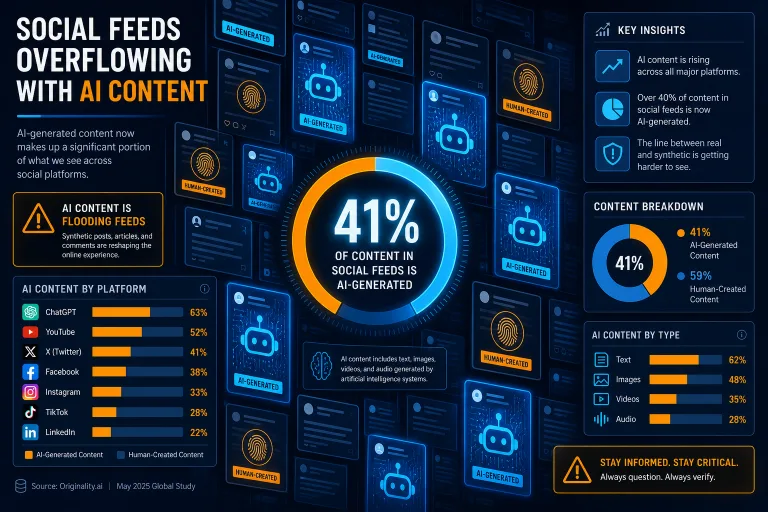
- Saturation of platforms with synthetic content. According to Pangram, 41% of long posts on LinkedIn are already AI-generated. Substack is facing a similar dynamic.
- Erosion of reader trust. When a reader cannot trust authorship, they stop paying for subscriptions — the platform’s core business model.
- Regulatory pressure. Requirements for AI content disclosure are tightening: from EU AI Act recommendations to Google’s policies on labeling synthetic content.
Platforms have realized that the passive “publish whatever you want” policy no longer works. Substack became the first major publishing platform to integrate AI detection directly into its publishing interface.
How the Substack tool works: a technical breakdown
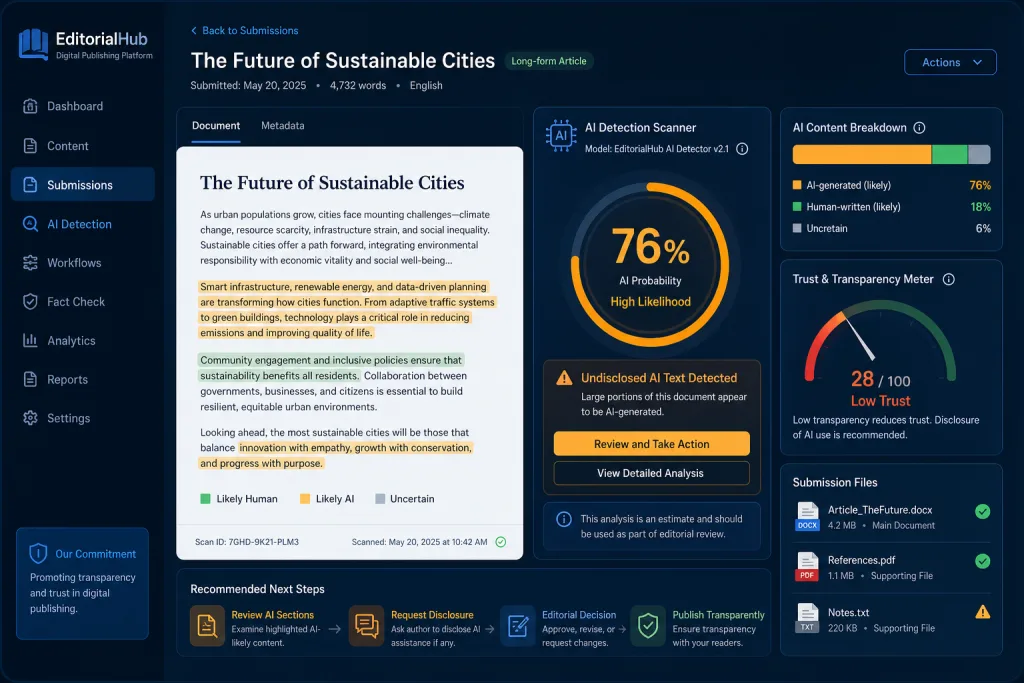
The Substack AI scanner analyzes the published text and outputs a percentage score — what proportion of the content, in the algorithm’s opinion, was written by AI. In CNET tests, the tool showed the following results:
- Hybrid text (human base + one AI paragraph from ChatGPT): detected ~10% AI content, which roughly matches reality.
- Fully AI-generated post: detected as 100% synthetic.
- Mixed texts with manual editing: the score varies depending on the degree of revision.
The percentage model fundamentally differs from a binary one (human/AI). It acknowledges that modern editorial content is often hybrid — an author might use AI for research, structuring, or drafting, but the final text goes through human editing. The platform evaluates not the fact of AI usage, but the proportion of untouched synthetic text.
This is a crucial nuance for editorial teams: the tool does not penalize the use of AI assistants. It identifies the mass publication of untouched AI content without disclosure.
Why a percentage score changes the approach to disclosure
Binary detection (“is this AI or not”) is technically unreliable and ethically problematic — it puts any well-structured text under suspicion. Substack’s percentage score solves this problem but creates a new dilemma for editorial teams: what threshold is considered acceptable?
The platform has not yet established strict thresholds or automatic sanctions. But logic suggests that texts scoring 80–100% AI generation without disclosure are exactly what Substack calls Claudefishing. Texts scoring 10–30% represent normal hybrid production, which the platform does not aim to penalize.
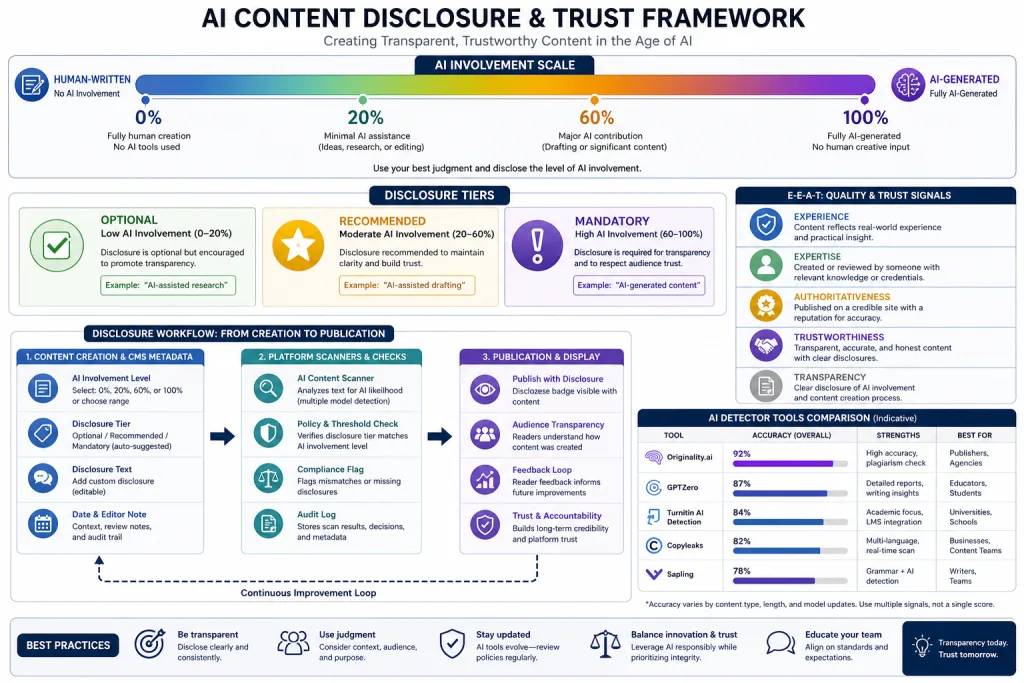
For editorial teams, this means that the disclosure policy should not be binary (“we use AI / we don’t”), but graded:
- 0–20% AI contribution: disclosure is optional (AI was used for research, fact-checking, brainstorming).
- 20–60% AI contribution: a brief methodology disclosure is recommended (e.g., “draft created with AI, edited by the author”).
- 60–100% AI contribution: mandatory disclosure, otherwise it is Claudefishing.
These thresholds are not official Substack policy, but a practical framework for editorial teams based on the logic of percentage detection.
Claudefishing vs transparent AI use: where to draw the line
It is critically important to distinguish between two scenarios that are often conflated in discussions about AI content:
Claudefishing — an author publishes untouched AI text, passing it off as their own work, without any disclosure. The reader expects human authorship and gets machine output. This is a breach of the trust contract between author and reader.
Transparent AI production — an author uses AI for drafting, structuring, research, or editing, but either discloses this or revises the text so much that the final version carries a pronounced human voice and judgment. The reader receives content where AI is a tool, not the author.
The line is drawn not by the fact of using AI, but by two criteria:
- Degree of revision. How much does the final text differ from raw AI output? If the author simply copies ChatGPT’s output — that’s Claudefishing. If the author uses AI as one of the sources, and the final text goes through editing, fact-checking, and the addition of unique insights — that’s transparent production.
- Disclosure. If the platform or reader expects human authorship, and the content is predominantly AI-generated — disclosure is mandatory. If the content is hybrid and revised — disclosure is desirable, but not critical.
How editorial teams can prepare for platform detection
Platform detection is not a temporary measure, but a trend. Substack is the first, but not the last. WordPress, Medium, Ghost, and other publishing platforms will inevitably follow. Editorial teams need to build a workflow that accounts for automated scanning.
Step 1: Audit your current content flow
Analyze what percentage of your published materials go through AI generation. Use tools like GPTZero, Originality.ai, or Winston AI to spot-check published texts. Compare the results with your editorial policy — is there a gap between declared and actual AI usage?
Step 2: A graded disclosure policy
Develop a policy that defines levels of AI involvement and corresponding disclosure formats. Don’t limit yourself to a binary “disclose / don’t disclose”. Consider the content type (news brief, analysis, opinion), the publishing platform, and audience expectations.
Step 3: Internal labeling workflow
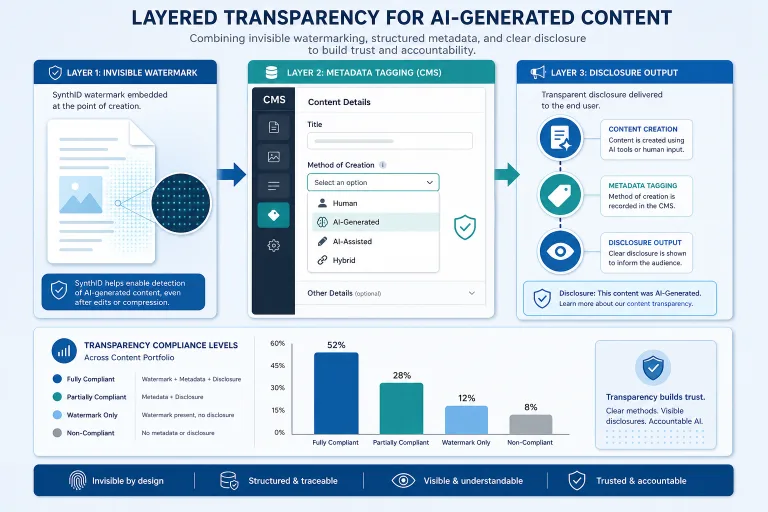
Implement metadata in your CMS or editorial tool that marks the level of AI involvement for each piece. This could be a simple field: “AI contribution: none / minimal / partial / primary”. This metadata will help not only with disclosure but also with internal quality audits.
Step 4: Training authors and editors
Authors must understand the difference between using AI as a tool and Claudefishing. Editors must be able to assess the degree of AI involvement in a submitted piece and decide whether disclosure is necessary.
Limitations of AI detection: false positives and false negatives
No AI detector is perfect. This is a critical limitation that editorial teams must account for:
False positives — the detector flags human text as AI-generated. This is especially likely for texts with predictable structures: lists, instructions, technical descriptions. Knowledge base and documentation teams are at risk — their content is inherently structured and formal, which detectors often associate with machine generation.
False negatives — the detector fails to recognize AI content. This happens when the text undergoes sufficient revision or when the author uses prompt engineering to mimic human style (adding “errors”, conversational phrasing, emotional coloring).
Practical takeaway: don’t rely on a single detector. Use 2–3 tools for cross-checking and always consider the context. If three detectors give divergent scores (one — 90%, another — 20%, a third — 50%), it’s a signal of text ambiguity requiring manual review.
Impact on E-E-A-T and search trust
Platform detection is not the only channel through which AI content impacts trust. Google’s E-E-A-T (Experience, Expertise, Authoritativeness, Trustworthiness) directly assesses how much content demonstrates real experience and expertise. AI-generated text without human experience is a structural violation of E-E-A-T, regardless of whether a detector caught it.
For content teams, this means the AI disclosure policy must be synchronized with the E-E-A-T strategy:
- Experience: add unique experience to AI drafts that couldn’t be in the LLM’s training data — case studies, first-hand data, insights.
- Expertise: credit authors with proven expertise, even if the draft was created with AI.
- Authoritativeness: link to authoritative sources and primary researchers.
- Trustworthiness: disclose AI usage where it affects perceived credibility.
Practical scenarios for different content types
Blog posts and opinion pieces. Here, the expectation of human authorship is maximal. If the AI contribution exceeds 30%, disclosure is mandatory. Best format: “The author used an AI assistant for research and structure. The final text, arguments, and conclusions are their own.”
Knowledge base and documentation. Here, authorship expectations are lower — the reader is looking for information, not the author’s personality. AI generation is more acceptable but requires intensified fact-checking. Disclosure is optional, but quality and accuracy are critical.
Analytics and research reports. Hybrid production is the norm. AI processes data, generates draft conclusions, and the author interprets and adds context. Disclosing the methodology (including AI tools) increases trust rather than diminishing it.
News content. AI for aggregation and summarization is acceptable. AI for writing the final text without editing is not. News content requires maximum speed, but also maximum accuracy. Automation here is a tool, not a replacement for the editor.
Checklist: preparing your editorial team for platform AI detection
- Conduct an audit: run 20–30 recent publications through 2 AI detectors and record the score distribution
- Develop a graded disclosure policy with thresholds: 0–20% / 20–60% / 60–100% AI involvement
- Add an “AI contribution” field to your CMS or editorial tracker for each piece
- Make a list of platforms where you publish and track their AI disclosure policies
- Train authors and editors to distinguish between Claudefishing and transparent AI production
- Synchronize your AI disclosure policy with your E-E-A-T strategy and search engine requirements
What to expect next: from detection to authorship verification
Substack is the first step. The next stage will not just be AI content detection, but authorship verification — confirming that the text was written by a specific human. Technologies like Google’s SynthID are already embedding watermarks into AI-generated content at the generation level. Platforms will inevitably start requiring authors to verify their creation process — not just “this is not AI”, but “here is how it was created”.
For editorial teams, this means the current moment is the best time to build a transparent workflow. Teams that implement graded disclosure policies, AI involvement metadata, and author training now will be ready for tightening requirements. Those who wait for platforms to introduce mandatory detection will find themselves in reactive mode — fixing already published materials under the threat of demonetization or search ranking drops.
FAQ
What is Claudefishing in simple terms?
Claudefishing is the publication of AI-generated text without disclosure when the reader expects human authorship. The term is derived from the Claude model and the concept of catfishing (creating a fake persona). The essence: the reader doesn’t know they are consuming machine content.
Can an AI detector mistakenly flag human text?
Yes. False positives are especially common for structured content — instructions, lists, technical descriptions. Use 2–3 detectors for cross-checking and consider the text type when interpreting results.
Do I need to disclose AI use if I only edited the draft?
If the AI contribution is minimal (up to 20%), disclosure is optional. If AI created the base of the text and you only edited it, a brief methodology disclosure is recommended. The deciding factor: how much the final text carries your authorial judgment and unique experience.
What platforms besides Substack are implementing AI detection?
So far, Substack is the first publishing platform with built-in detection. LinkedIn and Medium use AI detection for content moderation. Google requires AI content labeling for news. WordPress, Ghost, and other CMS are expected to add similar tools in the next 12–18 months.
Does AI detection affect Google search rankings?
Google does not penalize AI content as such, but evaluates it based on E-E-A-T criteria. If AI content does not demonstrate experience and expertise, it loses rankings. Platform detection and search evaluation are different mechanisms, but both aim at quality and trust.