Generative AI acts like an editor who always settles for “good enough.” Legendary designer David Carson described it in a recent interview with The Drum: AI is an editor who says “I can live with this” instead of demanding “let’s make this exciting.” For content teams producing long-form pieces, this poses a systemic threat: without deliberate guardrails, all your content gradually averages out into a faceless, generic state.
The problem isn’t that AI writes poorly. The problem is that it writes predictably. LLMs are optimized for the most likely next token, which structurally promotes averaging. Without a clear editorial system, well-crafted prompts, and multi-layered review, your blog or knowledge base will start producing content that readers can’t distinguish from dozens of others.
Why AI Content Slides into Banality
Averaging isn’t a bug; it’s an architectural feature of language models. When ChatGPT or Gemini generate text, they choose the most statistically probable continuation. This means that by default, the model gravitates toward the center of the distribution—the most common, most expected, most “safe” phrasings.
For editorial teams, this creates three specific problems:
- Loss of brand voice. AI writes “like everyone else,” and without strong prompt engineering, your content loses its recognizable tone.
- Template structure. A three-sentence intro, five subheadings with the same pattern, a conclusion starting with “so”—this skeleton repeats from article to article.
- Superficial analysis. The model avoids risky claims, ambiguous conclusions, and original interpretations, replacing them with safe generalizations.
Carson noted that years of imitation prepared him for the wave of AI copies: “Imitators never bothered me because up close the work didn’t hold up. AI work holds up even less.” For content teams, this means: on a superficial read, AI text looks fine, but on close inspection, it crumbles into clichés.
“Good Enough” Editor vs. “Wow” Editor: What to Change in Processes
Carson recalls an editor who would look at a layout and say, “I can live with this.” He hated that approach. This is exactly what AI does now: it agrees to “acceptable” rather than “outstanding.” To overcome this effect, editorial teams must rebuild their processes on several levels.
The first level is changing AI’s role in the editorial pipeline. If AI is used as the final author, you get “good enough” content. If AI is a tool for drafting, research, or structure, and a human makes the final decision, quality rises sharply.
The second level is system prompts that set editorial standards. Not “write an article about X,” but “write an article for [publication], with a tone of [description], avoid [list of clichés], use [format], check [facts].”
The third level is forced diversity. Editorial teams should track structural patterns: if the last five articles start with a rhetorical question, that’s a signal the model is stuck in a template.
Prompt Systems Against Averaging: Practical Approaches
An effective prompt system for editorial teams isn’t one big prompt, but a set of modular instructions that combine for a specific task. Here are the key components:
Tone and Voice Prompts
Instead of general instructions like “write professionally,” set specific parameters: “write with the confidence of an expert who has done the research, use short affirmative sentences, avoid introductory constructions like ‘it’s worth noting’ and ‘it should be emphasized.'” Provide negative examples—phrases the model should avoid.
Structure Prompts
Specify not just an outline, but structural constraints: “first paragraph—a direct statement without lead-ins, each section—150–200 words, end with a specific example, not a generalization.” This breaks the “introduction → development → conclusion” template.
Originality Prompts
Include instructions to provoke original thinking: “suggest three non-obvious arguments that usually don’t appear in content on this topic,” “formulate a counterargument to the commonly accepted position.” The model won’t always produce a brilliant result, but it shifts it away from the center of the distribution.
Content Operations: How Not to Scale Banality
As ADWEEK noted using Zalando as an example, speed isn’t an advantage if you’re scaling blandness. “If you just count the volume of AI output, you’re exacerbating the world’s problem of banality,” the brand’s leadership notes. For content teams, this means the quantity metric must be replaced with quality metrics.
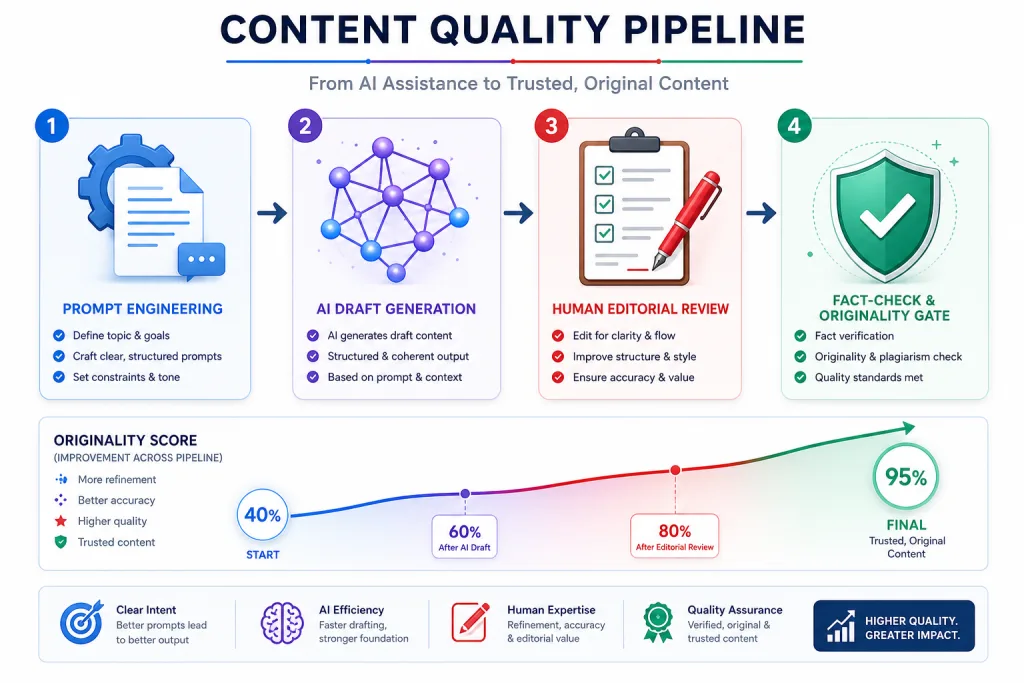
Content operations in the AI era require three changes:
- Pipeline with checkpoints. AI generates draft → editor checks for banality and clichés → fact-checker verifies data → final editor checks brand voice. Each point is a filter against averaging.
- Prompt templates by content type. Different formats (analysis, how-to, news, explainer) require different prompt strategies. A universal prompt is the main source of banality.
- Originality metrics. Track not just text uniqueness (which anti-plagiarism tools handle), but structural diversity: the share of articles with the same structure, recurring phrasings, cliché frequency.
The Role of Human Judgment in the AI Pipeline
Forbes in a recent article formulates the key principle: “the successful companies of the future are those who have aligned technical investments with the human judgment necessary to manage them.” For editorial teams, this means AI doesn’t replace editorial judgment—it demands more of it.
Human judgment in the AI pipeline works on three levels:
- Strategic topic selection. AI can suggest topics based on trends, but the decision about which topic deserves deep development is made by an editor. The model doesn’t know that your audience is already tired of a certain angle.
- Editorial revision. After generating a draft, the editor should ask: “Is there at least one statement in this text that will make the reader stop?” If not, the text goes back for revision.
- Final check for ‘good enough.’ The editor must consciously reject texts that “pass” but don’t “impress.” This requires a culture change: rewarding not publication speed, but the quality of the final result.
Fact-Checking and Originality as Filters Against Clichés
Banal content often contains not only phrasing clichés but also factual clichés: general numbers without sources, common claims without verification, examples that migrate from article to article. Fact-checking in the AI pipeline isn’t just verifying accuracy—it’s an originality filter.
Practical steps:
- Verify every number. If AI cites statistics, demand a source. If the source isn’t specified or accessible—remove or replace it.
- Find unique examples. Instead of accepting the examples the model generates by default, ask editors to find real cases from your practice or industry.
- Cross-check with competitors. If your AI content repeats the structure and argumentation of the top 3 Google results on the topic, that’s a signal you’re producing not original content, but paraphrased content.
How to Measure Content ‘Non-Banality’
‘Non-banality’ seems like a subjective metric, but it can be broken down into measurable components:
- Cliché index. The share of template phrases and constructions in the text. This can be automated: compile a list of 50–100 characteristic clichés and track their frequency.
- Structural diversity. Comparing article structures: if more than 60% of articles follow the same pattern, diversification is needed.
- Analysis depth. The share of statements supported by data or examples vs. general assertions. Target metric: at least 70% of statements with support.
- Editorial revision rate. What percentage of the AI draft changes during editing. If revisions are less than 10%, you’re either publishing raw AI content, or your prompt is so good that the model produces finished text. The latter is unlikely.
Practical Checklist for Editorial Teams
Checklist: How Not to Slide into Banality with AI Content
- Define and document your brand voice: tone, forbidden clichés, examples of ‘good’ and ‘bad’ paragraphs
- Create a library of modular prompts for each content type: analysis, how-to, news, explainer
- Implement a mandatory cliché checkpoint between AI generation and publication
- Track structural diversity: if more than 60% of articles have the same structure—change your prompts
- Demand a source for every number and fact in the AI draft; remove unverified data
- Measure the share of editorial revisions in the AI draft: target metric—at least 25–30%
A ‘Not Good Enough’ Culture in the Newsroom
Technical solutions—prompts, pipelines, metrics—are necessary but insufficient. The main barrier against averaging is an editorial culture where “good enough” is unacceptable. This means editors must have the right and authority to return texts for revision not because they contain errors, but because they’re uninteresting.
Carson put it most precisely: “That’s not the attitude I want. Let’s be delighted by this.” For content teams, this means: every published text should contain at least one element that makes the reader think “wow, I haven’t seen this angle before.” If an AI draft doesn’t contain such an element after the first generation—that’s fine. But if it doesn’t contain it after editorial revision—the problem isn’t the model, it’s the process.
The editorial teams that will win in the AI era aren’t those who generate content faster, but those who build systems that don’t let the model settle for “good enough.” Averaging is the default choice. Originality requires conscious effort at every stage of the pipeline.
FAQ
Why does AI content turn out banal even with a good prompt?
Language models are optimized for the most likely next token, which structurally promotes averaging. Even with a good prompt, the model gravitates toward ‘safe’ phrasings and general structures. Multi-layered editorial review is required to shift the text away from the center of the distribution.
What metrics help track content banality?
Key metrics: cliché index (share of template phrases), structural diversity (comparing article patterns), analysis depth (share of statements with data support), and editorial revision rate (percentage of changed text in the AI draft).
Do you need to abandon AI in the newsroom to maintain quality?
No. AI is effective for research, structuring, and draft generation stages. The problem arises when AI is used as the final author without editorial control. The solution isn’t abandoning AI, but building a pipeline with checkpoints where a human makes the final decision.
How often should prompts for editorial content be updated?
Prompts should be reviewed when the content strategy changes, new content types appear, or when quality metrics (cliché index, structural diversity) show deterioration. A quarterly audit of the prompt library is recommended.
What to do if editors can’t keep up with reviewing all AI content?
Implement prioritization: high-risk content (analysis, data, expert opinions) is fully reviewed; low-risk content (updating existing pages, technical descriptions) is checked against a checklist of key parameters. Also, automate checks for clichés and structural diversity.