Traditional SEO tools show Google rankings, keyword density, and backlinks. But when a reader asks ChatGPT, Perplexity, or Gemini, none of these metrics explain whether the model will mention your content—and if so, how. The category of LLM SEO analysis tools emerged precisely for this: it measures how large language models discover, understand, cite, and recommend content on surfaces like Google AI Overviews, ChatGPT Search, Perplexity, Claude, and Microsoft Copilot.
For editorial teams, this isn’t just “SEO with a new dashboard.” The behavioral shift is fundamental: AI engines synthesize answers from multiple sources, often without direct links, and the criteria for “selecting” content differ from classic SERP rankings. Choosing the right tool is a matter not of software budget, but of the editorial team’s ability to measure and improve distribution in this new environment.
What is LLM SEO Analytics and How it Differs from Traditional SEO
LLM SEO analytics is a discipline and a set of tools that measure content visibility in generative model responses. Unlike classic SEO, where metrics are tied to positions in ranked search results, LLM SEO deals with unpredictable, synthetic output: a model might cite a source, mention a brand without a link, combine several sources into one answer, or completely ignore the content.
Key differences from traditional SEO toolkits:
- Non-linear output. In Google, position #1 and #10 are different metrics. In an AI answer, a source might be mentioned first but without a link, or fifth—with a link. The tool must track both scenarios.
- Multiple surfaces. ChatGPT, Perplexity, Gemini, Claude, and Copilot use different sources and citation algorithms. One query can yield five different answers on five platforms.
- Answer volatility. Models update, answers change between sessions. The tool must capture snapshots and track changes over time.
- Semantics over keywords. AI engines “understand” concepts, not string matches. The tool must analyze topical coverage and entity associations, not keyword density.
Categories of LLM SEO Tools
The tool market in 2026 is divided into several functional categories. Understanding these categories is the first step to making a choice.
1. Citation Monitoring Platforms
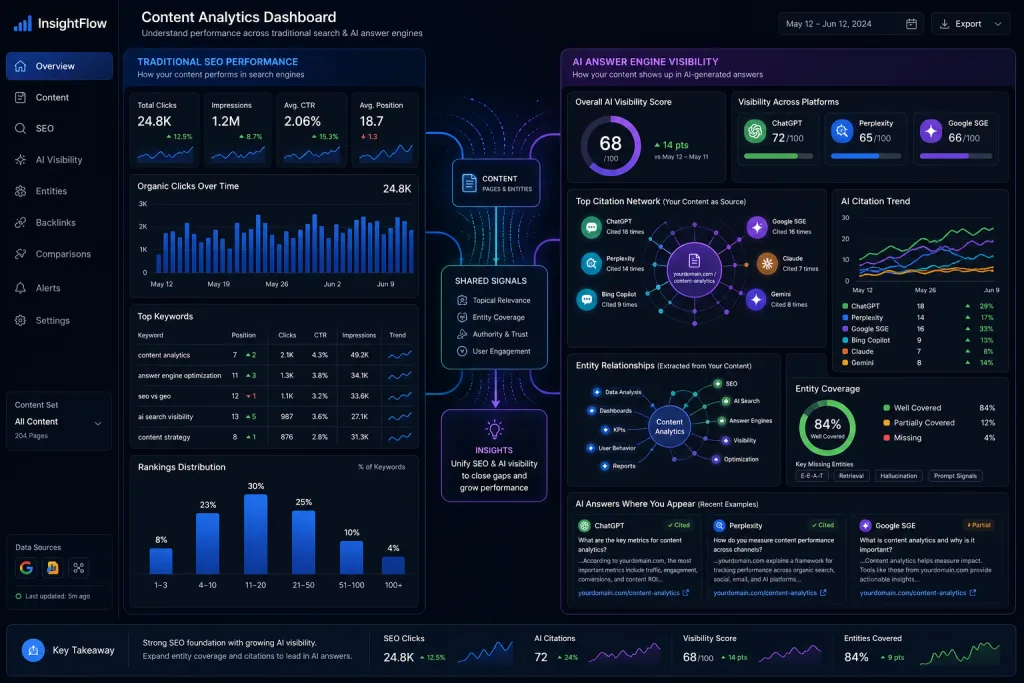
These tools send queries to AI engines and record which sources are cited, how often, and in what context. They show the “share of voice” of a brand or domain in answers to topical queries. Examples: Profound, AthenaHQ, Otterly.AI.
2. Generative Engine Optimization (GEO) Tools
Platforms that not only measure but also provide recommendations for optimizing content for AI answers: structure, markup, topic coverage completeness, presence of definitions and lists. Writesonic GEO Tools is an example of expanding from AI writing to GEO optimization.
3. Hybrid SEO+LLM Platforms
Traditional SEO tools that have added LLM analytics modules. Semrush, Surfer SEO, and MarketMuse partially cover LLM visibility, but the depth of analysis is inferior to specialized platforms.
4. One-off Audits
Free or one-time tools like HubSpot AI Search Grader provide a visibility snapshot without continuous monitoring. Useful for initial diagnostics, but not for operational use.
Selection Criteria: What Editorial Teams Should Evaluate
Choosing an LLM SEO tool depends on the maturity of content operations, portfolio size, and the number of surfaces to track. Here are practical criteria:
AI Surface Coverage
The minimum is Google AI Overviews, ChatGPT Search, and Perplexity. If a tool covers only one surface, its value is limited. Full coverage should include Gemini, Claude, and Microsoft Copilot. Check exactly which surfaces are supported and how frequently they are polled.
Citation Analysis Depth
The tool should distinguish between: a direct link, a brand mention without a link, a domain mention, and indirect attribution (when the model paraphrases your content without naming the source). Without this distinction, the “visibility” metric becomes meaningless.
Topical and Entity Coverage
A good tool analyzes not only individual queries but also topical clusters: which entities are associated with your brand in model responses, what coverage gaps exist, and which competitors are cited more often on related topics.
Integration into Editorial Workflow
The tool must connect to content operations: data export to the editorial calendar, CMS integration, API for automation. If data lives in a separate dashboard that no one opens, ROI approaches zero.
Time Trending
One-off snapshots are useless for operational work. The tool must show dynamics: how citation rates change after publishing new content, after a model update, or after content changes.
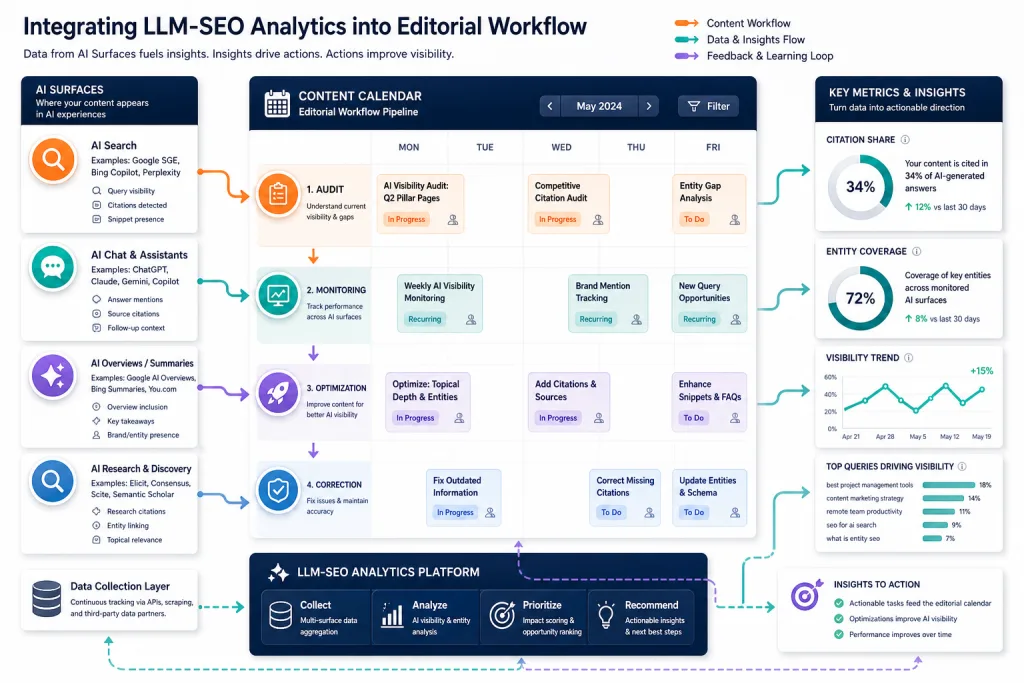
How to Integrate LLM SEO Analytics into Content Operations
A tool is not a strategy. Without integration into the editorial workflow, even the best platform turns into an expensive dashboard opened once a quarter. Here is a practical integration model.
Stage 1: Baseline Audit
Before choosing a platform, conduct a manual baseline audit. Send 30–50 topical queries to ChatGPT, Perplexity, and Gemini. Record: is your domain cited, are competitors cited, which sources appear most often. This creates a baseline and helps understand which surfaces and topics are priorities for a paid tool.
Stage 2: Priority-Based Tool Selection
If 80% of your audience uses ChatGPT—choose a tool with the best ChatGPT Search coverage. If the primary surface is Google AI Overviews, look for a platform with deep Google integration. Don’t try to cover everything at once.
Stage 3: Integration into the Editorial Calendar
Add an LLM SEO check to the editorial calendar as a separate stage. After publishing content—wait 7–14 days—and check if it appears in AI engine answers for target queries. If not, analyze the structure, markup, and topic coverage completeness.
Stage 4: Regular Monitoring and Correction
Set up a monthly report for key topical clusters. Track: your domain’s citation share vs. competitors, changes after model updates, the emergence of new surfaces. Adjust your content strategy based on data, not intuition.
A Practical View: What Works and What Doesn’t
Based on experience working with LLM SEO tools in editorial teams:
What works:
- Using specialized platforms for regular monitoring of 3–5 key topical clusters instead of trying to track hundreds of queries.
- Combining a paid tool with manual checks. No tool covers 100% of surfaces with perfect accuracy.
- Tying LLM SEO metrics to specific content pieces and editorial decisions, rather than abstract “share of voice.”
What doesn’t work:
- Buying an enterprise platform without a clear workflow integration plan. A dashboard that no one uses is an expense, not an investment.
- Relying on one tool as the single source of truth. Different platforms give different data for the same queries—cross-checking is necessary.
- Ignoring manual fact-checking of AI answers. A tool might show “citation,” but if the model distorts your content, it’s not a win.
ROI Assessment: When a Tool Pays Off
An LLM SEO tool pays off when three conditions are met:
- Measurable share of traffic or brand mentions from AI answers. If AI engines drive at least 5–10% of referral traffic or create measurable brand searches, the tool pays for itself.
- The editorial team changes decisions based on data. If the tool influences topic selection, content structure, or update prioritization—it works. If data is just copied into a quarterly report—it doesn’t.
- Speed of reaction to changes. The tool must allow noticing drops or growth in citations within days, not months. A team that learns about a visibility drop a quarter later is losing its audience.
Risks and Limitations
- Data accuracy. LLM SEO tools send queries to AI engines and scrape answers. Accuracy depends on methodology: how queries are phrased, how often each surface is polled, how answer volatility is accounted for. Different tools may yield different results for the same query.
- Cost. Specialized platforms cost from $200 to $2000+ per month. For small editorial teams, this is a significant expense. One-off audits and manual checks are a reasonable alternative at an early stage.
- Dependency on AI platform APIs. If OpenAI, Google, or Anthropic change APIs or restrict access, tools lose coverage. Choose platforms with transparent data collection methodologies.
- The illusion of completeness. No tool covers all surfaces and all answer variations. LLM SEO data is an indicator, not the full picture.
Checklist: Choosing an LLM SEO Tool for Your Editorial Team
- Identify 3–5 priority AI surfaces based on your audience (ChatGPT, Perplexity, Google AI Overviews, Gemini, Copilot)
- Check the coverage of these surfaces in the tool—not based on marketing, but on demos and trial periods
- Ensure the tool distinguishes between direct links, brand mentions, and indirect attribution
- Assess the presence of time trending, not just one-off snapshots
- Check integration with your CMS and editorial calendar—API, export, notifications
- Conduct a parallel manual audit of 30–50 queries and compare with the tool’s data
- Evaluate the cost relative to the measurable share of traffic/mentions from AI answers
The Future of the Category
The LLM SEO tools market is in its early stages. Platforms appear and disappear, methodologies are not standardized, metrics are not unified. For editorial teams, this means two things: first, don’t tie yourself to one platform for too long—review your choice every 6–12 months. Second, invest in your own monitoring methodology: even if a tool disappears, the manual check process and baseline data will remain.
The category will consolidate: traditional SEO platforms (Semrush, Ahrefs, Surfer) will absorb specialized tools or build their own modules. But until then, specialized platforms offer deeper analysis of AI answers, especially regarding citation and entity coverage.
FAQ
How does LLM SEO differ from traditional SEO?
Traditional SEO measures positions in ranked search results for keywords. LLM SEO measures how generative models discover, understand, and cite content in synthetic answers. The metrics, surfaces, and “ranking” factors are fundamentally different.
Do I need a paid tool if I can check ChatGPT answers manually?
For small editorial teams with 10–20 topical queries, manual checking is sufficient. A paid tool pays off when regularly monitoring 50+ queries, multiple surfaces, and the need to track changes over time.
Which AI surfaces are a priority for monitoring in 2026?
The minimum is Google AI Overviews, ChatGPT Search, and Perplexity. If your audience is technical, add Claude and Copilot. Gemini is important for markets where the Google ecosystem dominates on mobile devices.
Can an LLM SEO tool guarantee citation in AI answers?
No. Tools measure and recommend optimizations, but they do not control model algorithms. Any citation guarantees are marketing exaggerations. A realistic goal is improving the probability and frequency of citation, not a guarantee.
How often should I review my choice of LLM SEO platform?
Every 6–12 months. The market changes rapidly, new platforms appear, and existing ones update functionality. Regularly reviewing your choice ensures you are using the best tool for current tasks, not the one that was best a year ago.