In July 2026, Google accelerated the rollout of AI Mode in search, and content teams faced a new phenomenon: the search engine began citing its own generated answers instead of third-party sources. At the same time, the Search Relations team confirmed that the ‘crawled, currently not indexed’ status increasingly signals quality issues—especially for sites mass-publishing AI content. For editorial and content teams, this means the classic ‘produce content → get search traffic’ funnel is breaking on two levels simultaneously: Google is hoarding citations for itself and tightening filtration at the crawling stage.
In this article, we’ll break down exactly what is changing, how AI Mode self-citation impacts content distribution strategy, what practical steps editorial teams can take to maintain visibility, and how to restructure content operations so that AI scaling doesn’t lead to a loss of indexing.
What is Google’s Self-Citation in AI Mode?
AI Mode is a search mode where Google generates comprehensive answers to user queries using its own language models. Unlike AI Overviews, which appeared above search results, AI Mode functions as a full-fledged answer engine: the user receives a synthesized response rather than a list of links.
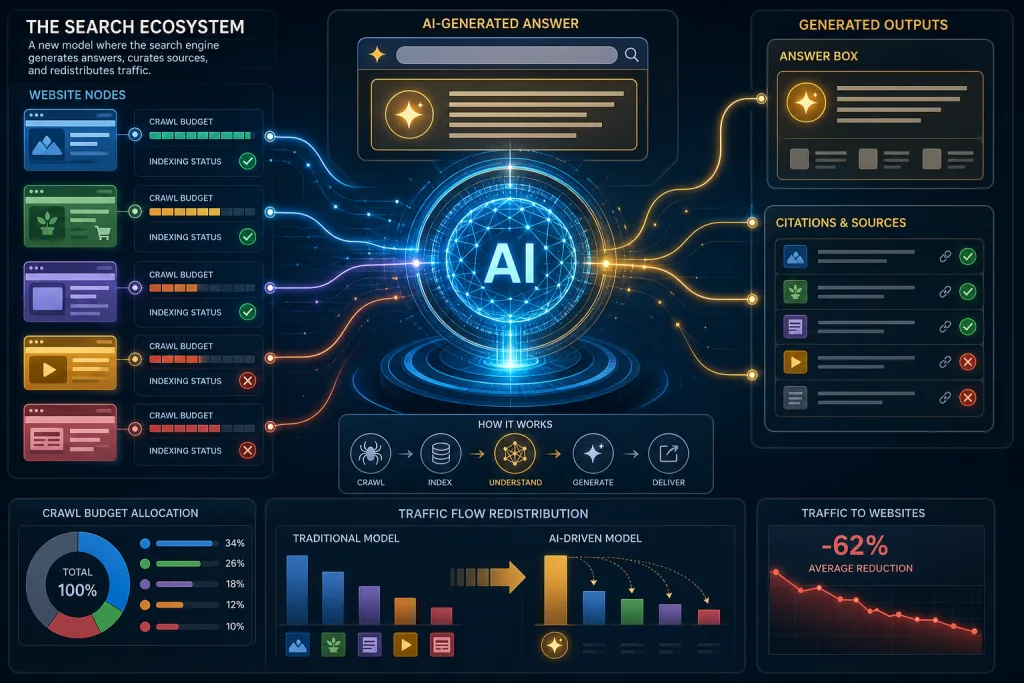
The issue observed by SEO analysts in July 2026 is that AI Mode started citing its own generated snippets as the primary source. Instead of referencing a publisher’s article, Google forms an answer based on its data and then links to its own knowledge base or previously generated AI content. This creates a closed loop: the search engine becomes the content creator, aggregator, and distribution channel all at once.
For content teams, this represents a fundamental shift. Previously, even with AI Overviews, there was still a chance to get a click: the user saw a citation and clicked through to the source. Now, when Google cites itself, a link to an external source might not appear in the answer at all.
Crawl Economics: Why AI Content is Losing Indexation
Alongside self-citation, crawl economics have tightened. Google physically cannot crawl and index all the content published on the internet. With the mass adoption of AI tools for content production, the volume of published materials has multiplied, while Google’s crawl budget remains limited.
In a July 16 episode of ‘Search Off the Record,’ John Mueller confirmed that the ‘crawled, currently not indexed’ status sometimes does indeed signal site quality issues. Previously, this status was considered temporary—the page was crawled but waiting in the indexing queue. Now, Google increasingly uses it as a soft penalty: the system crawls the page, evaluates its quality, and decides not to index it.
For teams scaling content with AI, this is critical. If 60–80% of the content on a site is generated or heavily rewritten by AI and hasn’t passed editorial quality control, Google may lower its trust in the entire domain. The result is that new pages don’t get indexed, and older ones lose rankings.
How Self-Citation Impacts Content Strategy
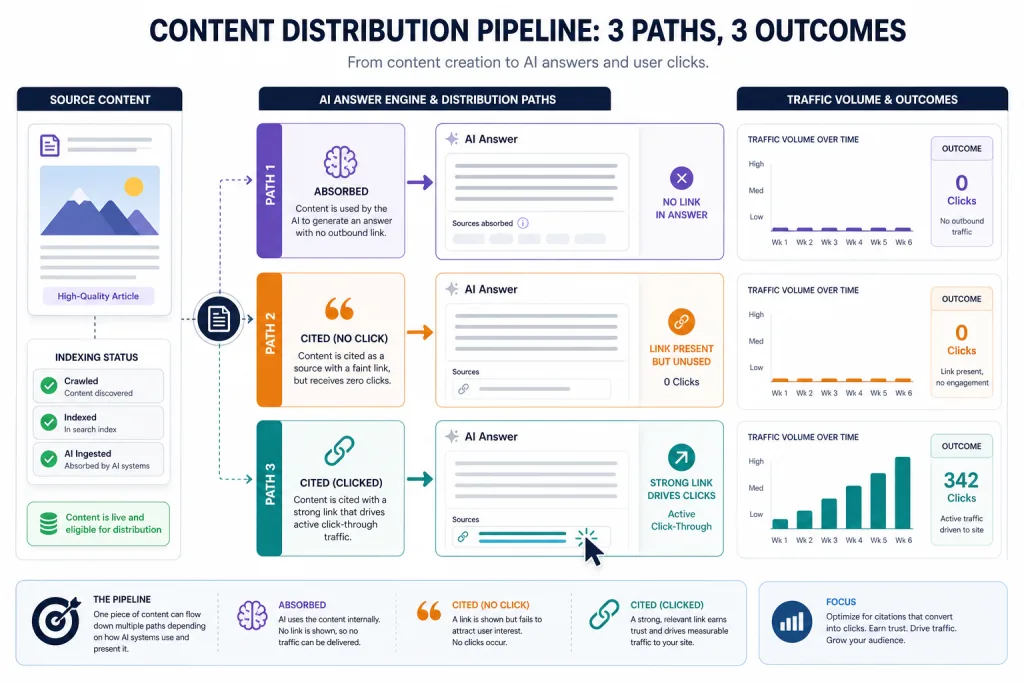
Google’s self-citation changes the ROI calculation for content production. If a 3,000-word article could bring organic traffic for years, that same content can now be used by Google to form an AI answer without linking to the source. Content teams must account for three scenarios:
Scenario 1: Content is absorbed without citation. Google uses information from your article to form an answer but doesn’t link to you. Search traffic for that query drops to zero.
Scenario 2: Content is cited, but without a click. Google mentions your site as a source, but the user gets the full answer in AI Mode and doesn’t click the link. Traffic exists, but it’s minimal.
Scenario 3: Content is cited and generates a click. Google links to your material, and the user clicks through because the answer is incomplete or requires depth that AI Mode cannot provide. This is the scenario to strive for.
The third scenario is only achievable if the content contains what AI Mode cannot synthesize from publicly available data: original research, expert opinions, unique data, primary interviews, and in-depth analysis with specific numbers.
Signs of Content Losing Visibility in AI Mode
Content teams can diagnose the problem through several signals:
- Decrease in impressions with stable rankings. Pages remain indexed, but impressions drop—AI Mode is intercepting the queries.
- Growing share of ‘crawled, not indexed’. If the share of such pages exceeds 15–20% of new publications, it’s a signal of declining domain trust.
- Decrease in search CTR with growing AI Overviews impressions. Google shows your snippet, but the user gets the answer in the AI block.
- Drop in traffic for informational queries. AI Mode intercepts informational queries best—definitions, instructions, explanations.
- Stable or growing traffic for transactional queries. AI Mode currently handles queries with commercial intent less effectively.
Adaptation Strategy: What to Change in Content Operations
1. Shift from Informational to Analytical Content
AI Mode handles basic informational queries perfectly—’what is,’ ‘how it works,’ ‘what’s the difference.’ Content teams need to shift their focus to analytical content: case studies, comparisons with real data, expert assessments. If your content can be fully synthesized from the top 10 search results, AI Mode will do it without you.
2. Integration of Primary Data
Original data is the main defense mechanism against self-citation. Google cannot cite its own AI answer if the data exists only in your article. Surveys, internal research, client data analysis, exclusive interviews—all of this creates content that AI Mode is forced to cite.
3. Restructuring Content for AI Answers
Instead of fighting AI Mode, use its structure. AI engines extract content better when organized in a ‘question → direct answer → expanded context’ format. Structure articles so that the first paragraphs of each section contain a clear, citable answer, while the subsequent text provides depth.
4. AI Generation Quality Control at the Pipeline Level
If a team uses AI for mass content production, every stage of the pipeline must include quality control: fact-checking, originality checks, and expert editorial input. Content that passes through an AI pipeline without a human-in-the-loop is the prime candidate for the ‘crawled, not indexed’ status.
5. Diversification of Distribution Channels
With Google’s self-citation, organic search is no longer the only channel. Content teams must develop direct distribution: email newsletters, closed communities, partner publications. If Google takes 30–40% of search traffic through AI Mode, a direct audience becomes an insurance policy.
Crawl Budget and AI Content: A Practical Audit
Teams publishing more than 50 pages per month using AI should regularly conduct a crawl budget audit. Steps:
- Export pages with ‘crawled, not indexed’ status from Google Search Console. Segment by section, date, content type.
- Pattern analysis. If a certain type of content (e.g., AI-generated category descriptions) is systematically not indexed, it’s a signal of low quality.
- Reduction of low-quality AI content. Delete or merge pages that aren’t indexed and don’t bring traffic. This frees up crawl budget for quality content.
- Internal link optimization. Strengthen internal linking to priority pages so Google understands their importance.
- Indexation speed monitoring. If the time from publication to indexing grows, it’s an early signal of declining domain trust.
LLM Benchmarks and Model Selection for Content Production
Alongside changes in search, the LLM market is experiencing its own evaluation crisis. As BankInfoSecurity noted regarding Kimi K3, benchmark leaderboards increasingly fail to reflect the real quality of models for specific tasks. For content teams, this means that choosing an LLM for the editorial pipeline cannot be based on general ratings.
A practical approach is internal A/B testing of models on your own tasks: comparing draft quality, fact-checking accuracy, and brand tone preservation. Teams should create their own set of test tasks (10–20 typical editorial tasks) and evaluate models on specific criteria: accuracy, originality, style match, and topic coverage completeness.
What This Means for Content Teams: Key Takeaways
Google’s self-citation in AI Mode is not a temporary anomaly, but a direction of development. The search engine will increasingly form answers on its own, reducing traffic to external sources. Content teams that continue producing content under the old ‘scale through AI → indexing → traffic’ model will face a drop in visibility.
The solution is not to abandon AI, but to change where AI is applied in the pipeline. Use AI for research, structure, drafts, localization—but add a layer of primary data, expert editing, and unique analysis that will force AI Mode to cite you rather than absorb you.
Checklist: Content Audit for AI Mode Resilience
- Check the share of pages with ‘crawled, not indexed’ status over the last 90 days—if it’s above 15%, a quality audit is needed
- Identify the top 20 queries where traffic dropped alongside an increase in AI Overviews—these are the queries AI Mode is intercepting
- For every new article, check: does it contain data or analysis that isn’t in the top 10 search results
- Conduct A/B testing of LLMs on your own editorial tasks quarterly instead of relying on public benchmarks
- Diversify channels: if more than 60% of traffic comes from Google search, launch at least one direct distribution channel
- Delete or merge pages that haven’t been indexed and haven’t brought traffic for over 6 months
FAQ
What is Google’s self-citation in AI Mode?
This is a situation where Google generates an answer in AI Mode and links to its own generated data or knowledge base instead of an external source. The user gets the answer without clicking through to the original site.
Is the ‘crawled, not indexed’ status always a quality issue?
Not always, but increasingly so. John Mueller confirmed that sometimes this status does indeed signal low quality. If the share of such pages is growing, it’s a reason for a content audit.
What types of content does AI Mode intercept the most?
Basic informational queries—definitions, instructions, concept explanations. Content that can be synthesized from publicly available sources is the most vulnerable.
Should we completely abandon AI content generation?
No. AI is effective for research, drafts, localization, and structure. The problem arises when AI content is published without editorial control, primary data, and an expert layer.
How can I measure if AI Mode is affecting my traffic?
Compare the dynamics of impressions and clicks in Google Search Console with the deployment dates of AI Overviews and AI Mode for your key queries. A drop in impressions with stable rankings is an indicator of interception.