What is Limited Animation and Why It Works on Mobile Screens
Limited animation is not a synonym for cheap animation. It is a deliberate production approach where movement is focused only on the frame elements that actually drive the plot. Everything else—backgrounds, static objects, secondary characters—remains still or is reused from episode to episode.
On a mobile screen, the viewer watches animation on an area of about 5–6 inches. Minor details of secondary movement aren’t visible anyway. If a character is speaking, the viewer watches the face. If the action takes place against a city backdrop, the background is there for atmosphere, not for constantly moving clouds and passersby. Limited animation turns this physiological limitation into an advantage: resources are directed exactly where the viewer is looking.
Studios producing short vertical series—60–90 seconds per episode, 20–30 episodes per season—cannot afford full animation of every frame. A 30-episode season with full animation, even in 2D, can cost 3–4 times more than with limited animation. The difference between $15,000 and $45,000 per season is the difference between a project that breaks even and a project that never goes into production.
Repeated Backgrounds: How One Set of Locations Works for the Entire Season
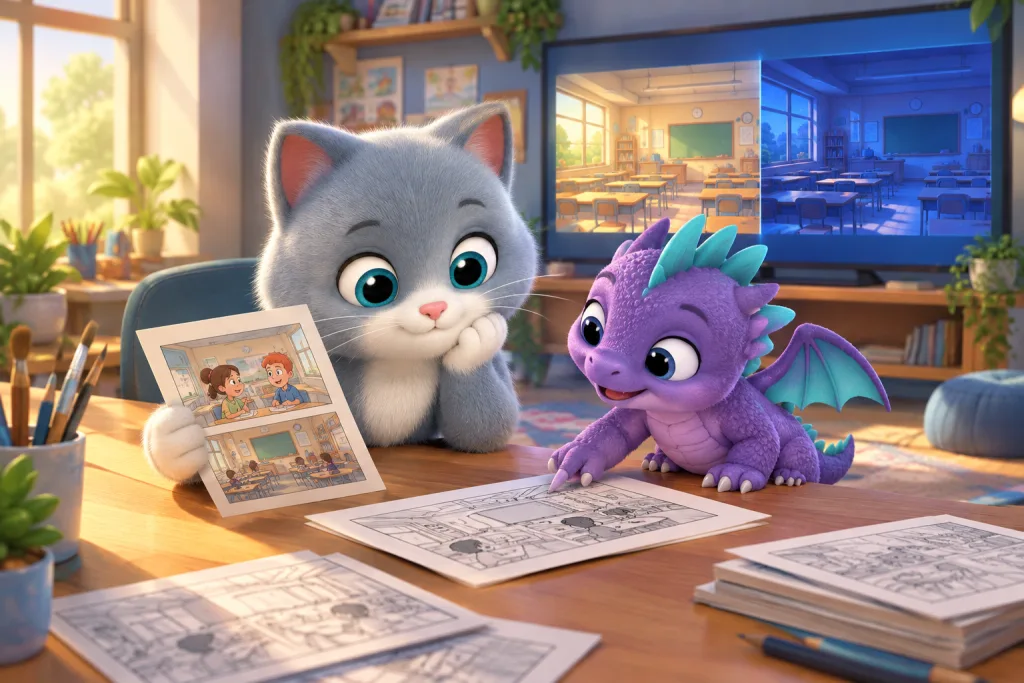
The most obvious way to cut costs is to use the same set of backgrounds across all episodes. A school-based series can get away with just five locations: a classroom, a hallway, a courtyard, a cafeteria, and the roof. These backgrounds are drawn or modeled once and used in every episode of the season.
It might seem like this makes the series visually boring, but in practice, the opposite is true. Repeated locations give the viewer a sense of a familiar place. The viewer recognizes the classroom where the action takes place and doesn’t need to spend time orienting themselves in a new space. It works like sitcom sets: you don’t notice that the action always takes place in the same apartment because the focus is on the characters and the dialogue.
The key to making repeated backgrounds not look lazy is variability within the location. Lighting changes from episode to episode: morning, evening, rain. A slight shift in color temperature or the position of the light source creates the feeling of a different time without redrawing the background. In 2D, this is done through overlay layers and color correction. In 3D—by changing lighting parameters and rendering with the same models.
Movement Cycles and Repeated Passes
A walk cycle, a breathing cycle, a blink cycle—these are the basic blocks that are animated once and used multiple times. In short vertical animation, cycles are especially effective because the episode lasts 60–90 seconds, and the viewer doesn’t have time to get tired of the repetitive movement.
A character’s walk cycle down a hallway can be used in five episodes, changing only the direction and speed. A breathing cycle in a dialogue scene creates a sense of life, while only the lips and eyebrows are animated. This isn’t saving for the sake of saving—it’s allocating the budget to what the viewer actually sees.
Repeated passes are a separate technique. If a character enters the frame from the left and stops, this pass can be used in several episodes with different backgrounds. The body animation is identical, but changing the background and camera position creates the illusion of a new action. In series with 20+ episodes per season, this saves dozens of hours of animation.
Where Movement is Necessary and Where It Can Be Cut
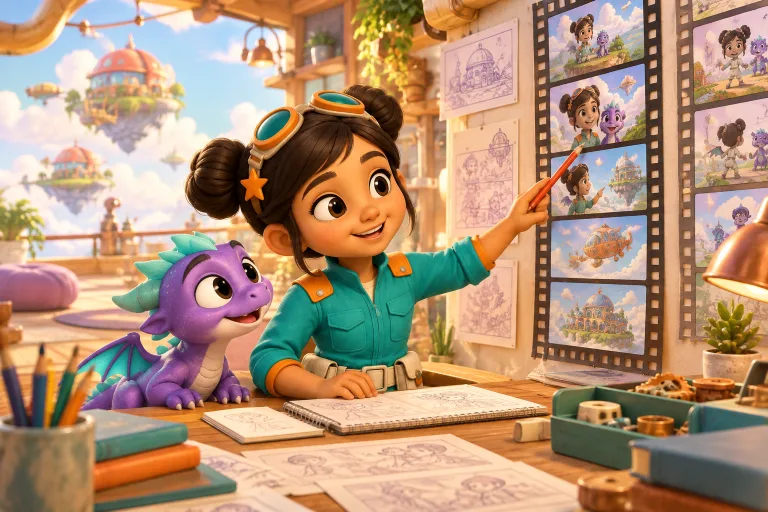
The decision of what to animate and what to leave static is made at the storyboard stage. The general rule: movement is needed where it changes the viewer’s emotional state. A close-up of a face—yes. A crowd in the background—no. A hand reaching for an object—yes. Clothing fabric fluttering in the wind—no, unless it’s part of the scene.
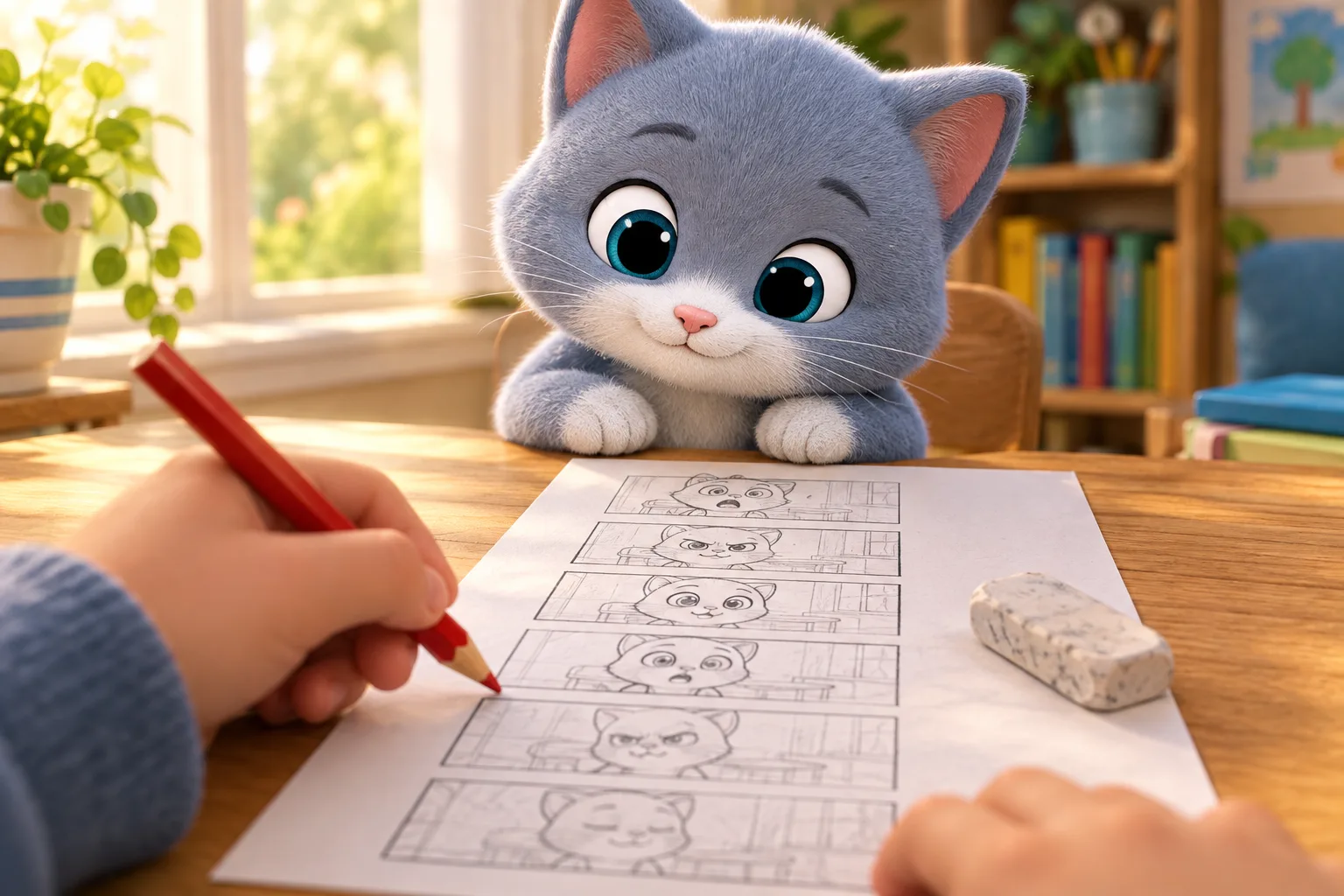
Dialogue scenes are the main candidate for limitation. The viewer looks at the lips and eyes. The rest of the body can be almost motionless. In a vertical frame, a close-up of a face takes up a significant portion of the screen, and detailed body animation simply isn’t visible. If an episode is 70% dialogue, limiting movement in these scenes cuts the animation budget by about 40%.
Action scenes are the opposite case. Here, movement is the essence of the scene. But even in action, animation can be limited: instead of full fight choreography, use a series of close-ups of strikes and reactions. The viewer assembles the scene in their head, and it feels more dynamic than smooth full-body animation in a wide shot.
How Reused Assets Affect Retention
The question arises: doesn’t reusing backgrounds and cycles reduce the quality that keeps viewers engaged? Data shows that no—provided that reused elements are used intelligently.
In series where backgrounds are repeated but lighting and frame composition change, the completion rate of the first episode averages 78–85%. In series with unique backgrounds in every episode but less expressive facial animation, retention drops to 60–65%. The viewer reacts to the character’s emotions, not to the variety of settings.
This doesn’t mean backgrounds aren’t important. They create atmosphere and context. But their variety isn’t the main retention factor. The main factor is the character’s expressiveness at the moment of emotional tension. And that’s exactly where the budget should go.
Episode Budget: What Costs What
To understand how limited animation affects the budget, it’s helpful to break down the typical cost structure of a single episode of a short vertical series.
Storyboard and script—about 10% of the episode budget. This is a fixed cost that depends little on the animation approach.
Backgrounds—15–20% when created from scratch. When reusing already finished backgrounds—3–5% per episode, only for adjusting lighting and minor tweaks.
Character animation—40–50% of the budget. This is the most resource-intensive part. Limiting movement and using cycles can reduce this block by 30–40%.
Compositing and rendering—10–15%. Repeated backgrounds and cycles also reduce compositing time because there are fewer layers and fewer unique scenes to assemble.
Voice acting and sound—10%. This is a separate line item, independent of the animation approach.
In total, switching from full animation to limited animation with reused assets can reduce the cost of an episode by 25–35%. For a 30-episode season, this is the difference that determines whether the project happens at all.
How to Control Quality on a Limited Budget
Limited animation doesn’t mean a lack of quality control. On the contrary, when there is less movement, every movement must be more precise. The viewer notices an awkward blink or an unnatural head turn when it’s the only movement in the frame.
The first rule—animate what the viewer sees. In a vertical frame with a face close-up, that’s the lips, eyes, and eyebrows. Micro-expressions are more important than macro-movements. Half a second of delayed blinking before a line works better than a smooth turn of the entire body.
Second—change the composition within a repeated background. The same classroom can be shot from three different angles: front, side, and top. This creates visual variety without new locations.
Third—use sound to create movement that isn’t in the animation. Off-screen footsteps, the sound of a door opening, the noise of a crowd—all of this creates a sense of presence and dynamics without a single drawn movement.
Planning Reused Assets at the Pre-production Stage
The decision to limit animation is made not at the production stage, but at the pre-production stage. If the script is written so that every episode takes place in a new location, repeated backgrounds won’t help. If the script has 15 scenes in 5 locations—that’s already a foundation for efficient production.
At the storyboard stage, the director determines which scenes will be fully animated and which will be limited. This is documented in the production bible, which is handed to the animation team. Without this document, every animator will make decisions on their own, and the result will look inconsistent.
The production bible should contain a list of all locations for the season, a list of all movement cycles indicating the episodes where they are used, and a minimum movement checklist for dialogue scenes. This isn’t a creative limitation—it’s a production standard that ensures consistency.
Checklist: How to Reduce Episode Costs Without Sacrificing Quality
- Limit the number of locations to 5–7 per season and plan lighting variability within each.
- Create a library of movement cycles: walking, breathing, blinking, head turns—and use them in all episodes.
- Focus the animation budget on close-up faces, not on body movement in wide shots.
- Change the angle and composition within a repeated background to create visual variety without new locations.
- Use sound to create dynamics that don’t need to be animated: footsteps, doors, crowd noise off-screen.
- Create a production bible specifying scenes with full and limited animation before production begins.
- Check the retention of the first three episodes and adjust the movement balance based on data, not feelings.
Mistakes That Make Limited Animation Look Cheap
The most common mistake is a complete lack of movement in dialogue scenes. The character stands like a statue, moving only their lips. This looks unnatural because a living person always moves slightly: swaying, shifting weight, blinking. The solution is to add a breathing cycle and random micro-movements of the head. It costs little but completely changes the feel.
The second mistake is identical composition in all scenes of the same location. If the classroom is always shown from the same angle, the viewer feels monotony. Three angles per location is the minimum that creates variety.
The third is ignoring sound design. When visual movement is limited, sound becomes the main carrier of dynamics. A quiet scene with two characters against a static background only works if the soundscape is alive: distant voices, noise outside the window, creaking chairs. Without this, the scene feels dead.
FAQ
Won’t the viewer get bored of repeated backgrounds?
No, if the lighting, angle, and composition change. The viewer focuses on the characters, and the backgrounds are perceived as familiar space. It works like sitcom sets—no one complains that the action is always in the same apartment.
How many locations are needed for a 30-episode season?
5–7 locations is optimal. This is enough for plot variety and few enough for efficient production. Each location should be used in at least 4–5 episodes.
How do you explain to a client that limited animation isn’t cutting costs at the expense of quality?
Show a retention comparison. A series with expressive facial animation on repeated backgrounds retains viewers better than a series with diverse backgrounds but bland animation. The budget is directed where the viewer is looking.
Can limited animation be used in 3D?
Yes, and it’s even easier. In 3D, reusing models, locations, and movement cycles is standard practice. Changing lighting and camera position creates variety without redrawing.
At what stage should the decision to limit animation be made?
At the pre-production stage, before storyboarding begins. The script must be written with a limited number of locations in mind, and the production bible must fix which scenes are fully animated and which are limited.