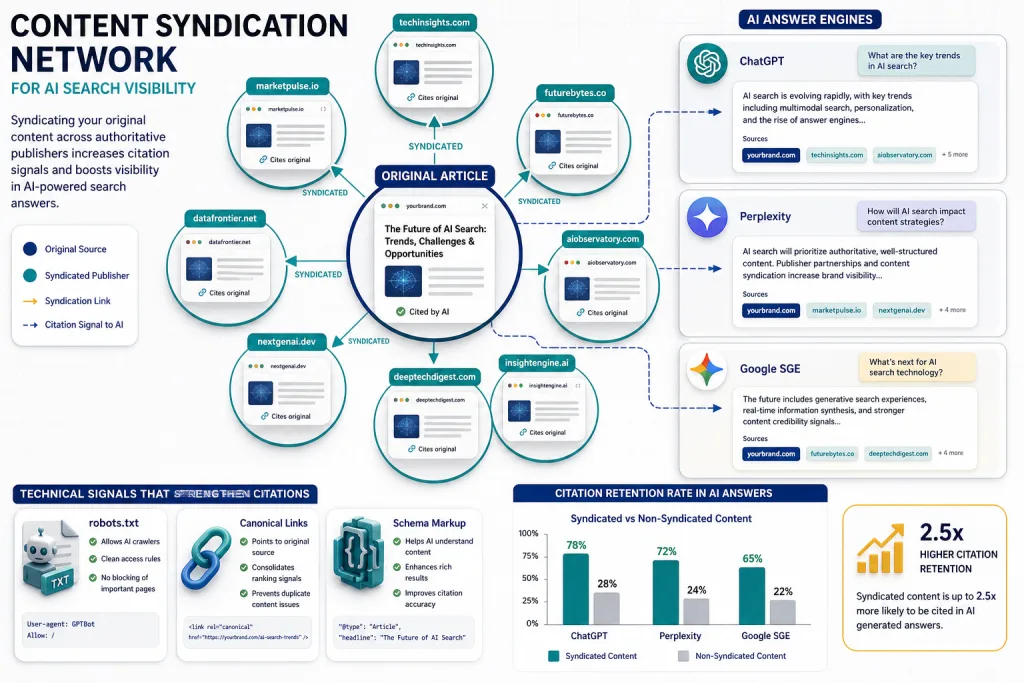
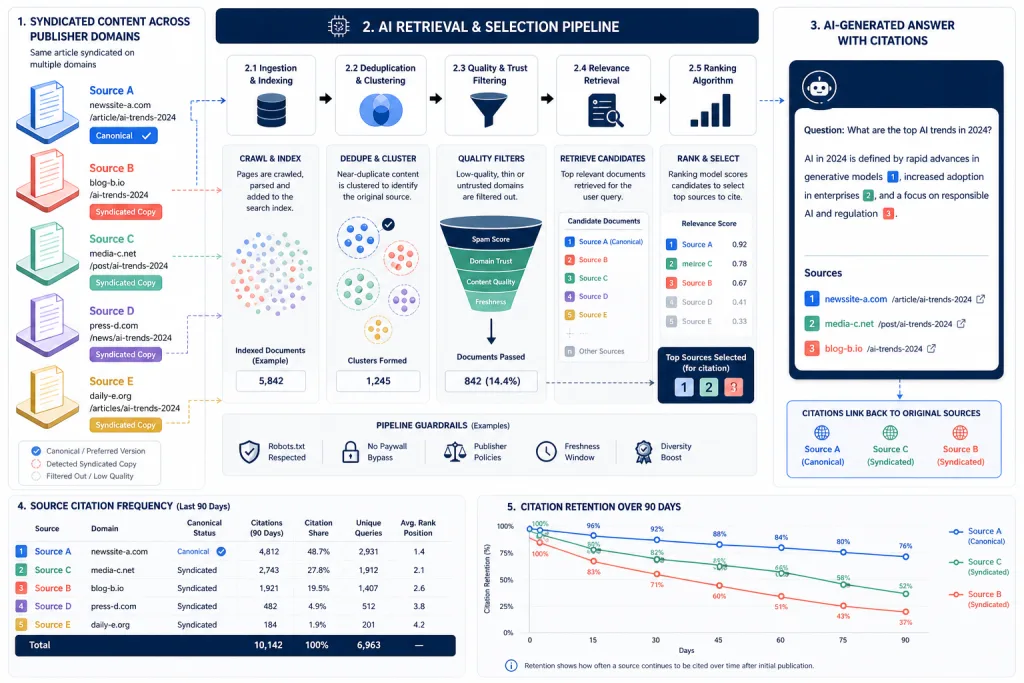
Content syndication—distributing materials through partner publisher networks—has long been used to earn backlinks and expand reach. But in 2026, it took on a new dimension: data shows that content distributed through publisher networks stays in AI engine citations roughly twice as long as similar materials published solely on the original domain. This means distribution has become not just a traffic channel, but a strategic lever for visibility in ChatGPT, Perplexity, Google AI Overviews, and Copilot.
For content teams, the conclusion is clear: if your AI visibility strategy is limited to optimizing article structure and conducting prompt audits, you are missing an entire layer of opportunity. Syndication is the channel through which your content enters the data corpora that LLMs rely on to generate answers. And the longer a material circulates within a network of trusted publishers, the higher the likelihood that an AI engine will choose it specifically as a source.
What the Data Shows: The Stacker Case and AI Citation Retention
In August 2026, Stacker, a company managing a content syndication network for publishers, received the MarTech Breakthrough Awards as AEO Solution Provider of the Year. The key insight from their internal research: content distributed through their publisher network retains AI citations for approximately twice as long as comparable content published outside the network.
This isn’t a marketing promise, but an observation from real distribution infrastructure. The mechanics are simple: when a piece appears on dozens of domains with different URLs but with consistent attribution and structured data, AI engines encounter it more frequently in their training and extraction corpora. Multiple presence amplifies the signal that “this source is relevant and authoritative.”
For editorial teams, this changes the calculation: previously, syndication was evaluated through the lens of SEO duplicates and cannibalization. Now a new factor is added—each placement increases the surface area that AI engines can “see” and cite.
How AI Engines Choose Sources for Citation
To understand why syndication works, you need to look at the mechanics of LLM source selection. AI engines don’t use classic PageRank. Instead, they rely on a combination of factors:
- Corpus frequency. If a fact or narrative appears across multiple domains, an LLM is more likely to consider it credible and citable.
- Content structure. Clear headings, tables, lists, and schema.org markup help extraction models accurately identify the snippet to cite.
- Source domain authority. Publishers with a high reputation in a niche get priority when choosing between multiple sources with the same information.
- Freshness and updates. Materials that are updated and republished (via syndication) stay in the active extraction corpus longer.
- Attribution consistency. If the same content on different domains links back to the original source, AI engines associate authorship with the original, not the mirror.
Syndication vs. Original Publication: What Works Better
This isn’t an “either-or” dilemma. Original publication on your own domain remains the foundation—it ensures E-E-A-T, copyright, and control over monetization. Syndication is an amplification layer that works on top of the original.
The key difference in the era of AI search: an original article on your domain might be cited by an AI engine once and then displaced by a fresher or better-structured competitor’s material. A syndicated version placed on five to ten authoritative platforms creates a “multiple anchor” effect—even if one citation fades, another version continues to generate mentions.
Practical balance for content teams:
- Original — full long-form content with unique data, expert insights, and brand style. Published first, indexed, receives the canonical tag.
- Syndication — an adapted version (not a full copy) with a canonical link to the original, placed 24–72 hours after publication. Volume is 60–80% of the original, with local edits tailored to the platform’s audience.
- Derivatives — short summaries, infographics, quotes for social platforms, created based on the original and syndicated versions.
Choosing Networks and Partnerships: Criteria for Content Teams
Not all syndication networks are equally useful for AI visibility. When selecting partners, evaluate the following parameters:
Network Domain Profile
Sites in the network must have real editorial reputation, not be created for SEO link-building. AI engines are trained to distinguish content farms from genuine publications. Check: do the platforms have an editorial policy, named authors, and a publication history predating AI tools?
Attribution Format
How the network formats the source is critical. The ideal format: visible text “Based on materials from [Your Publication Name]” + a canonical link + schema.org markup for article:author and canonical. Avoid networks that publish content without attribution or with nofollow links hidden in the footer.
Distribution into AI Corpora
Ask partners if their platforms are indexed by major crawlers (Googlebot, Bingbot, Common Crawl, GPTBot, PerplexityBot). If a domain blocks AI bots in robots.txt, syndication won’t yield AI visibility. This is a basic but often overlooked filter.
Retention Metrics
Before signing a contract, request data on how long syndicated materials retain visibility—both in classic search and in AI answers. Reliable networks track this and are willing to share aggregated statistics.
AEO Optimization for Syndicated Content
Syndication without AEO optimization is just scattering content without structure. Every syndicated version must be adapted for extraction by AI engines:
- Preserve heading structure. H2 and H3 tags from the original should transition into the syndicated version unchanged—this helps AI engines match snippets.
- Add a summary block. A short paragraph at the beginning of the article (2–3 sentences) answering the main question. AI engines often cite this first structured block.
- Use a Q&A format. An FAQ section with questions and answers increases the likelihood of being cited by answer engines. Keep the question phrasing identical across all versions.
- Embed data and tables. Numbers, statistics, and tabular data are cited by AI engines more often than narrative. Ensure tables render correctly in all syndicated versions.
- Canonical link. Every syndicated version must contain
<link rel="canonical" href="original_URL">. This prevents SEO cannibalization and signals the original source to AI engines.
Risks and Limitations: Cannibalization, Attribution, Control
Syndication isn’t a free lunch. Content teams must manage several risks:
SEO Cannibalization
If a syndicated version outranks the original in classic search, you lose organic traffic. Solution: canonical link, a 24–72 hour syndication publication delay, and using noindex for full mirrors (if the network allows).
Loss of Attribution in AI Answers
AI engines sometimes cite the syndicated version instead of the original. This means the partner platform gets brand recognition, not you. Mitigation: embed the brand name in the first paragraphs of the content and use Organization structured data.
Quality Control
Every syndicated version is a copy of your content on a third-party domain. If a partner alters the text, adds errors, or removes context, it will reflect on your reputation. Include the right to audit and remove in your contracts.
Erosion of Originality
If the same content appears on 20+ domains, AI engines might start perceiving it as “common knowledge” and stop citing a specific source. Limit the number of syndicated placements: 5–10 authoritative platforms are usually sufficient.
How to Measure Syndication Effectiveness for AI Visibility
Unlike classic SEO, where traffic and rankings are tracked via Search Console, AI visibility requires separate metrics:
- Citation frequency — how often your content (original or syndicated) is cited in ChatGPT, Perplexity, Gemini, and Copilot answers for relevant prompts.
- Citation retention — how long after publication citations continue to appear. Compare the retention of the original and syndicated versions.
- Source attribution rate — the percentage of citations where your brand is mentioned, not just the partner’s URL.
- Prompt coverage — the share of target prompts where your content appears in the answer in at least one version.
Use AI visibility tracking tools (Profound, Otterly, VerseOdin, and similar) to automate monitoring. Manual checks in ChatGPT and Perplexity only work for 10–20 prompts; when scaling to 100+ queries, automation is mandatory.
Checklist: Launching Syndication for AI Visibility
- Identify 5–10 target platforms with open access for AI bots (GPTBot, PerplexityBot, Bingbot) in robots.txt
- Prepare a syndicated version template: 60–80% of the original volume, canonical link, summary block, Q&A section
- Agree on the attribution format: visible text + link + schema.org markup
- Set a syndication publication delay: 24–72 hours after the original
- Set up AI citation monitoring: citation frequency, retention, source attribution across 30–50 target prompts
- Conduct a monthly audit: which versions are cited more often, which platforms provide better retention
Practice: Integrating Syndication into Content Operations
Syndication shouldn’t be a manual process. Build it into your content pipeline:
Stage 1 — Planning. When approving the content plan, mark materials intended for syndication. Not every text is worth distributing—prioritize content with unique data, research, and expert opinions.
Stage 2 — Production. Write the original with syndication in mind: structured headings, tables, Q&A blocks. Simultaneously prepare an adapted version for partners—with local edits but without losing key facts.
Stage 3 — Publication. The original goes live first. After 24–72 hours, syndication launches through selected networks. Each version gets a canonical link.
Stage 4 — Monitoring. Check AI citations 7, 30, and 90 days after publication. If syndicated versions are cited but the original isn’t, it’s a signal to strengthen the original’s structure or revise your attribution strategy.
Stage 5 — Iteration. Review the partner list quarterly. Disable platforms with low retention and add new ones, guided by AI visibility metrics, not just domain authority.
FAQ
How is syndication for AI search different from classic SEO syndication?
Classic syndication focuses on backlinks and reach. Syndication for AI search adds a goal—multiple presence in the data corpora from which LLMs extract information. This requires attention to robots.txt (access for AI bots), content structure for extraction, and attribution that AI engines can recognize.
Won’t syndication lead to SEO cannibalization?
The risk exists, but it is mitigated by a canonical link, a 24–72 hour publication delay, and using noindex for full mirrors. With proper setup, the original retains priority in classic search, while syndication works for AI visibility.
How many platforms are enough for the AI citation retention effect?
Practice shows that 5–10 authoritative domains with real editorial reputation are enough to create a “multiple anchor.” Exceeding this number increases the risk of originality erosion—AI engines might stop citing a specific source.
What types of content are best suited for syndication in AI search?
Materials with unique data, research, expert interviews, and structured information (tables, comparisons, step-by-step guides). Overview and commodity materials are less suitable—AI engines already have access to them from multiple sources.
Should I use llms.txt alongside syndication?
llms.txt is a manifest file that helps AI engines understand your site’s structure. It is complementary to syndication: llms.txt improves content extractability on your domain, while syndication expands presence on others. Using both tools amplifies the overall AI visibility effect.
Bottom Line: Distribution as the Missing Layer of AI Strategy
Most content teams in 2026 are focused on two tasks: producing quality content with AI and measuring visibility in AI answers. There is a gap between these two tasks—distribution. Syndication fills this gap, turning every published material from a single point of presence into a network of nodes that AI engines discover, extract, and cite.
The data on doubling AI citation retention for syndicated content isn’t an announcement, but an observation from real infrastructure. For content teams, this means that investments in partner networks and distribution pipelines now directly affect a metric previously considered uncontrollable—how often and how long your content appears in ChatGPT, Perplexity, and Google AI Overviews answers.
Start with a pilot: select 5–7 materials with unique data, find 3–5 platforms with open access for AI bots, and measure citation retention over 90 days. The results will provide an argument for scaling or adjusting your strategy.