The Problem: AI Visibility Is Expensive, and There Is No Direct Revenue
By mid-2026, content teams found themselves in a paradoxical situation. On one hand, AI search engines — ChatGPT, Perplexity, Gemini, Google AI Overviews — have become a significant channel for content discovery. On the other, over 90% of AI queries are informational, not transactional. A user asks “how DCB billing works” or “what synthetic AI networks are” — they are looking for knowledge, not a “buy” button. At the same time, basic instrumentation for measuring and attempting to influence AI visibility costs around $5,000 per month — before accounting for content creation, tools, and human capital. If you add the production of long-form editorial content to this, the cost easily doubles or triples. The question editors and content directors ask is: how do you calculate ROI when there is no direct revenue tied to informational queries? The answer requires a fundamentally different approach — not performance metrics, but a brand investment framework with modified attribution.
Why the Classic ROI Calculation Doesn’t Work Here
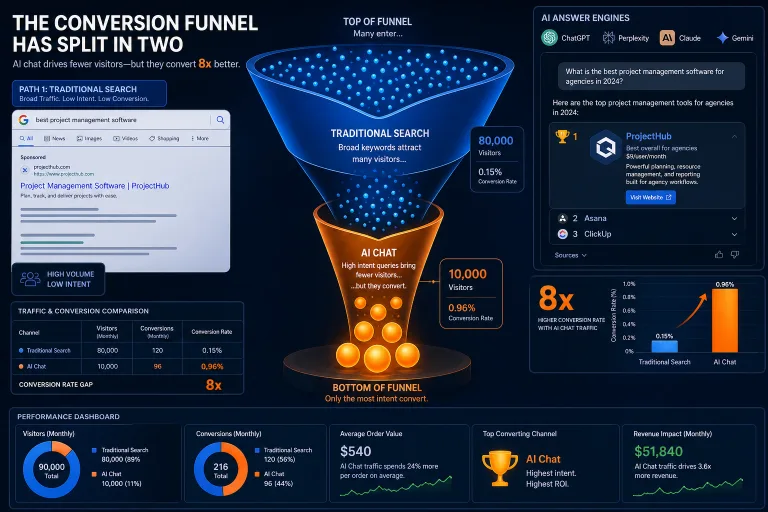
The traditional ROI model for content marketing is built on the chain: traffic → conversion → revenue. In AI search, this chain is broken in three places. The first break — no click. AI engines often provide the answer directly, without navigating to the source. The user gets a synthesized summary; your link might be in a footnote — or not there at all. This isn’t a “zero-click” in the classic sense of a Google Featured Snippet, but a complete replacement: the answer is generated, the need is satisfied. The second break — informational intent. Even when a user clicks a link from an AI answer, their intent is almost always exploratory. They are studying the topic, comparing approaches, forming an understanding — not making a purchase. Conversion to a transactional action might happen weeks or months later, through several other touchpoints. The third break — attribution. AI engines don’t pass reliable UTM parameters. ChatGPT doesn’t send a referrer in the usual format. Perplexity does, but with caveats. Gemini doesn’t provide detailed attribution at all. You can’t just look at Google Analytics and say “here are 47 conversions from ChatGPT worth $12,000.” This means that trying to apply the formula “AI visibility costs / revenue from AI channel = ROI” gives a meaningless result: the denominator is close to zero not because there is no return, but because you can’t see it.
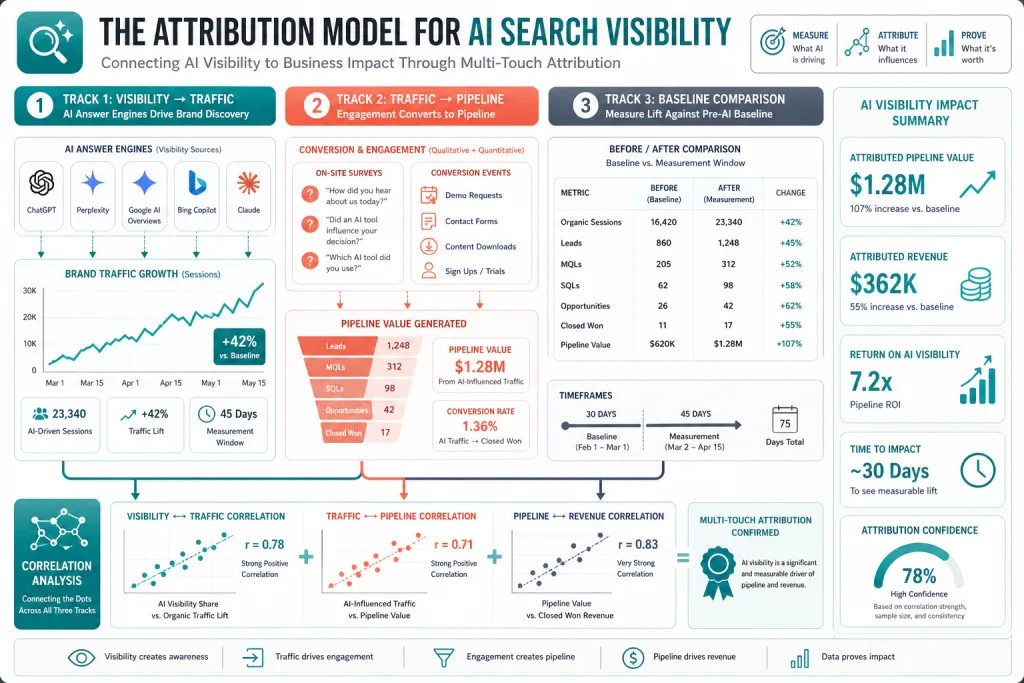
The Framework: AI Visibility as a Brand Investment
The key mindset shift: AI visibility today is not a performance channel, but a brand investment. This doesn’t mean “spend money and hope.” It means the measurement system must be different.
The Three-Level Evaluation Model
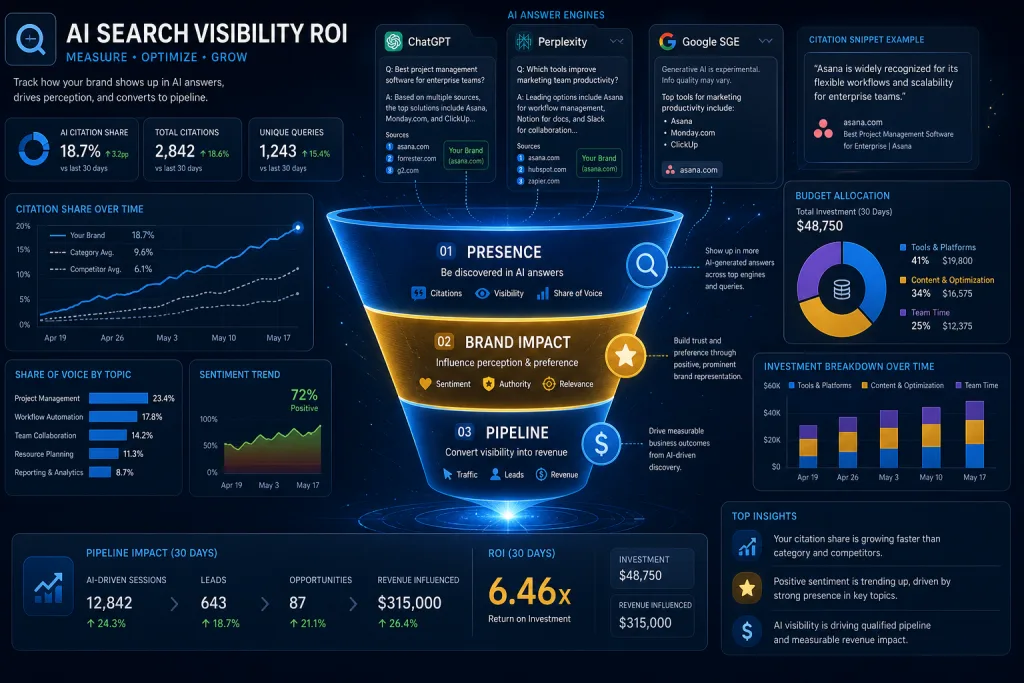
Level 1 — Presence. Measured by the share of queries in your subject area where your content is cited or mentioned in AI engine answers. This is the basic “share of voice” metric in AI search. Tools like Profound, AthenaHQ, Otterly.ai, and similar ones provide this metric, albeit with varying accuracy. Level 2 — Brand Impact. Measured through the correlation between AI visibility growth and brand metrics: direct traffic, branded queries in Google, social mentions, inbound inquiries. If after six months of systematic work on AI visibility, direct traffic grows by 15% and branded queries by 22%, this is an indirect signal. Level 3 — Pipeline Influence. Measured by surveying inbound leads and customers: “Where did you first hear about us?” and “What sources did you research before making a decision?”. This provides qualitative data that can’t be obtained from analytics but reflects real value.
The Calculation Formula
Instead of classic ROI, use a modified model: AI-Visibility ROI = (Brand Impact Value + Pipeline Influence Value) / Total AI-Visibility Investment Where: – Brand Impact Value = (brand traffic growth × average value of a branded visitor) + (branded query growth × average value of a branded query) – Pipeline Influence Value = (share of inbound leads mentioning AI sources × average lead value × conversion rate) – Total AI-Visibility Investment = tool costs + content costs + team time This won’t give an exact figure down to the penny. But it will provide a justified range that can be presented to management.
What’s Included in $5,000+ per Month
Let’s break down the cost structure so content teams can plan their budgets. Measurement tools ($1,500–$3,000/mo). Platforms for monitoring AI visibility: tracking citations in ChatGPT, Perplexity, Gemini, Google AI Overviews. Pricing usually starts at $500/mo for a basic package and goes up to $2,500+ for enterprise with API access and custom prompt sets. Influence tools ($500–$1,500/mo). Platforms for optimizing content for AI answers: structure analysis, semantic completeness, schema markup. Often included in premium-level SEO tools or purchased separately. Additional content production ($2,000–$5,000/mo). Production of content optimized for AI answers: structured articles, data-driven materials, expert insights with primary data. This isn’t “in addition to the content plan,” but a reallocation of resources — but reallocation costs money because it changes the format and depth. Team time ($1,000–$3,000/mo equivalent). Analyzing results, adjusting prompt strategy, monitoring changes in AI engine behavior, AEO auditing of existing content. Total: the real cost of a full-fledged AI visibility program is $5,000–$12,000+ per month for a mid-sized team.
When AI Visibility Is Justified — and When It’s Not
Not every content team should invest in AI visibility. The decision depends on four factors. Subject area. If your niche is specialized B2B (payment infrastructure, telecom monetization, regulatory tech), AI engines synthesize answers from your domain less often because there is less training data. Here, every cited query is more valuable. If you are in a broad consumer niche — competition for AI visibility is higher, and the return is diluted. Decision cycle length. The longer your audience’s decision-making cycle, the more informational queries precede a conversion. For products with a 3–12 month cycle, AI visibility is the top-of-funnel stage that feeds the middle and bottom. For impulse purchases — almost useless. Brand maturity. If the brand is already known, AI visibility growth amplifies existing awareness — users are more likely to click a familiar name in AI answer footnotes. If the brand is unknown, AI visibility can be the first touchpoint — but without subsequent touchpoints, conversion is unlikely. Revenue structure. If 70%+ of revenue comes from 5–10 large clients, one inbound lead coming through AI research can pay off the annual budget. If the model is mass subscription with low ARPU, the economics are different: you need scale, which takes more time.
A Practical Attribution Model for Informational Queries
Since standard attribution doesn’t work, content teams need an alternative model.
The Touch-Influence Model
Instead of tracking direct conversions from the AI channel, track the aggregate impact: 1. Brand traffic as a proxy. Establish a correlation between AI visibility growth (citation share) and direct and branded traffic growth. If the correlation is stable for 3+ months — it’s a signal of causality. 2. Surveys at conversion points. Add a question to registration forms and key pages: “How did you hear about us?” with options including “AI search (ChatGPT, Perplexity, Gemini)”. Even 3–5% of responses mentioning AI sources is a significant signal with sufficient volume. 3. Comparative analysis. Compare the behavior of users coming from AI answers (where attribution is available — Perplexity, partially Google AI Overviews) with users from regular search. If AI users spend more time on the site, return more often, and subscribe to the newsletter more frequently — this is a qualitative signal of value. 4. Control group. If possible, compare brand traffic and inbound inquiry metrics before and after the start of the AI visibility program. Use the pre-program period as a baseline.
How to Build a Business Case for Management
Management won’t accept a “brand investment” without specifics. Here is the presentation structure: Step 1 — Assess the missed opportunity. Run a prompt audit on 50–100 key queries in your subject area. If competitors appear in AI answers and you don’t, this is a quantified loss of share of voice. Show the percentage of queries where you are absent. Step 2 — The cost of inaction. Assess what will happen if AI search continues to grow and your content doesn’t appear there. According to WPP Media, GenAI search ad revenue will reach $100 billion by 2030 — the fastest-growing advertising channel in history. If advertisers are investing that kind of money, it means users are there. Step 3 — Phased budget. Don’t ask for $10,000/mo right away. Propose a 3-month pilot for $3,000–$5,000/mo with clear KPIs: increase citation share by X%, appear in top-3 answers for Y target queries, grow brand traffic by Z%. Step 4 — Comparison with alternatives. Compare the cost of AI visibility with alternative top-of-funnel channels: brand PR, sponsorships, native advertising. Often, AI visibility turns out to be cheaper with comparable reach in niche B2B categories.
Dividing Responsibility: Who Does What
In a content team, the distribution of roles for an AI visibility program must be clear: – Content Strategist — defines thematic query clusters for optimizing AI answers, prioritizes by potential value. – SEO/AEO Specialist — conducts prompt audits, tracks visibility metrics, analyzes the structure of AI engine answers. – Editors — ensure that content optimized for AI answers maintains editorial quality, originality, and E-E-A-T. – Analyst — builds the attribution model, tracks correlations, prepares reporting for management. In small teams, roles are combined, but responsibility for each element must be assigned.
Checklist: Evaluating AI Visibility ROI for Your Team
- Run a prompt audit on 50–100 target queries across 3+ AI engines and record a baseline citation share
- Calculate the full cost of the program: tools + content + team time — not just subscriptions
- Determine what percentage of revenue comes from clients with a long decision cycle (3+ months) — this is your target audience for AI visibility
- Set up a survey in conversion forms with an “AI search” option as a source — collect data for at least 90 days
- Establish a correlation between AI visibility dynamics and brand traffic for 3–6 months before starting investments
- Prepare a 3-month pilot budget with measurable KPIs: citation share, brand traffic, inbound inquiries
- Compare the cost of AI visibility with alternative top-of-funnel channels — show relative efficiency
What Not to Do
Don’t try to buy AI visibility directly. Platforms promising “guaranteed citation in ChatGPT” are either scams or short-term tricks that will stop working after the next model update. AI engines cite content that is semantically relevant, structurally clear, and authoritative. This can’t be “hacked” — it can only be earned. Don’t duplicate your SEO strategy one-to-one. AI answers value completeness, structure, and primary data differently than classic search. An article that ranks #1 in Google isn’t necessarily cited in Perplexity. You need separate AEO optimization, not a copy of your SEO plan. Don’t ignore quality for the sake of volume. If you start mass-producing content “for AI answers” without editorial control, you risk falling into the “generic AI-generated content” category, which platforms — LinkedIn is already doing this — actively demote. Quality and originality are not a wish, but a condition of survival. Don’t expect quick payback. AI visibility is an investment with a 3–9 month lag. If management expects ROI in the first quarter, either revise expectations or don’t start.
The Market Is Moving Toward $100 Billion — But Not for Everyone
WPP Media’s data on $100 billion in GenAI search ad revenue by 2030 is a signal that the market believes in monetizing AI answers. But for content teams, this signal is ambiguous. On one hand, growing ad revenue means AI search will attract more users — and your potential audience is growing there. On the other, ad monetization means AI engines will prioritize paid placements over organic citations. This won’t kill AI visibility, but it will change its economics: organic citation will become more competitive, and its value higher, because it is perceived as independent. For content teams, this means: the window for relatively inexpensive AI visibility growth is currently open wider than it will be in 2–3 years when ad formats take up more space.
FAQ
Is it possible to not invest in AI visibility at all and focus on classic SEO?
Yes, but it’s a strategic risk. If AI search continues to replace classic search — and data shows a steady trend — you will lose share of voice in the channel where audience opinion and preference are formed. The best approach is not “either/or”, but reallocating 10–20% of your SEO budget to AEO activities.
What is the minimum budget for testing AI visibility?
The minimum meaningful pilot is $2,000–$3,000/mo for 3 months: one measurement tool ($500–$1,000), reallocating existing content production to AEO optimization ($1,000–$1,500), analytics and reporting ($500). Any less, and you won’t get statistically significant data.
Which AI visibility measurement tools actually work in 2026?
Profound, Otterly.ai, AthenaHQ, AthenaHQ, and similar tools provide basic citation tracking. Accuracy varies: Perplexity is tracked more reliably, ChatGPT is harder due to dynamic answer generation. No tool gives 100% coverage — use 2–3 sources and cross-check.
How does AEO optimization differ from classic SEO?
AEO focuses on semantic completeness, data structure, schema markup, primary data, and expert depth — things AI engines can synthesize into an answer. SEO focuses on relevance, link profile, and behavioral factors for ranking pages. There is overlap, but the priorities are different.
Should you buy paid placements in AI search when they become available?
It depends on your model. For transactional queries — yes, it’s a direct conversion channel. For informational ones — organic citation is more valuable because it’s perceived as independent. Split your budget: performance campaigns for transactional queries, organic AEO strategy for informational ones.