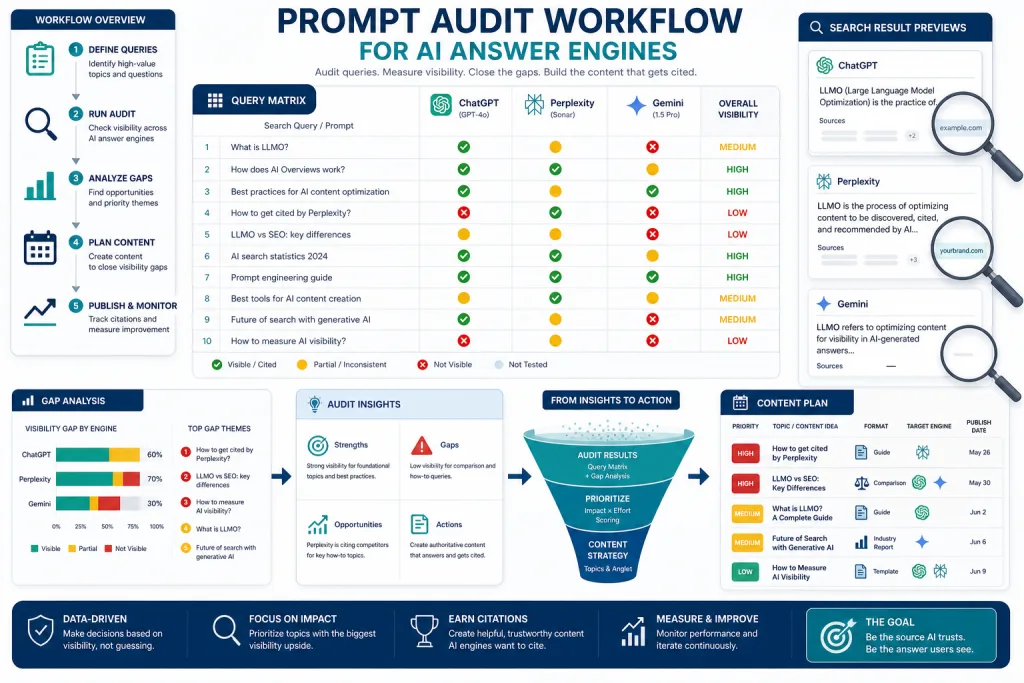
Prompt auditing is a systematic iteration through queries in answer engines (ChatGPT, Perplexity, Gemini, Google AI Overviews) to identify topics where competitors are cited in AI answers, and your content is absent. Unlike a traditional SEO audit, which analyzes rankings in search results, a prompt audit records which sources LLMs choose to synthesize an answer, which fragments they cite, and which query phrasings lead to your brand or competitors appearing.
According to Search Engine Land, companies that run prompt audits find hundreds of queries where competitors appear in AI answers, and they do not. The reaction of most is to mass-publish AI-generated posts. This is a mistake: Google does not reward flows of average content, and LLMs do not cite materials without unique facts. The right next step is to turn audit results into an editorial plan prioritized by visibility gaps, commercial value, and the real ability to produce quality material.
What is a prompt audit and how it differs from an SEO audit
An SEO audit answers the question: “Where do we rank, and competitors rank higher?” A prompt audit answers a different question: “Where do LLMs include competitors in the answer, and not us, and why?”
Key differences:
- Unit of measurement — not the position in search results, but presence in the synthesized answer: a quote, brand mention, link, or paraphrase.
- Multiple results — the same query gives different answers in ChatGPT, Perplexity, and Gemini. The audit should cover at least 3 engines.
- Query phrasing — users ask LLMs differently than they Google: longer, more conversational, with context. The query matrix must include conversational phrasings.
- Volatility — LLM answers change more often than SERPs. The audit is a snapshot that needs to be updated every 4–8 weeks.
Why editorial teams need a prompt audit right now
LLMs increasingly use search tools to extract relevant pages and generate answers from their content. The higher your content ranks for questions users ask LLMs, the higher the chance your material will become the source of the answer. But there is a distance between “ranking” and “being cited in the answer”.
Prompt auditing closes this distance because it:
- Shows not just the fact of presence/absence, but the type of presence — full quote, brand mention, link, or invisible contribution to a paraphrase.
- Identifies thematic clusters where your content is systematically, not just occasionally, absent.
- Provides input for the content plan — specific queries for which materials need to be produced or refined.
- Creates a baseline for measuring AEO efforts over time.
Step 1. Building the query matrix
The query matrix is the foundation of the audit. Without it, you get random observations, not a systematic picture.
Query sources
- Google search suggestions and Related Searches for your core topics.
- People Also Ask — question blocks in search results that are often phrased conversationally.
- Reddit and Quora — real user questions in discussion threads. LLMs actively cite Reddit.
- Internal data — search queries from Search Console that drive traffic but have low CTR (the user might be looking for an answer, not an article).
- Competitor content — titles and H2s of articles from the top 3 competitors in your niche.
Matrix structure
The matrix should contain at least 4 columns:
| Query | Query type | Commercial value | Audit priority |
|---|---|---|---|
| “how to choose a CRM for small business” | informational | high | 1 |
| “CRM vs Excel for sales” | comparative | medium | 2 |
| “how to migrate data from one CRM to another” | practical | high | 1 |
The query type determines the expected LLM answer format: informational — definition + list; comparative — table or pros/cons; practical — step-by-step guide.
The target volume of the matrix for the first audit is 150–300 queries. Less is not enough to identify patterns. More is hard to process manually without automation.
Step 2. Running batch prompts
Manually iterating through 300 queries in three engines is 900 queries. This is unrealistic for an editorial team without a system.
API approach
If you have access to the OpenAI, Anthropic, or Google Gemini API, you can automate sending queries and collecting responses. The audit prompt should be structured:
You are a content visibility analyst. I am sending you a user’s search query.
Answer it as ChatGPT/Perplexity/Gemini would, using only
information from the internet. At the end of the answer, specify:
- Which sources you would cite (site name + URL)
- Which fragment from each source you used
- Why you chose these specific sources
This gives you not only the answer but also the justification for source selection — the most valuable part of the audit.
Approach without an API
If an API is unavailable, use a semi-manual process:
- Divide the matrix into batches of 20–30 queries.
- Send each query to ChatGPT (with web search), Perplexity, and Gemini.
- Record: whether your brand appeared, whether a competitor appeared, which sources were cited, what type of answer was generated.
- Use a shared spreadsheet to record the results.
Time for one batch of 30 queries across three engines is roughly 2–3 hours of an analyst or editor’s work.
Step 3. Categorizing visibility gaps
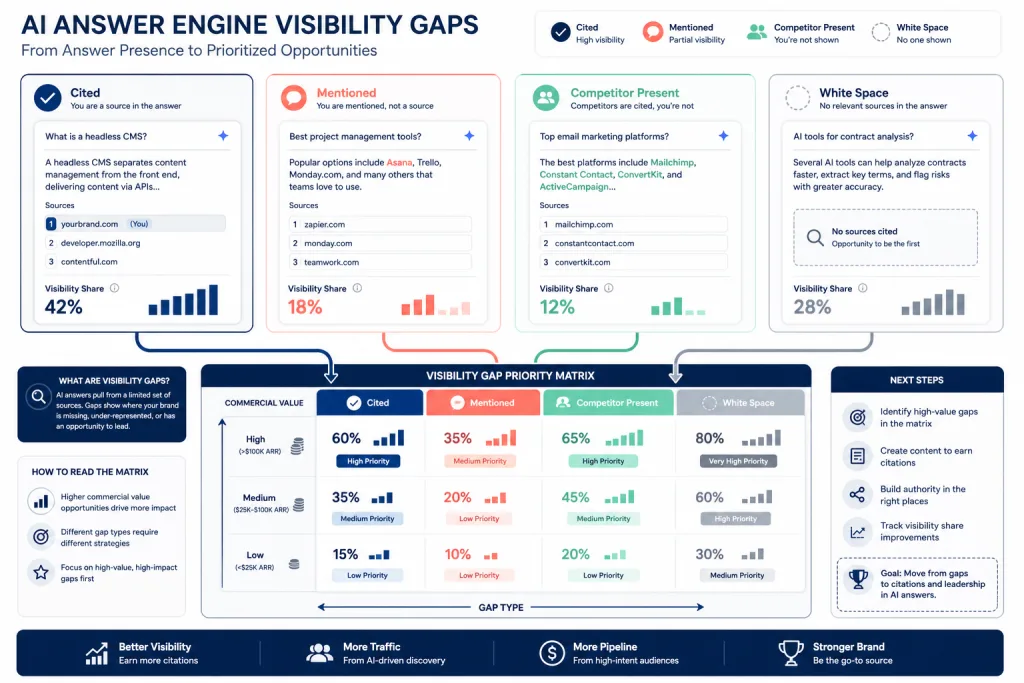
The collected data needs to be turned into a manageable picture. Each row of the matrix after the audit gets one of four statuses:
- Presence with citation — your site is cited, a fragment is used. This is your zone of strength.
- Presence without citation — the brand is mentioned, but without a link or fragment. Partially successful.
- Absence, competitor present — a visibility gap with a known competitor. Priority for the content plan.
- Absence, no one present — a “blind spot”. The LLM finds no quality source. The highest opportunity to produce original content.
Gap map
After categorization, group the gaps by thematic clusters. For example, if 12 out of 15 queries in the “CRM integrations” cluster show an absence of your content — this is not 12 separate tasks, but one content project: a series of articles or an expanded guide on integrations.
Clustering reveals three types of situations:
- Systemic gap — an entire cluster is missing. Solution: producing a new content project.
- Point gap — individual queries in a cluster where content exists but is not cited. Solution: refining existing articles — structure, facts, citability.
- Format gap — content exists, but the format does not match what LLMs extract. For example, you have an essay article, but LLMs look for a comparison table. Solution: restructuring.
Step 4. Prioritizing the content plan
Not every gap is worth closing. Prioritization is a critical step that separates meaningful AEO from mindless production.
Prioritization criteria
- Commercial value of the query — is the query related to a product, service, or funnel stage where conversion is real.
- Query frequency — how often a variant of this query appears in Search Console, Reddit, PAA.
- Gap type — a “blind spot” (no one is present) is prioritized over “competitor present” because the barrier to entry is lower.
- Production cost — can you create material with unique facts (primary data, expert experience, original research) that LLMs will want to cite.
- Strategic importance of the cluster — is the cluster related to the brand’s core topic or peripheral.
Priority matrix
Match commercial value and gap type:
- High value + blind spot → produce immediately, this is your chance to become the primary source.
- High value + competitor present → produce with differentiation: primary data, expert experience, a more complete structure.
- Low value + any gap → postpone or delegate to refine existing content.
- High value + presence without citation → refine existing material: add citable fragments, structured data, clear definitions.
Step 5. Transforming results into an editorial plan
The result of a prompt audit is not a report, but an updated content plan. Each priority gap should become a specific task in the editorial system.
Task types
- New material — for “blind spots” and clusters where content is completely absent. Topic, format, target queries, expected LLM answer type.
- Refining existing — for point and format gaps. Specific changes: add a comparison table, structured definition, FAQ block, primary data.
- Updating outdated — for queries where your content was relevant but stopped being cited. LLMs prefer fresh sources.
Workflow integration
A prompt audit should not be a one-time project. Build it into the editorial cycle:
- Every 4–8 weeks — full audit across the query matrix.
- Weekly — monitor 10–15 key queries from the matrix to track changes.
- Before launching a content project — mini-audit of 20–30 queries in the topic cluster to refine the angle and structure.
Step 6. Measuring progress
Without measurement, a prompt audit turns into an exercise without a result. Track three metrics:
- Presence rate — the percentage of queries in the matrix where your content appears in LLM answers. Baseline after the first audit, goal — growth by 5–10 percentage points per cycle.
- Presence rate with citation — the percentage of queries where your site is not just mentioned, but cited with a fragment. This is a quality metric, not just reach.
- Gap closure rate — how many gaps from the previous audit are closed in the current one. Shows the efficiency of content production.
Common mistakes when launching a prompt audit
- Using only one engine — ChatGPT, Perplexity, and Gemini give different answers. Auditing in one engine creates a blind spot.
- Ignoring conversational phrasings — if the matrix consists only of Google-style “keywords”, you won’t see real LLM user queries.
- Reacting with mass publishing — the most common scenario according to Search Engine Land: finding hundreds of gaps and flooding them with AI content. This harms both SEO and AEO.
- Lack of clustering — working with each gap individually without grouping by topics leads to fragmented content that LLMs do not cite.
- Ignoring the type of presence — a brand mention without a citation is not a win. The goal is to become a source that LLMs cite with a fragment.
Checklist: Launching your first prompt audit
- Collect a matrix of 150–300 queries from 5 sources: Search Console, PAA, Reddit, competitor content, search suggestions
- Tag each query: type (informational/comparative/practical), commercial value, priority
- Run the matrix through 3 engines: ChatGPT with web search, Perplexity, Gemini
- Record for each query: your brand presence, competitor presence, cited sources, answer type
- Categorize results: presence with citation / without citation / absence with competitor / blind spot
- Group gaps by thematic clusters and determine the type: systemic / point / format
- Match clusters with the priority matrix and transfer the top 10 gaps to the editorial plan as specific tasks
How prompt auditing relates to traditional SEO
According to Avinash Kaushik of Human Made Machine, “traditional SEO remains important and creates a solid foundation for AEO”. A prompt audit does not replace an SEO audit — it expands it. SEO provides the base: ranking, indexing, technical health. A prompt audit adds a layer: visibility in synthesized answers, citation type, competitive landscape in AI answers.
Editorial teams that run a prompt audit in addition to an SEO audit get a more complete picture: where they are visible in classic search results, where in AI answers, and where gaps in both channels align or diverge. Divergence is a particularly interesting signal: if content ranks in Google but is not cited in LLMs, the problem is not quality, but structure and format that LLMs cannot extract.
FAQ
How does a prompt audit differ from a regular SEO audit?
An SEO audit analyzes positions in search results. A prompt audit records which sources LLMs choose to synthesize an answer, which fragments they cite, and in which query phrasings your brand or competitors appear in AI answers.
How many queries are needed for the first prompt audit?
A minimum of 150–300 queries from 5 sources: Search Console, People Also Ask, Reddit, competitor content, and search suggestions. Less is not enough to identify patterns, more is hard to process without automation via an API.
How often should a prompt audit be repeated?
A full audit of the matrix — every 4–8 weeks, because LLM answers change more often than SERPs. Weekly, it is worth monitoring 10–15 key queries to track dynamics.
Do I need to use an API for a prompt audit, or can I do it manually?
For the first audit, a semi-manual process is sufficient: batches of 20–30 queries in three engines with recording in a spreadsheet. For regular audits and scaling the matrix beyond 300 queries, automation via the OpenAI, Anthropic, or Google Gemini API is recommended.
What should I do with the results of a prompt audit?
Categorize the gaps, group them by thematic clusters, prioritize by commercial value and gap type, then transfer the top 10 to the editorial plan as specific tasks: new material, refining existing, or updating outdated.
Conclusion
Prompt auditing is the bridge between SEO and AEO. It turns the abstract goal of “being visible in AI answers” into a concrete list of gaps, clusters, and tasks. Editorial teams that run audits systematically — with a query matrix, batch prompts, categorization, and prioritization — get not just another report, but a working content planning tool that directly links visibility in AI answers to the team’s production plan.