What is an AI persona and why does your editorial team need one?
An AI persona is a saved system prompt that defines the role, style, constraints, and behavioral rules of a language model when working with content. Unlike one-off prompts, a persona is loaded automatically every time the model is accessed, ensuring consistency across dozens or hundreds of articles. If your editorial team publishes long-form content—guides, reviews, knowledge base articles—personas turn chaotic LLM interactions into a manageable production process.
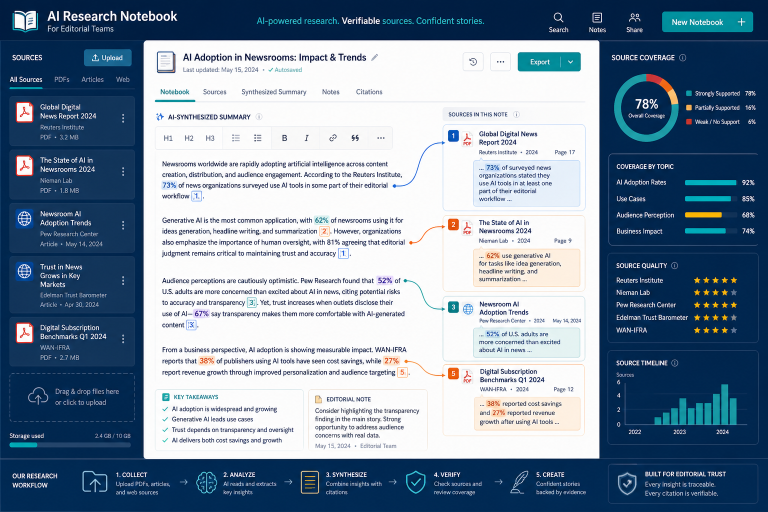
The recent release of workspaces like Odysseus shows where the industry is heading: the agent doesn’t just execute instructions but remembers context—who you are, what you value in a text, what errors annoy you. One tester noted that the system quickly identified him as an editor and started making notes: “values scientific accuracy in technical texts” and “has strong technical preferences.” This is the next level after Custom GPTs and Gemini Gems—personas with memory.
For editorial teams, this means instead of explaining to the model what “our style” is every time, you configure a persona once—and it works as an invisible editor, filtering output according to your standards.
How an AI persona differs from a standard prompt
A standard prompt is a one-off instruction: “write an article about X in the style of Y.” It lives for exactly one session. A persona is a persistent configuration that includes:
- Role model — who is writing: technical editor, copywriter, fact-checker, SEO specialist.
- Style constraints — tone, sentence structure, bans on clichés, formatting requirements.
- Context anchors — information about the brand, target audience, rubricator.
- Behavioral rules — what to do when data is missing, how to handle controversial claims, when to add disclaimers.
- Preference memory — accumulated notes on what the editor has approved or rejected previously.
The difference is critical when scaling. When a content team of five editors publishes 30 articles a week, one-off prompts lead to stylistic inconsistency. Personas ensure a unified output standard—like templates in a CMS, but for generation.
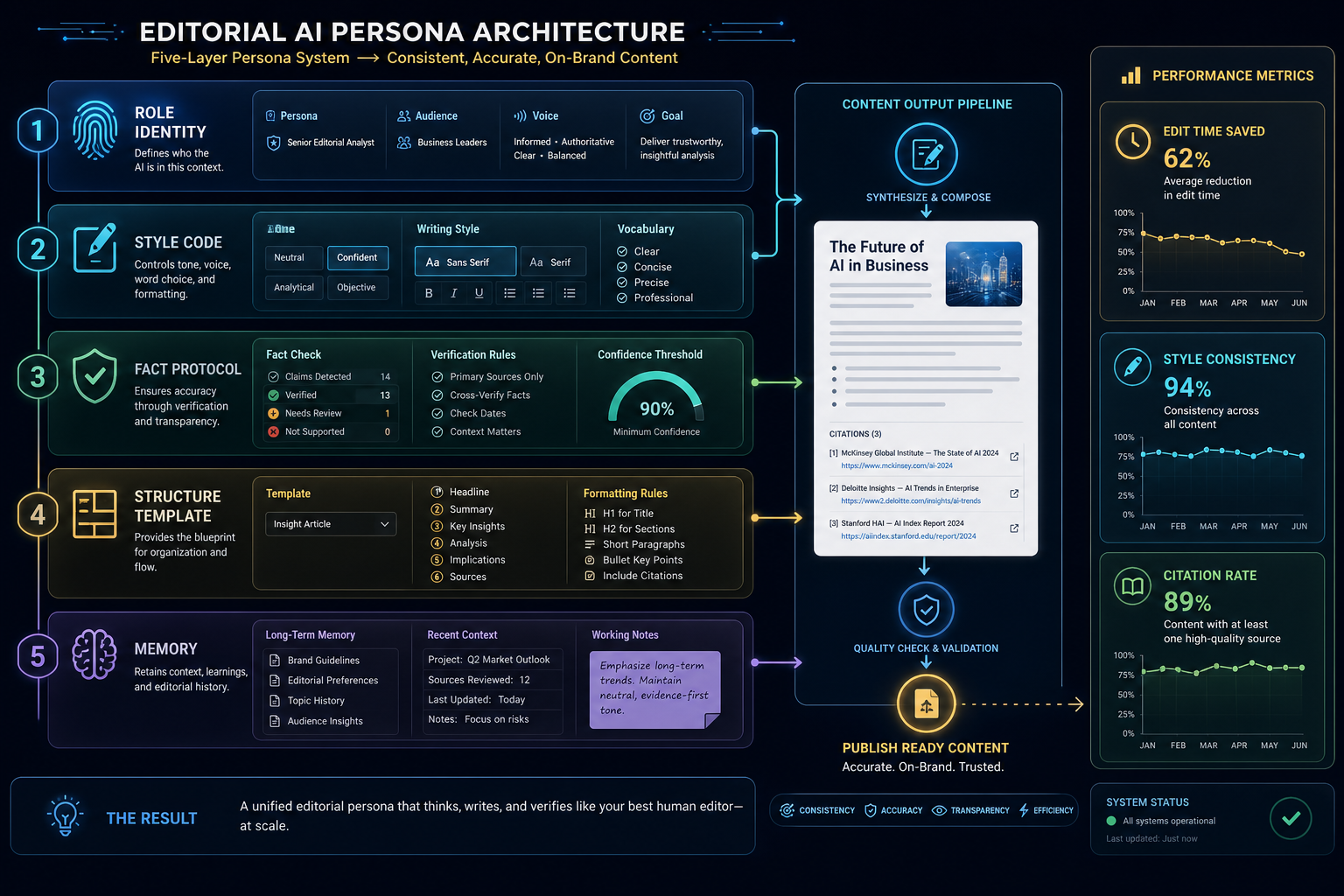
The architecture of an editorial AI persona: five layers
For a persona to work as a true editorial tool, it must be built layer by layer. Each layer is responsible for a specific aspect of content quality.
Layer 1: Role identity
Defines on whose behalf the model generates text. Not “you are a professional writer”—that’s too broad. Be specific: “you are a senior editor of the B2B technology section with 10 years of experience in investigative journalism.” The more precise the role frame, the fewer banalities in the output.
Layer 2: Style code
This is where specific bans and prescriptions live. Not “write vividly,” but:
- Sentences no longer than 25 words in 80% of cases.
- Ban on introductory phrases like “it should be noted,” “it is necessary to emphasize.”
- At least one practical example for every 300 words.
- H2 headings — in the imperative mood.
Layer 3: Fact-checking protocol
Rules for handling data and claims. What should the model do if it is unsure of a fact? Should it add links to sources? How should it flag controversial claims? This layer is critical for content that gets cited by AI answer engines—Perplexity, ChatGPT Search, Google AI Overviews.
Layer 4: Structural template
The expected output structure: introduction with a direct answer, 8–12 sections, a checklist, FAQ. The persona should know not only what to write but also how to organize the material.
Layer 5: Memory and adaptation
The newest layer, currently available only in advanced workspaces. The agent accumulates notes on preferences: which phrasing the editor corrects most often, which structures they reject, which sources they consider authoritative. Over time, the persona becomes more accurate—but this layer requires control so the model doesn’t retrain on erroneous edits.
Practical scenarios: where personas deliver maximum impact
Scenario 1: Mass localization of long-form content
The editorial team publishes in five languages. Instead of explaining the nuances of each local market to the model every time, you create five personas—one per language. Each persona knows: for the German market, formality and accuracy of technical terms are important; for Spanish, a more direct, conversational tone; for Japanese, contextual politeness and structure with explicit transitions.
The persona eliminates typical localization errors: literal translation of idioms, ignoring cultural context, losing SEO semantics during translation.
Scenario 2: Editing at scale
A team of three editors processes 50 drafts a week. Instead of manually proofreading every text, the editor runs the draft through a “stylistic editor” persona—it removes passive voice, cuts wordiness, and checks compliance with the style code. The editor focuses on meaning, facts, and structure, rather than the mechanics of the text.
An Odysseus tester described exactly this case: he set up a persona to find spelling and grammatical errors and remove passive voice from article drafts.
Scenario 3: Content for AI answer engines
The persona can be configured to optimize for citability in Perplexity, ChatGPT Search, and Google AI Overviews. Rules: clear definitions in the first paragraphs, structured lists, facts with sources, direct answers to likely questions. This isn’t classic SEO—it’s optimization for how models extract and formulate answers.
Scenario 4: Multi-format adaptation
The same facts are needed in three formats: a long article, an email newsletter, a LinkedIn post. Instead of three separate prompts, you create three personas with a shared fact-checking layer but different style codes and structural templates. The facts are synchronized, the formats are different.
How to create your first persona: a step-by-step process
Step 1. Deconstruct benchmark content. Take 5–10 of your editorial team’s best articles. Identify common patterns: paragraph length, frequency of examples, types of headings, tone. This will form the basis of your style code.
Step 2. Formulate the role identity. Describe not an abstract “writer,” but a specific professional with experience, knowledge, and limitations. Include what this specialist knows and doesn’t know.
Step 3. Compile a list of bans. List specific words, constructions, and patterns that are unacceptable. Not “avoid clichés,” but an exact list: “in this context,” “it is worth noting,” “it is important to understand,” “in the modern world.”
Step 4. Configure the fact-checking protocol. Define: the model must flag controversial claims with a [NEEDS VERIFICATION] tag; when data is missing, it should write “data unavailable” rather than inventing it; for every numerical claim, it must cite a source.
Step 5. Test on benchmark cases. Run 3 topics you have already published through the persona. Compare the output with the published version. If the persona systematically loses, refine the corresponding layer.
Step 6. Document and version. Every persona must have a version, update date, and changelog. When you change a rule, record why and what result is expected.
Risks and limitations of personas with memory
Agent memory is a double-edged sword. A model that remembers an editor’s edits can overfit to one person’s individual preferences and start imposing them on the whole team. If one editor systematically cuts introductions, the agent might start trimming intros for everyone—even when it’s inappropriate.
The second risk is style drift. As notes accumulate, the persona can gradually deviate from the original style code. The solution: periodic audits of the agent’s memory and resetting accumulated notes when drift is detected.
The third risk is the illusion of control. A persona creates the feeling that the output is manageable, but an LLM remains a probabilistic system. The same persona with the same input can yield different results. Fact-checking and editorial control aren’t canceled—they shift focus from mechanics to meaning.
Comparison of tools for editorial personas
| Tool | Personas | Memory | Versioning | Best for |
|---|---|---|---|---|
| Custom GPT (OpenAI) | Yes | Limited | No | Small teams |
| Gemini Gems | Yes | No | No | Quick presets |
| Claude Projects | Yes | Context window | No | Long-form content |
| Odysseus (self-hosted) | Yes | Yes, with notes | Partial | Technical editorial teams |
| Custom pipeline (API + prompt manager) | Full control | Configurable | Yes | Mature content operations |
For teams just starting out, Custom GPT or Claude Projects are sufficient. For editorial teams producing 50+ pieces of content a month, it’s worth investing in a custom pipeline with prompt versioning and managed memory.
Integrating personas into the editorial pipeline
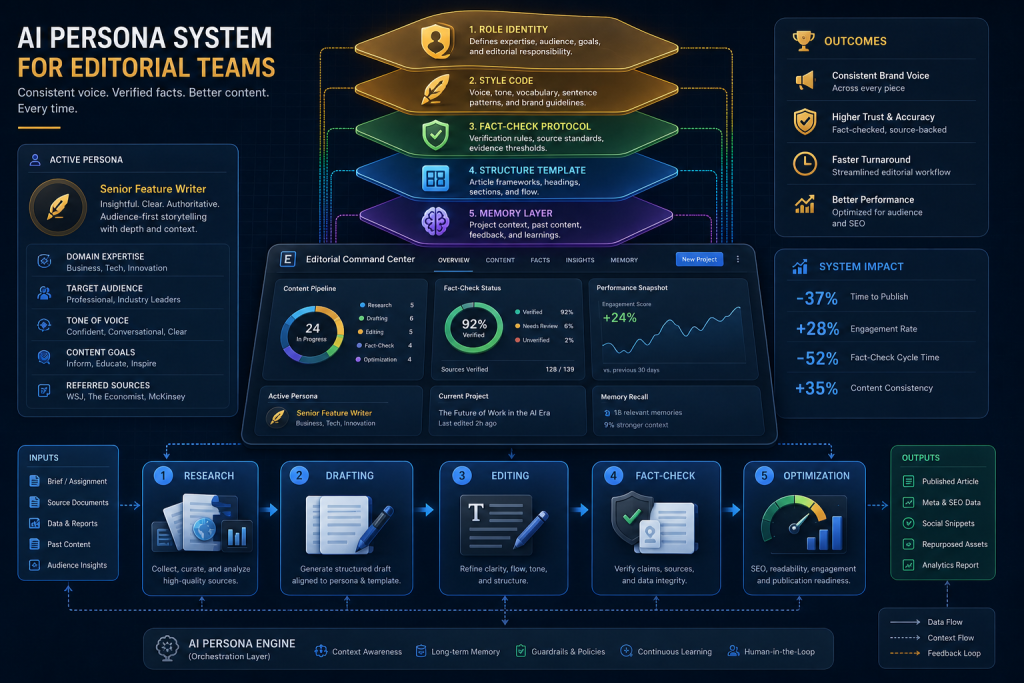
A persona is not a standalone tool, but part of a pipeline. Here is how it fits into a typical long-form content production cycle:
- Planning. The researcher persona gathers facts, checks topic relevance, and forms a thesis outline.
- Drafting. The writer persona generates the first draft according to the structural template.
- Editing. The stylist persona proofreads the draft, removes passive voice, and checks the style code.
- Fact-checking. The fact-checker persona flags controversial claims and searches for supporting sources.
- Optimization. The SEO specialist persona checks semantics, heading structure, and readability.
- Final edit. A human editor checks meaning, accuracy, and brand alignment.
At each stage, there is a specific persona—or one persona with switchable modes. The key principle: humans aren’t removed from the cycle, but moved to the stages where their skills are indispensable.
Measuring the effectiveness of personas
To justify investments in a persona system, track these metrics:
- Share of edits at the styling stage — should decrease as the style code is configured.
- Time from draft to publication — target reduction of 20–40%.
- Tone consistency — score on a brand voice alignment scale across a sample of 20 articles.
- Frequency of factual errors — should decrease with the implementation of the fact-checking protocol.
- Citability in AI answer engines — track how many of your articles appear as sources in Perplexity and ChatGPT Search.
Checklist: Launching your first AI persona for an editorial team
- Deconstructed 5–10 benchmark articles, extracted style patterns
- Formulated role identity with specific experience and limitations
- Compiled a list of 15–20 banned words and constructions
- Configured fact-checking protocol: flags for controversial claims, source requirements
- Tested persona on 3 benchmark topics, compared results with published versions
- Set up versioning: version, date, changelog of changes
- Defined efficiency metrics and recorded baseline values
The future: from personas to agentic editorial systems
The current generation of personas consists of static configurations with rudimentary memory. The next step, already emerging in tools like Odysseus, is agents that don’t just remember but actively learn. The agent notices that the editor always adds a “risks” section to articles about financial products, and starts suggesting this section automatically. The agent sees that the last three articles were rejected due to a lack of sources, and strengthens the fact-checking protocol.
This creates new management challenges. Who is responsible for the agent’s “learned” behavior—the developer or the editor-in-chief? How do you prevent the accumulation of systemic biases? How do you ensure transparency—so the editor understands why the agent is suggesting this specific edit?
The answers to these questions are still forming. But the direction is clear: editorial AI systems are moving from generation tools to content co-management tools. Personas are the first step on this path.
FAQ
How does an AI persona differ from a Custom GPT?
A Custom GPT is an implementation of the persona concept within the OpenAI ecosystem. An AI persona is a broader concept, encompassing any saved system prompt with a role model, style rules, and context. A persona can exist in any tool: Claude Projects, Gemini Gems, or a custom pipeline via API.
Does a small editorial team need agent memory?
For teams of up to 3 people and up to 20 articles a month, agent memory is overkill. A static persona with a well-configured style code is sufficient. Memory becomes useful when scaling: when different editors work with the same persona and you need to ensure consistency in their edits.
How often should you update a persona?
An audit every 4–6 weeks is recommended. Check: has style drift accumulated, have style rules become outdated, have new clichés appeared in the model’s output. When changing a brand guide or editorial policy, update immediately with a new version.
Can one persona replace an editor?
No. A persona automates mechanics—stylistics, structure, formatting. The editor remains indispensable for evaluating meaning, factual accuracy, brand alignment, and making editorial decisions. A persona reduces time spent on routine but doesn’t replace editorial judgment.
How do you measure the ROI of implementing personas?
Compare the time from draft to publication and the number of stylistic edits before and after implementation. The target time reduction is 20–40%. Additionally, track tone consistency and the frequency of factual errors. If at least two out of three metrics improve, the implementation is justified.