Generative AI accelerates content creation, but it also creates new legal risks for editorial teams. Models are trained on copyrighted texts and sometimes reproduce fragments almost verbatim. If such text ends up on your site, the responsibility lies not with the AI tool developer, but with you—the publisher or content team that published the material. Lawsuits against end users of AI tools are already a reality, and the legal landscape continues to evolve.
The solution is not to abandon AI, but to build processes: clear usage policies, checking every public text for originality, documenting the content creation chain, and understanding the indemnification conditions from tool providers. Below is a practical guide on how to organize this work in an editorial team.
Why AI Content Creates Legal Risks
Generative models don’t create text from scratch—they predict word sequences based on training data. If the training set included copyrighted articles, books, or research, the model might reproduce their fragments in response to a prompt. This doesn’t necessarily happen every time, but the risk of unintentional borrowing exists.
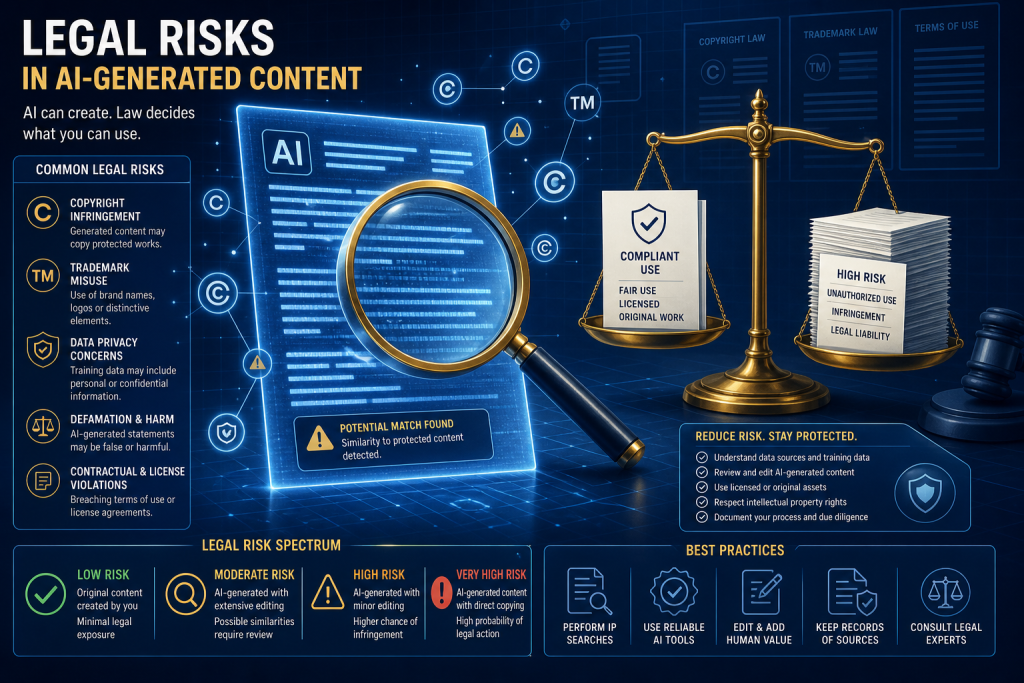
Key risks for content teams:
- Copyright infringement. AI might output text very similar to an existing work. If you publish it without checking, you become the infringer.
- Trademark infringement. Using protected names, slogans, or branding elements in content without permission can lead to claims.
- Fact distortion and defamation. AI can generate inaccurate statements about people or companies. If such statements are published, it can be grounds for a defamation lawsuit.
- Lack of copyright protection. In some jurisdictions, content created solely by AI without significant human creative input may not be protected by copyright. This means competitors can freely copy such materials.
Responsibility for published content always lies with the publisher, not the AI tool. Even if the tool provider offers indemnification, its conditions are often limited and require compliance with specific procedures.
How AI Providers Share Responsibility: Indemnification
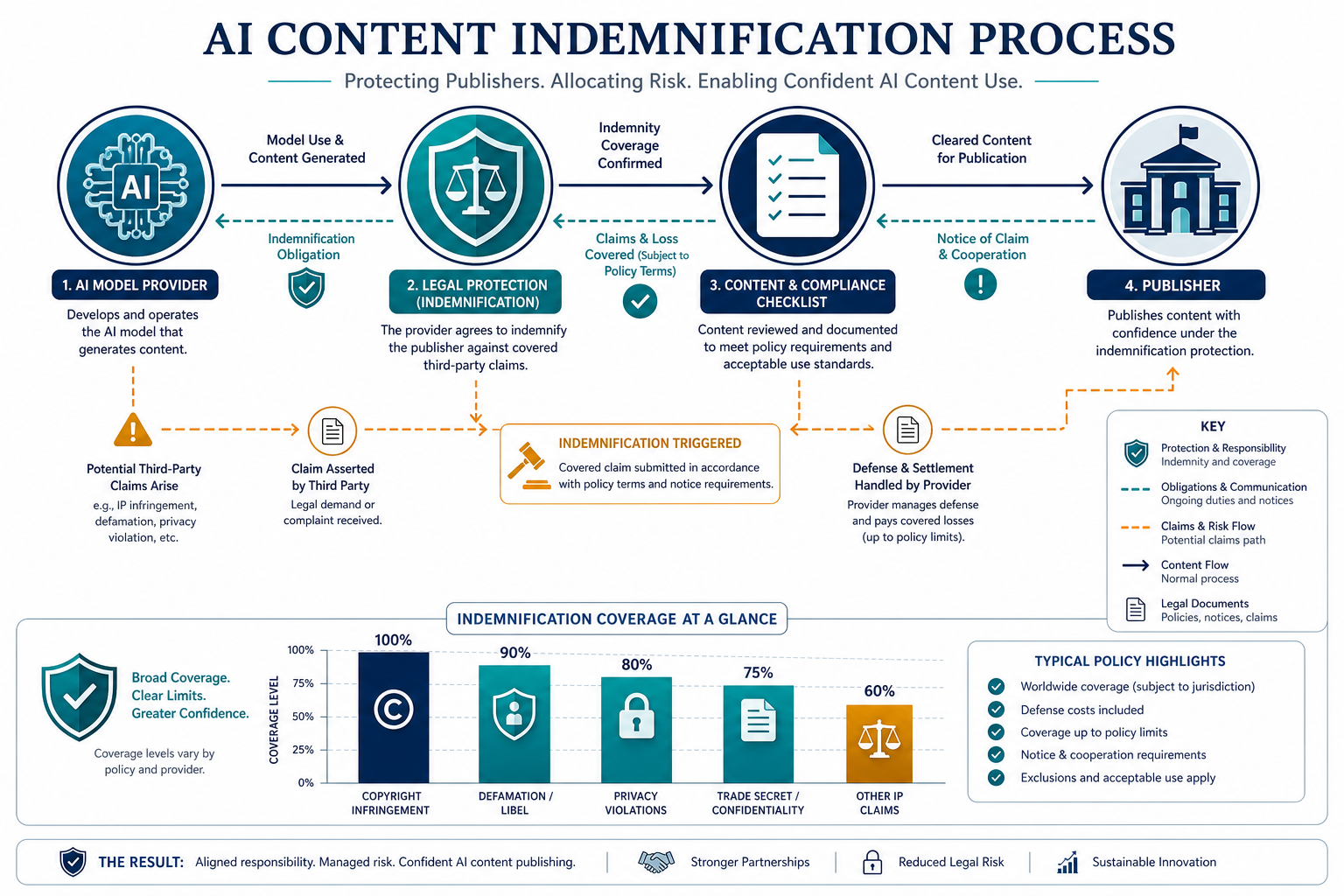
Major AI tool providers—OpenAI, Google, Microsoft, Anthropic—offer indemnification programs that protect clients from copyright claims related to training data. But conditions vary significantly.
What Indemnification Covers
Indemnification typically covers third-party claims that the model’s output infringes their copyright. To get protection, the client must:
- Use only approved model features (e.g., commercial API versions, not research ones).
- Not use prompts that directly encourage copying someone else’s content.
- Comply with the provider’s technical requirements (e.g., not disabling safety filters).
- Publish content without substantial modification that violates the terms of use.
What Indemnification Does NOT Cover
- Claims related to trademarks.
- Defamation or fact distortion lawsuits.
- Situations where you used a prompt directly instructing the model to copy someone’s style or text.
- Use of free or research versions of tools.
For editorial teams, this means: indemnification is an insurance policy with many exceptions. It does not replace internal verification and control processes.
AI Usage Policy in the Editorial Team: What to Include
An AI usage policy is an internal document defining how, when, and who can use AI tools in the editorial workflow. It protects the team from unintentional violations and creates a foundation for unified processes.
Key Policy Sections
- Purpose and scope. Which types of content the policy applies to (articles, blogs, knowledge bases, marketing materials).
- Approved tools. A list of approved AI tools and versions. A ban on using free or unverified models for public content.
- Roles and responsibilities. Who is responsible for generation, who for verification, who for publication. Separating roles reduces the risk of missing errors.
- Prompting rules. A ban on prompts encouraging copying someone’s style, imitating specific authors, or reproducing protected works.
- Verification procedure. A mandatory stage of originality checking and fact-checking before publication.
- Documentation. Requirement to save prompts, model versions, and edit history for every published material.
- Training. Regular training of the team on the legal aspects of working with AI.
A policy is not a formality. In case of a claim, it proves that the editorial team acted in good faith and took reasonable measures to prevent violations.
Content Creation Chain: How to Document the Process
Documenting the content creation chain is your main argument in case of a claim. If you can show how the text was created, what prompts were used, and who checked it, you significantly simplify your defense.
What to Record for Each Article
- Initial prompt. The exact text of the request to the AI model, including system instructions and context.
- Model version. The name and version of the AI tool (e.g., GPT-4 Turbo, Claude 3.5 Sonnet, Gemini 1.5 Pro).
-. Date and time of generation. When the draft was created. - Edits made. What changes the editor, fact-checker, and proofreader made. If a version control system (Git, Google Docs Version History) is used, save the edit history.
- Originality check result. Report from a plagiarism checker (Copyleaks, Originality.ai, Turnitin) indicating the percentage of matches and sources.
- Fact-checking result. Confirmation of key facts with links to primary sources.
How to Automate Documentation
Manually recording every step is labor-intensive. Use tools that automate the process:
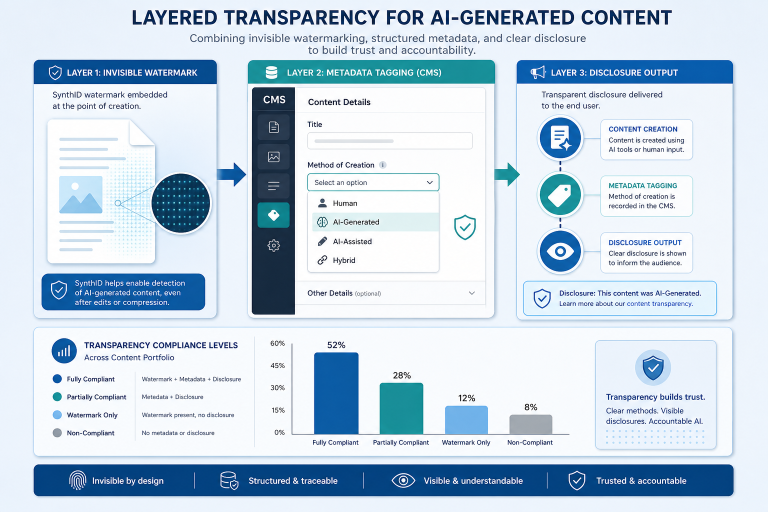
- Content Management Systems (CMS) with AI metadata support. Save prompts and model versions in custom fields of the article.
- Integration with verification tools. Connect plagiarism and AI content detectors via API so reports are saved automatically.
- Prompt templates. Use a library of approved prompts that have been tested for safety and comply with the policy.
Originality and Plagiarism Checking: Tools and Thresholds
Originality checking is a mandatory stage before publishing any AI-generated content. Even if the prompt did not contain copying instructions, the model might unintentionally reproduce protected text.
Verification Tools
- Copyleaks. Detects AI-generated text and plagiarism, supports multiple languages. Integrates with LMS and CMS.
- Originality.ai. Specializes in AI content and plagiarism detection. Suitable for pre-publication checks.
- Turnitin. An academic standard, but also applicable in editorial work for deep borrowing analysis.
- Grammarly Premium. Built-in plagiarism checking as part of comprehensive editing.
Thresholds and Actions
Set clear thresholds for the team:
- 0–10% matches. Text is original. Publication is allowed after fact-checking.
- 10–25% matches. Manual review required. The editor analyzes matched fragments and rewrites them if necessary.
- Over 25% matches. The text is sent back for regeneration with a modified prompt or rewritten manually.
These thresholds are a starting point. For legally sensitive topics (finance, medicine, law), thresholds should be stricter.
Fact-Checking AI Content: Why It’s a Legal Issue
Fact-checking is not just a matter of quality, but of legal defense. AI models are prone to hallucinations—generating plausible but false statements. If such a statement about a person or company is published, it can be grounds for a defamation lawsuit.
What to Check Mandatorily
- Names and titles. AI often confuses names, positions, and historical roles.
- Quotes. AI can generate fictitious quotes. Every quote must be verified against the primary source.
- Statistics and data. Numbers, percentages, dates must be confirmed by an authoritative source.
- Legal statements. If the article contains legal advice or descriptions of laws, they must be checked by a specialist.
How to Organize Fact-Checking in the Editorial Team
- Assign the fact-checker role. This can be a dedicated person or a function shared by the editor.
- Use verifiable sources. Primary sources: official documents, press releases, academic research, reputable media.
- Record sources. For every key fact in the article, a primary source must be specified in an internal document or the article’s metadata.
Compliance Check Before Publication
A compliance check is the final stage before publication. It combines the results of all previous steps and confirms that the content is ready for publication.
Compliance Check Checklist
Checklist: AI Content Compliance Check Before Publication
- Approved prompt from the editorial library used and recorded
- AI model version and generation date saved in article metadata
- Originality check passed: less than 10% matches
- All key facts confirmed by primary sources
- Text contains no statements capable of damaging the business reputation of third parties
- Use of trademarks and brands agreed upon or complies with fair use rules
How to Train Your Team to Work Safely with AI
Policies and processes only work when the team understands and applies them. Training is not a one-time event, but an ongoing process.
What to Include in Training
- Copyright basics. What is protected, what isn’t, what is fair use, how indemnification works.
- Prompting rules. How to formulate prompts that don’t encourage copying. For example, instead of “write in the style of author X,” use “use an analytical tone with short sentences.”
- Working with verification tools. How to interpret plagiarism and AI content detector reports, which thresholds to apply.
- Fact-checking. How to check facts, which sources to consider authoritative.
Training Formats
- Short internal workshops. 30–45 minutes once a quarter to discuss cases and update the policy.
–Written guides. Brief memos on key rules, available in the editorial knowledge base. - Retrospectives. Review of errors that were prevented or, conversely, missed.
Practice: How to Build a Process from Prompt to Publication
Theory works when it’s integrated into the daily process. Here is what an editorial workflow using AI might look like:
- Planning. The editor defines the topic and angle. Creates or selects an approved prompt from the library.
- Generation. The author uses the approved AI tool, records the prompt and model version.
- Editing. The editor works with the draft: improves structure, adds expertise, removes clichés.
- Fact-checking. The fact-checker verifies all key facts, records primary sources.
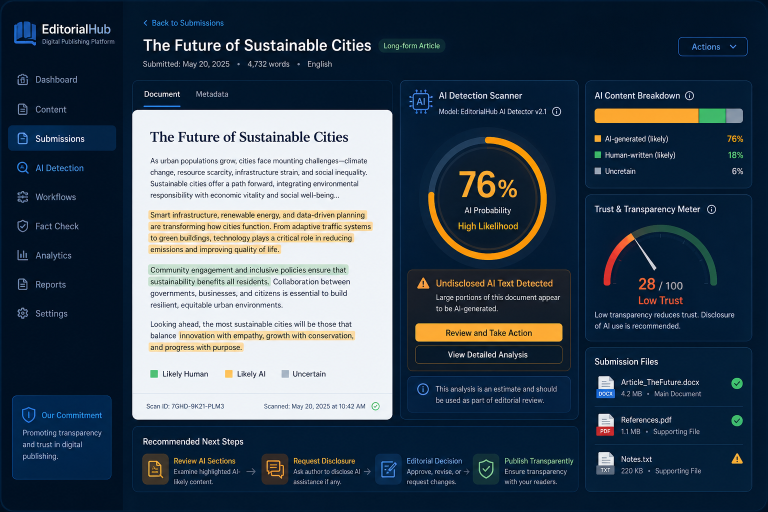
- Originality check. The text goes through a plagiarism and AI content detector.
- Compliance check. The responsible employee goes through the compliance checklist.
- Publication. The article is published with saved metadata about the creation process.
Such a process doesn’t slow down the work, but makes it predictable. Every participant knows their role and area of responsibility.
FAQ
Who is responsible for copyright infringement when using an AI tool: the developer or the user?
In most cases, the user is responsible—that is, the publisher or content team that published the material. AI tool providers offer indemnification programs, but they cover only a narrow range of situations and require compliance with several conditions. The editorial team must rely on its own verification and control processes, not on the provider’s indemnification.
Is it enough to just check AI content for plagiarism before publishing?
No, a plagiarism check is not enough. It reveals matches with existing texts, but does not protect against fact distortion, defamation, or trademark infringement. A full compliance check includes fact-checking, originality verification, trademark use control, and documentation of the creation process.
Do we need to disclose the use of AI in published content?
There is currently no direct requirement to disclose AI use in content in most jurisdictions. However, many publishers voluntarily indicate AI use for transparency with readers. Internal documentation (prompts, model versions, edit history) is mandatory regardless of external disclosure.
Which prompts are considered legally risky?
Prompts that directly instruct the model to copy someone’s style, imitate a specific author, or reproduce a protected work are considered risky. For example, “write in the style of Stephen King” or “copy the article structure from Forbes.” Safe prompts describe the desired tone, structure, and format without referencing specific protected works.
What should I do if the plagiarism detector shows a match of over 25%?
The text is sent back for regeneration with a modified prompt or rewritten manually. Publishing content with a high match percentage creates a legal risk of copyright infringement. For legally sensitive topics (finance, medicine, law), the threshold should be lowered to 10–15%.