In Brief: What Happened and Why It Matters for Content Teams
In late July 2026, LinkedIn made an unexpected decision: the platform removed the “enhance your post” feature—a tool that allowed users to generate and “improve” posts with AI—and replaced it with a proofreading function. This is not a cosmetic change. It is a public signal from one of the largest social publishing platforms that the “AI as author” model doesn’t work in the feed.
For editorial boards, content teams, and publishers, this step is not just news about another platform, but an indicator of an industry shift. When a platform with billions of users deliberately rolls back a generative feature and replaces it with an editorial one, it means that the quality of AI generation in mass application fell below the threshold where it improves the user experience. AI-slop—low-quality, generic, indistinguishable AI content—began destroying the feed’s value, and the platform chose editing over generation.
In this article, we’ll break down why post generation failed at the platform level, what the shift from AI-as-writer to AI-as-editor means, and how content teams can restructure their workflows so that AI enhances the editorial process rather than replacing it.
What Exactly LinkedIn Did
LinkedIn replaced the “enhance your post” feature—which allowed users to generate post text or “improve” a draft with AI—with a proofreading tool. Essentially, the platform moved from a “write it for me” model to a “check and fix my text” model.
This decision is notable for several reasons. First, LinkedIn was one of the platforms most aggressively integrating AI generation into the feed. The “enhance your post” feature existed specifically to lower the barrier to content creation—a user writes a draft, and AI turns it into a “finished” post. Second, the decision comes amid data showing that a significant share of long posts on the platform are already AI-generated—according to Pangram, this figure reached 41% for long posts.
Third, and most importantly, LinkedIn didn’t just remove the feature; it replaced it with something qualitatively different. Proofreading is not generating new text, but checking existing text: grammar, style, clarity, structure. AI acts as an editor-corrector, not as an author. The user remains the author; AI helps improve what has already been written by a human.
Why “Enhance Your Post” Failed
The “enhance your post” feature was a logical product from the perspective of the “amount of content created” metric. The lower the barrier, the more posts. But platforms don’t thrive on volume alone—they thrive on engagement and retention. And here, AI generation created a problem the industry has already dubbed: AI-slop.
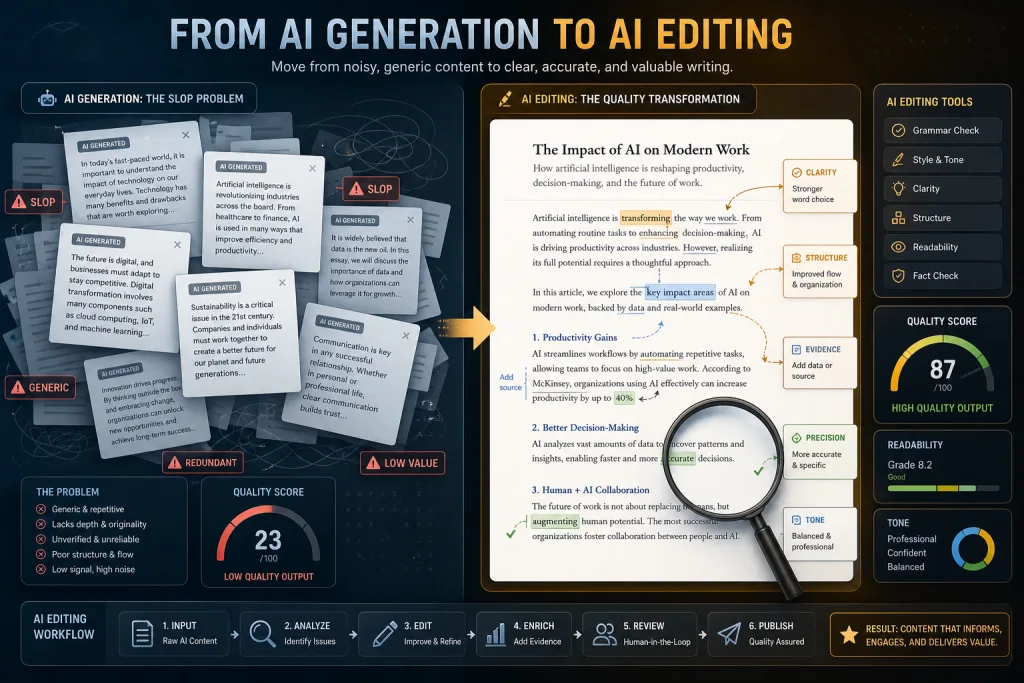
AI-slop is low-quality, generic, indistinguishable content mass-produced by AI tools. The problem isn’t that it’s “bad” in an absolute sense—an individual AI post can be quite readable. The problem is that when thousands of users apply the same type of generation, the feed fills up with monotonous texts with identical structures, identical transitions, and identical conclusions. The platform loses its informational value.
For LinkedIn, this is especially critical because the platform positions itself as a space for professional content. When the feed fills up with AI-generated “insights” of uniform quality, users stop trusting the content—and this hits the core metric: time spent on the platform and return frequency.
LinkedIn’s decision to replace generation with proofreading is, essentially, an admission: AI works better as a tool to improve human text than as a replacement for human authorship.
The Shift from AI-as-Writer to AI-as-Editor: What It Means
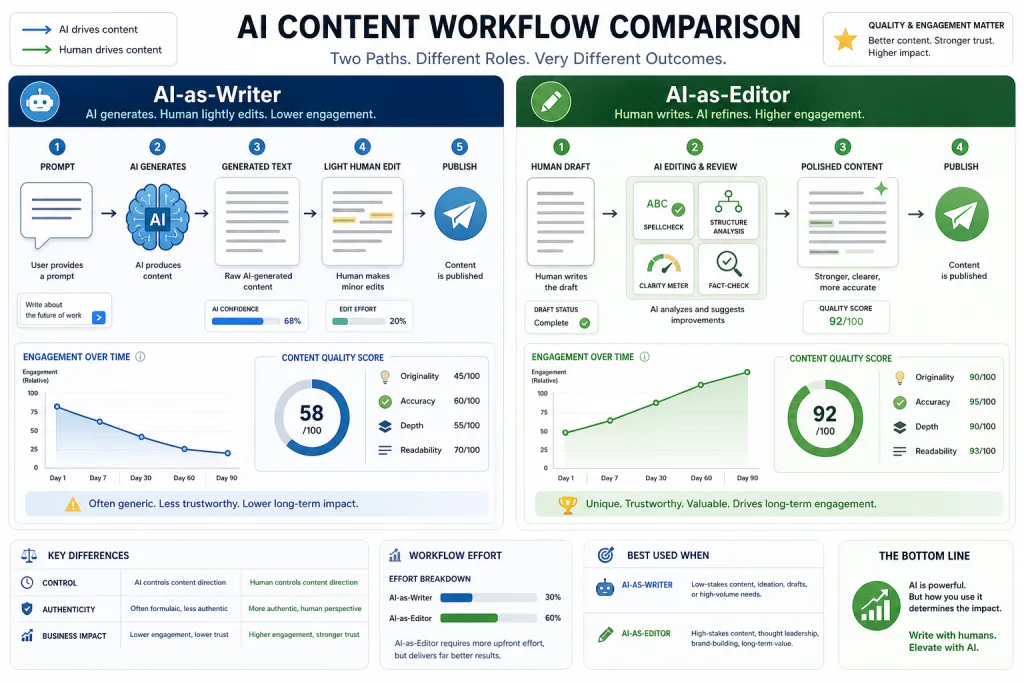
The “AI as writer” (AI-as-writer) model assumes that AI generates the main text—a draft, a post, an article—and the human merely edits or approves it. This is the model many content teams tried to implement in 2024–2025: prompt → generation → light editing → publication.
The “AI as editor” (AI-as-editor) model reverses the sequence. The human writes the draft—or at least a structural framework with key points, data, and examples. AI is used for proofreading, checking clarity, optimizing structure, identifying gaps, fact-checking, and adapting to the format. AI doesn’t create the content—it improves the form.
The difference seems subtle, but it is fundamental to quality. In the AI-as-writer model, the content often averages out: the model pulls toward the most probable phrasing, and the result is competent but impersonal text. In the AI-as-editor model, the content remains human—with unique experience, specific data, and an authorial angle—while AI works on the quality of expression.
By replacing generation with proofreading, LinkedIn effectively chose the second model at the platform level. And this is a signal that content teams should take seriously.
AI-Slop as a Platform Economic Problem
The AI-slop problem is not just an aesthetic issue. For platforms, it is an economic problem. When the feed fills up with generic AI content, engagement drops. Users comment less, share less, and return less often. Ad revenues are tied to attention—and attention to AI-slop fades quickly.
LinkedIn is not the only platform facing this. Pinterest, as noted in the same reports, introduced generative AI tools and simultaneously AI detection—and faced a 20% drop in its stock. Omnicom launched “Brave Bot”—an agent that evaluates whether an AI-generated creative is “truly unique, innovative, and culturally relevant, or just another noise.”
The pattern is the same: platforms and ad holdings realize that AI generation without editorial control destroys value. And they respond not by banning AI, but by shifting to quality control—detection, proofreading, originality assessment.
For content teams, the conclusion is direct: platforms will increasingly reward content that is human-created and AI-improved, and increasingly penalize content that is AI-generated and only formally “checked” by a human.
How to Restructure Your Workflow: From Generation to AI-Assisted Editing
Restructuring the workflow from the AI-as-writer model to AI-as-editor requires changes at several levels: prompt systems, team roles, and quality control checkpoints.
1. Human Writes First
Instead of a prompt “write an article about X,” a human creates a draft. This might not be a full text, but a structural framework: key points, data, examples, conclusions. The main thing is that the content and angle remain human. AI doesn’t invent what to write about; it improves what is already written.
2. AI Prompts for Editing, Not Generation
Instead of generator prompts, use editor prompts. Examples:
- “Check this text for clarity and suggest structural improvements without changing the content”
- “Find logical gaps and unsupported claims in this draft”
- “Check the alignment between the headline and the article’s conclusions”
- “Suggest 3 ways to improve the opening paragraph for a better hook”
- “Highlight points that are not supported by data or examples”
These prompts don’t ask AI to create content—they ask it to evaluate and improve existing content.
3. Separate Generation and Editing in the Pipeline
If AI generates a draft in your content pipeline and a human edits it, formally separate these stages. Generation should happen from a structured brief with specific data, points, and an angle, not from a “write about X” prompt. Editing should include an originality check, fact-checking, and a differentiation assessment—how much this text differs from what any model would generate on the same topic.
4. Proofreading Layer as a Separate Stage
Add a separate AI proofreading stage to your workflow before publication. This isn’t the final human check—it’s an intermediate layer where AI checks grammar, style, readability, tone of voice compliance, sentence length, and SEO parameters. The human then validates the AI’s edits and decides which ones to accept.
Where AI Editing Works Better Than Generation
Experience from platforms and content teams shows that AI is more effective as an editor in several specific areas:
- Structural correction. AI is good at identifying weak transitions, disproportionate sections, and missing conclusions. The prompt “evaluate the structure of this text and suggest a redistribution of emphasis” works more reliably than “write an article.”
- Clarity and readability. Checking sentence length, vocabulary complexity, and information density is a task where AI proofreading systematically outperforms manual checking in speed.
- Identifying unsupported claims. AI can flag points that aren’t backed by data or examples—this is especially valuable for long-form editorial content.
- Format adaptation. Turning a long article into a series of short posts, adapting it for LinkedIn, creating a summary for a newsletter—AI acts as a repackager, not a creator.
- SEO and AEO checks. Checking for key entities, heading structure, and completeness of the answer to a query—an AI editor can assess content readiness for search and answer visibility.
Quality Metrics for AI Editing
When moving from generation to editing, the metrics you should track also change:
- Retained human content share. What percentage of the original draft (by points, data, examples) remains in the final version. If AI editing changes more than 50% of the content, it’s generation, not editing.
- Final text originality. Checking via AI detectors and comparing with typical AI output on the same topic. The goal is text that detectors don’t classify as AI-generated.
- Editing vs. generation time. In the AI-as-editor model, human time shifts from writing to editing. If overall time doesn’t decrease, that’s fine; the value is in quality, not speed.
- Platform metrics. For content published on platforms like LinkedIn: engagement, retention, comment quality. If AI-edited content shows better metrics than AI-generated, it validates the model.
- Differentiation. How much the final text differs from the average content on the topic. The metric can be assessed with a prompt: “Compare this text with a typical AI output on the same topic and highlight the unique elements.”
Platform Signals and Distribution Strategy
LinkedIn’s decision is not an isolated case. It is part of a broader trend where platforms are revising their attitude toward AI content. For content teams, this means that distribution strategies must account for platform policies:
- Platforms will enhance detection. Pinterest, LinkedIn, Substack—all are implementing mechanisms to recognize AI content. Content detected as AI-generated may receive less distribution.
- Proofread content will have an advantage. If a platform sees that text is human-written and AI-improved (rather than AI-generated and “checked” by a human), it can serve as a quality signal.
- AI disclosure is becoming the norm. Transparency policies—SynthID, AI content labeling, mandatory disclosure—are no longer optional but a requirement. Content teams need to build a labeling system that distinguishes “AI-generated” from “AI-edited.”
- Dual strategy. For platform content, use the AI-as-editor model (human writes, AI improves). For content on your own site, a more flexible approach is fine, but with the same principle: the content must be human.
Checklist: Transitioning from AI Generation to AI Editing
- Audit your current workflow: identify at which stages AI generates content and at which it edits. Formally separate these functions.
- Rewrite your prompt systems: replace generation prompts (“write an article about…”) with editorial ones (“check structure,” “highlight unsupported claims,” “suggest clarity improvements”).
- Implement a “human writes first” rule: even if AI generates a draft, it should work from a structured brief with data and points, not from a “write about X” prompt.
- Add a proofreading layer: a separate AI proofreading stage before the final human check—grammar, style, readability, SEO parameters.
- Set up metrics: retained human content share, originality via AI detectors, platform engagement, differentiation from typical AI output.
- Check platform policies: ensure content for LinkedIn, Substack, and other platforms complies with their AI disclosure and quality requirements.
- Train your team: editors should understand the difference between AI generation and AI editing and know how to apply the appropriate prompts.
Practical Takeaway
LinkedIn replaced AI generation with proofreading not because AI is useless for writing, but because in mass application, generation without editorial control destroys value. This is a lesson content teams can apply at the workflow level: AI works better as an editor than as an author.
Restructuring doesn’t mean abandoning AI—on the contrary, it’s a more mature use. AI proofreading, structural checks, gap identification, and format adaptation are tasks where AI systematically adds value. Generating content “from scratch” from a prompt is a task where AI systematically produces an averaged result.
Editorial teams that are the first to restructure their workflow from generation to editing will gain a double advantage: content that platforms reward and quality that readers recognize.
FAQ
How does AI editing differ from AI generation in a content workflow?
In AI generation, the model creates the main text—a draft, post, or article—and a human edits it. In AI editing, a human writes the draft or structural framework, and AI checks grammar, style, clarity, structure, identifies gaps, and suggests improvements. The content remains human; AI works on the form.
Why did LinkedIn remove the “enhance your post” feature?
LinkedIn replaced AI post generation with proofreading due to the AI-slop problem—the mass filling of the feed with generic AI content that reduced user engagement and trust. The platform recognized that AI is more effective as a proofreading tool than as a replacement for authorship.
What prompts should be used for AI editing of long-form content?
Use editor prompts: “check the structure and suggest a redistribution of emphasis,” “highlight unsupported claims,” “assess clarity and suggest improvements,” “check the alignment between the headline and conclusions,” “suggest ways to improve the opening.” These prompts don’t ask AI to create content—they ask it to evaluate and improve existing content.
How do you measure quality when transitioning to AI editing?
Track: the retained human content share in the final text, originality via AI detectors, platform engagement (for content on LinkedIn and other platforms), differentiation from typical AI output on the topic, and editing vs. generation time.
Does this mean AI content generation is no longer needed?
No. AI generation is useful for specific tasks: creating structured drafts from briefs with data, repackaging content, summaries, localization. It’s not about banning generation, but about shifting the center of gravity: the content must be human, and AI should enhance the form, not replace the content.