What Is Commodity Content and Why It’s Dead
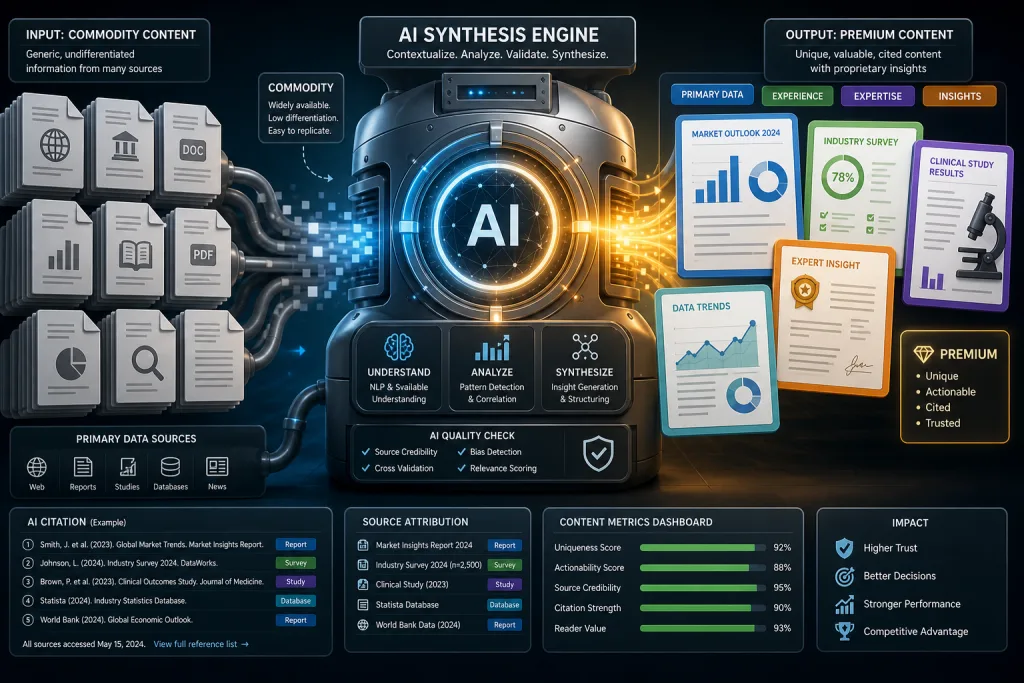
Commodity content is text that restates publicly available facts without adding a unique perspective, primary data, or expert insight. Before the era of generative search, this content worked: an article like “10 Ways to Improve Landing Page Conversions” could rank because search engines evaluated relevance, structure, and keywords. Today, ChatGPT, Perplexity, Gemini, and Google AI Overviews synthesize those same facts in seconds — for free, without users ever visiting your site.
The market logic is simple: if an AI engine can instantly assemble an answer from public sources, your restatement of those sources has zero distribution value. Generative engines don’t cite commodity content — they consume and reprocess it, leaving no attribution. Content teams that continue to produce factual rewrites aren’t competing with each other; they’re competing with free, instant synthesis. That’s a losing battle.
The pivotal shift in 2026: the distribution value of content is determined not by how well it restates the known, but by whether it contains something absent from AI models’ training data. Primary data, original research, expert insights, and unique observations are the only classes of content that AI engines are forced to cite because they cannot generate them independently.
How AI Engines Evaluate Content Citeability
Generative search engines — ChatGPT Search, Perplexity, Google AI Overviews, Gemini — go through three stages of source filtering when forming their answers:
-
Fact extraction. The engine looks for sources from which it can extract specific claims, figures, and definitions. Here, commodity content competes with thousands of identical rewrites.
-
Uniqueness assessment. If multiple sources contain the same information, the engine selects one — usually the most authoritative based on E-E-A-T signals. Ordinary articles lose to major publications even if the quality of the restatement is identical.
-
Primary source citation. Engines prefer to cite the source where the information first appeared — an original study, a primary report, or an expert analysis with unique data.
This means that to earn citations in AI search, editorial teams must produce content that occupies stage 3 — being the primary source, rather than just another rewriter.
Four Types of Content AI Cannot Generate
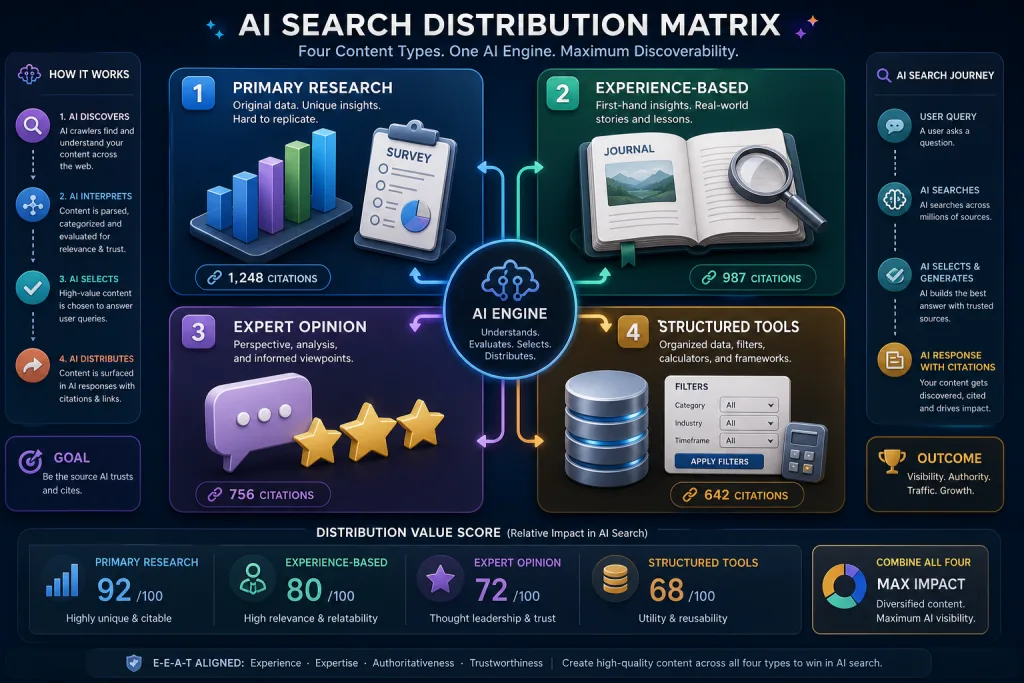
Not all long-form content is equally vulnerable. Four categories retain and grow their distribution value:
1. Primary Data and Original Research
Audience surveys, internal platform data analysis, performance benchmarks, tool tests — anything that creates new information. If your editorial team surveyed 500 content managers about the AI tools they use and published the results, that’s a primary source. AI engines will cite you specifically because that data exists nowhere else.
Example: Instead of an article like “How AI is Changing Content Marketing” (commodity) — a report on “The State of AI in Content Marketing 2026: Data from 500 Editorial Teams” (primary source). The difference in citeability is tenfold.
2. Experience-Based Insights
Content based on a practitioner’s personal experience: a breakdown of a real case study with specific numbers, mistakes and lessons learned from personal execution, and observations impossible to gather without deep immersion in the process. The E-E-A-T “Experience” signal is something Google explicitly highlights as a ranking factor, and what AI engines use to filter out synthetic content.
Example: Instead of “A Guide to Content Localization” (commodity) — “How We Localized 200 Articles into 12 Languages with AI: What Broke, What It Cost, and the Quality Metrics We Introduced.”
3. Expert Assessments and Forecasts
Opinions from recognized experts that take a stance rather than restate consensus. AI models are trained on existing texts and by definition reproduce the median opinion. An original expert perspective is exactly what’s missing from their training data.
Example: Instead of “SEO Trends 2026” (commodity) — “Why Zero-Click Isn’t a Problem But an Opportunity: A Counterargument from an Editor Who Grew via AI Citations.”
4. Structured Data and Tools
Calculators, comparison tables, uniquely structured knowledge bases, and interactive tools. AI engines cite structured resources because they provide concrete answers to specific queries — price, rating, specifications.
Example: Instead of “Comparison of AI Tools for Editorial Teams” (commodity) — an continuously updated database of AI tools with filters for price, features, and integrations.
Transition Framework: From Commodity to Primary Content
The transition requires systemic changes to your editorial process, not just piecemeal tweaks to individual articles. The framework consists of five stages:
Auditing Your Existing Portfolio
Divide all articles into three categories: commodity (restating public facts), hybrid (restatement + elements of originality), and primary (unique data or experience). Use AI for mass classification: a prompt system that evaluates each article based on originality, presence of primary data, and citeability. The result is a portfolio map showing what percentage of your content is vulnerable to absorption by AI engines.
In practice: batch upload the titles and first 500 words of each article, and the prompt system will assign an originality score from 1 to 10. Articles scoring 1–4 are candidates for rewriting or deletion. Articles scoring 5–7 are candidates for enhancement with primary data. Articles scoring 8–10 form the core of your distribution.
Identifying Your Zones of Primary Advantage
Not every editorial team can conduct large-scale research. Identify 2–3 areas where your team has a natural advantage: access to internal platform data, a built-in audience for surveys, or niche expertise. Concentrate your resources on these areas rather than trying to cover every topic.
Example: A blog about DCB payments has access to conversion data across 30+ countries. Its zone of primary advantage is reports on conversion rates and ARPU by geo — something no one else can produce.
Rebuilding the Editorial Calendar
Shift the balance: 60% of resources to primary content (research, case studies, expert breakdowns), 30% to hybrid (restatements with an added original perspective), and 10% to commodity (basic explanations, glossaries — necessary for top-of-funnel, but not the foundation of distribution).
A Primary Data Collection System
Implement repeatable processes: a quarterly audience survey, a monthly internal metrics analysis, regular expert interviews with recording and transcription. Each artifact becomes the foundation for 2–3 primary articles. AI tools (NotebookLM, custom prompt systems) help process raw data: interview transcripts, survey responses, metric logs.
Tagging Primary Content in Metadata
Add content type tags to your CMS: primary_research, experience_based, expert_analysis, commodity. This allows you to track the share of primary content in your portfolio and adjust your strategy. It also helps AI engines: structured metadata increases the likelihood of extraction and citation.
How AI Tools Help Produce Primary Content
The paradox: AI is both the problem (devaluing commodity content) and the solution (accelerating primary content production). Key applications include:
Processing raw data. Transcripts of expert interviews (50+ pages) — AI extracts key insights, groups them by theme, and structures the article. The editor works with a ready-made framework rather than raw text. This cuts the time from interview to publication from 2 weeks to 2 days.
Analyzing survey data. Upload a CSV of respondent answers to an LLM — AI finds correlations, anomalies, and segment differences. Prompt system: “Analyze survey data from 500 content managers. Find three non-obvious insights that contradict conventional wisdom. For each, provide the data, sample size, and statistical significance.”
Fact-checking primary claims. Before publishing a study, use AI to check every numerical claim against external sources. If your number differs from the public one, it’s either a mistake or a unique insight. Both cases require the editor’s attention.
Localizing primary content. Original research is your most valuable export. An AI localization pipeline using glossaries and contextual prompting translates a report into 10+ languages while preserving data accuracy. A localized version of a primary study acts as a separate primary source for every language market.
Risks and Pitfalls During the Transition
The “fake primary” trap. Some editorial teams try to simulate primary data: inventing “surveys” with unrepresentative samples or publishing “case studies” without real numbers. AI engines and users quickly spot these discrepancies. The reputational damage outweighs any short-term citation gains.
The “research paralysis” risk. A team decides every piece must be a groundbreaking study and stops publishing regularly. A drop in publishing frequency reduces the overall volume of signals sent to search engines. Solution: alternate primary content with hybrid pieces to maintain a steady publishing rhythm.
The “single source” problem. If all your primary content relies on one data type (e.g., only surveys), the content becomes predictable. Diversifying primary formats — surveys, internal data, expert interviews, tool tests — creates a more resilient distribution strategy.
Ignoring technical SEO. Even primary content won’t get cited if the page is technically inaccessible to crawlers. Structured data (Schema.org for Dataset, Article, FAQ), proper headings, load speed, and mobile optimization are baseline requirements; without them, primary advantage won’t convert into visibility.
Metrics: How to Measure the Shift to Primary Content
Token burn and the volume of AI-generated articles are irrelevant metrics. To evaluate your transition to primary content, use:
-
Share of primary content in the portfolio — the percentage of articles tagged
primary_researchorexperience_basedout of total volume. Goal: 50%+ within 6 months. -
AI citation rate — the ratio of your content citations in AI engine answers to total brand mentions. Tracked through regular queries in ChatGPT, Perplexity, and Gemini on your core topics.
-
Share of traffic from primary articles — what percentage of organic traffic goes to articles with primary data. Primary content should drive more traffic per unit of volume.
-
Scroll depth and time on page — primary content should show higher engagement than commodity content. If it doesn’t, the primary value isn’t pronounced enough.
-
Number of backlinks to primary materials — other sites link to studies and case studies, not rewrites. Growth in link mass to primary articles is a key indicator you’re on the right track.
In Practice: How to Rebuild One Article from Commodity to Primary
Let’s take a typical commodity piece: “How to Use AI for Content Localization.” The article restates publicly available advice that ChatGPT would spit out for the same query in 3 seconds.
Step 1. Add real data: “We localized 200 articles into 12 languages in 3 months. Here is a table with time, cost, and quality metrics for each language.” This turns a rewrite into a case study.
Step 2. Add mistakes and takeaways: “Japanese and Korean had a 40% error rate with automatic localization. The reason is contextual differences in formality. The solution was a custom glossary with politeness levels.” This is an experience-based insight that doesn’t exist in training data.
Step 3. Add primary measurements: “A comparison of four AI localization tools on the same corpus of 50 articles: BLEU score, editing time, cost per 1,000 words.” This is original research.
Step 4. Structure for extraction: a comparison table with Schema.org Dataset, clear headings featuring key data, and a “Key Takeaways” block with specific numbers.
Result: an article that AI engines are forced to cite because the data and experience exist nowhere else.
Checklist: Transitioning from Commodity to Primary Content
- Conduct an AI audit of your portfolio: classify all articles by originality on a scale of 1 to 10
- Identify 2–3 zones of primary advantage where your team has a natural edge (data, audience, expertise)
- Rebuild your editorial calendar: 60% primary content, 30% hybrid, 10% commodity
- Implement a primary data collection system: quarterly surveys, monthly metrics analysis, regular expert interviews
- Add content type tags to your CMS and track the share of primary materials in your portfolio
- Set up metrics: share of primary content, AI citation rate, share of traffic from primary articles
- Audit technical SEO: Schema.org for research, page speed, mobile optimization
Strategic Takeaway for Editorial Teams
Commodity content won’t disappear overnight — it’s still needed for top-of-funnel, glossaries, and explanatory materials. But it has ceased to be an engine for distribution. Editorial teams that continue to invest the bulk of their resources into restating public facts will gradually lose visibility in AI search, even if their technical SEO is flawless.
The competitive advantage in 2026 isn’t a better AI model for generating text, but a system for producing primary data and experience-based insights. Teams that have built this system earn citations in AI answers, backlinks from other publications, and a loyal audience that comes looking for what they can’t get from ChatGPT.
The transition requires investment in data collection processes, not text generation tools. It’s an organizational shift, not a technological one. And the earlier a team starts, the harder it will be for competitors to catch up — because a repository of primary data only grows over time.
FAQ
What should I do with existing commodity content in my portfolio?
Don’t delete everything blindly. Divide it into three groups: 1) articles with traffic and backlinks — enhance them with primary data and expert inserts; 2) articles without traffic but with potential — rewrite them into an experience-based format; 3) articles without traffic or potential — delete or merge them into topical hubs. Mass deletion without analysis can harm your site’s overall visibility.
How often should we publish primary research?
It depends on your team’s resources. A realistic minimum is one full-fledged study per quarter and 2–3 experience-based case studies per month. The quality of primary data is more important than frequency: one study with a representative sample will generate more citations than ten superficial surveys.
Can AI be used to create primary content?
Yes, but AI is used to process and structure raw data, not to create it. AI helps analyze interview transcripts, find patterns in survey data, format tables, and localize finished research. The primary value lies in the data and experience that are absent from the models’ training sets.
How can I measure if AI search is citing my primary content?
Regularly run targeted queries in ChatGPT, Perplexity, and Gemini on the topics of your research. Track whether your brand and links are being cited. Use AI mention monitoring tools (Profundo, AthenaHQ, Otterly.ai). Compare citation rates before and after your shift to primary content — growth should be visible within 2–3 months.
What if our editorial team doesn’t have access to internal data for research?
Primary content isn’t just internal data. Audience surveys (even with just 100 respondents), expert interviews with practitioners, tool tests with measurable results, and observations from your own practice are all primary sources. Start with what’s available: one audience survey per quarter already creates content your competitors don’t have.