What “Algorithms Don’t Care About Aesthetics” Really Means
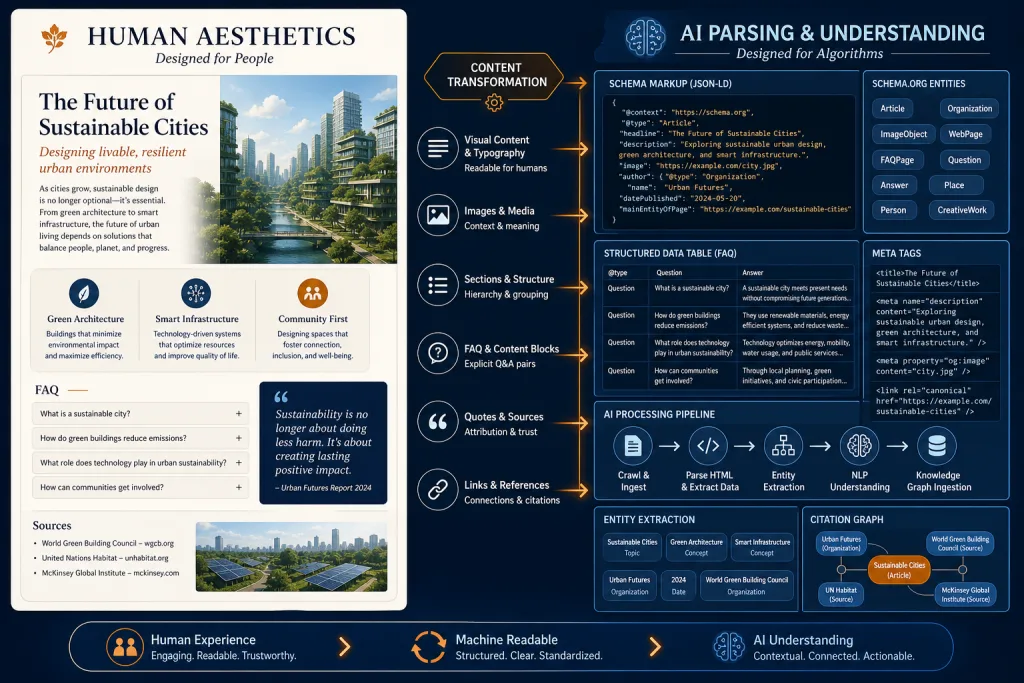
In July 2026, The Drum published a discussion on how AI is reshaping the rules of product and content discovery. The central thesis is provocative but precise: algorithms don’t care about the same things people care about. Humans value aesthetics, design, and emotional resonance. AI engines care about data quality, metadata, completeness, and accuracy of information. If a product is out of stock, a human will click “notify me when available.” An LLM will simply skip you and move on to the next source.
For editorial teams, this signals a fundamental shift. Long-form content — articles, guides, knowledge base materials — now needs to be optimized not only for the human reader but also for the algorithm that decides whether to cite your source. And the criteria that algorithm uses are different from what editors have grown accustomed to over twenty years of SEO.
Why Traditional SEO Optimization Is No Longer Enough
Classic SEO was built around signals that are easy for humans to interpret: headlines, keywords, keyword density, backlinks, and behavioral metrics. AI answer engines — ChatGPT with search, Perplexity, Gemini, Copilot — work differently. They don’t “click” on links. They extract information from content, synthesize an answer, and decide which source to cite.
This shifts the priorities:
- Bot readability matters more than human clickability. Title tags and meta descriptions are still needed, but now the semantic structure within the page — headings, lists, tables, definitions — is critical.
- Data completeness beats emotional appeal. An AI engine will choose the source that lists all product parameters or every step of an instruction, not the one with beautiful storytelling.
- Freshness is a binary filter. An outdated date or a missing update can entirely exclude a source from an AI-generated answer.
- Structured data is the language you speak to the algorithm. Schema.org, JSON-LD, tables with explicit attributes — this is what AI “understands” instantly.
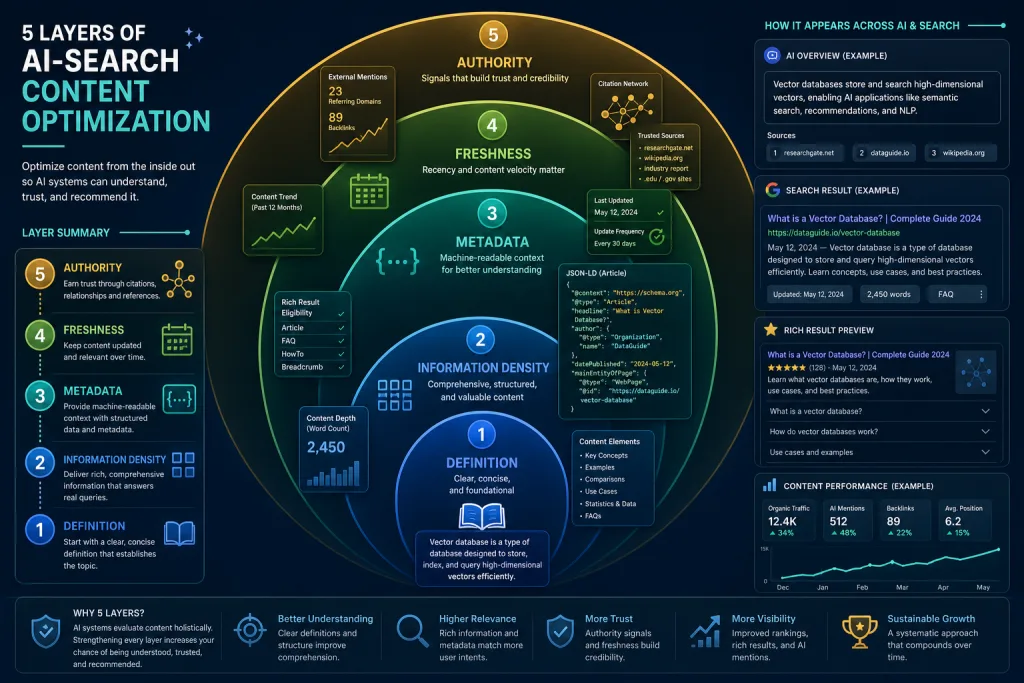
How AI Engines Evaluate Content: Five Key Signals
Understanding exactly what an AI engine looks for allows editorial teams to deliberately restructure their content. Here are five signals that currently determine whether your material makes it into a ChatGPT or Perplexity answer.
1. Structural Clarity
AI engines parse content and extract facts. The clearer the structure, the higher the probability that a specific fragment will be selected as the answer. This means: every section should have a clear heading, every key point should be its own paragraph, and every enumeration should be a bulleted or numbered list. Long, unstructured walls of text that a human might still manage to read are just noise to an AI engine.
2. Information Density
AI engines favor sources where more extractable facts are packed per unit of text. An article that delivers a definition, three characteristics, and an example in a single paragraph is more useful to AI than one where the same information is stretched across three screens with lyrical digressions. This doesn’t mean you should write dryly — it means information blocks should be compact and self-contained.
3. Metadata and Markup
Page title, H1, meta description, image alt text, Schema.org markup — all of these are metadata that an AI engine reads directly. An article without structured data is text without a “label.” AI may find it, but won’t be able to classify it confidently. For editorial teams, this means markup should be part of the content process, not a task handed to an SEO specialist at the final stage.
4. Freshness and Relevance
AI engines prefer fresh sources. If your article is dated 2023 and a competitor’s is dated 2026, the algorithm will most likely choose the competitor. For editorial teams, this means a systematic update process: not a one-off refresh, but a regular cycle of revising existing materials. AI tools can automate the detection of outdated articles — for example, scanning dates, statistics, and links to products that have changed.
5. Authority and Citability
AI engines consider how frequently a source is cited by others. This isn’t classic PageRank, but a similar principle: if other authoritative sources link to your material, the likelihood of being cited in an AI answer increases. For editorial teams, this means PR and outreach strategy is part of content operations, not a separate marketing function.
Practical Restructuring: From a Human Article to a Bot-Readable Article
Restructuring long-form content for AI search doesn’t mean rewriting everything. It means adding a structural layer that makes the content machine-readable. Here are the concrete steps.
Add a Definition Up Front
AI engines frequently generate answers to “what is X” questions. If your article opens with a clear definition in one or two sentences, the probability of being cited rises sharply. Format: “X is a [category] that [key function], used for [application].” This definition should appear in the first or second paragraph, with no preamble or context-setting.
Use Question-Answer Blocks
FAQ sections aren’t just a UX element. They’re the most direct way to land in an AI engine’s answer. Each question should be phrased the way a user would ask it, and the answer should follow immediately in one to three sentences. Avoid long preambles before the answer.
Structure Data in Tables
Tables are the ideal format for AI extraction. Comparisons, specifications, pricing plans, feature lists — anything that can be represented as “attribute — value” should be in a table. AI engines extract tabular data with high accuracy and frequently cite it directly.
Add Schema.org Markup
For articles — Article, for FAQs — FAQPage, for instructions — HowTo, for product reviews — Review. This isn’t a replacement for content; it’s a semantic label for it. Without markup, an AI engine will still find the content, but with markup it will classify it more accurately and faster.
Update Dates and Facts
Every piece of content should have a visible update date (not just a publication date). AI engines read these dates. If an article has been updated, state it explicitly: “Updated: July 2026.” A regular update cycle means once per quarter for key materials and once every six months for secondary ones.
The Role of AI Tools in Optimizing Content for AI Search
Paradoxically, AI tools are the best way to optimize content for AI search. Editorial teams can use LLMs at several stages.
Auditing Existing Content
Upload an article into an LLM and ask: “What facts can be extracted from this text? What questions does it answer? What information is missing but expected?” The response will show you what an AI engine “sees.” If the LLM can’t extract a key point, the structure isn’t clear enough.
Generating Structured Data
LLMs are effective at generating Schema.org markup based on article content. This doesn’t require manual developer work — a prompt like “Generate JSON-LD FAQPage markup for the following questions and answers” produces ready-made code that just needs to be reviewed and inserted.
Identifying Coverage Gaps
Compare your article with the top 5 competitors through an LLM: “What topics are covered by competitors but missing from my article?” An AI engine will choose the source with more complete coverage. Filling those gaps is a direct path to increasing citability.
Simulating an AI Engine’s Answer
The most practical test is to ask ChatGPT or Perplexity a question your article should answer. If your source doesn’t appear in the answer, analyzing what does appear and why gives you concrete directions for improvement.
Differences Between AI Engines: ChatGPT, Perplexity, Gemini
Editorial teams need to understand that different AI engines cite sources differently. A unified “AI search optimization” strategy is a starting point, not a finish line.
ChatGPT tends to rely on authoritative, highly-cited sources and prefers materials with clear question-answer structure. Articles with FAQ blocks and definitions perform best.
Perplexity explicitly displays sources and prefers materials with high fact density and fresh dates. Tables and structured comparisons give you an edge.
Gemini is integrated with Google Search and accounts for classic SEO signals alongside AI-specific ones. Materials with good Schema.org markup and high query relevance gain an advantage.
Integrating Into the Editorial Process
Optimization for AI search shouldn’t be a separate step performed after an article is written. It should be built into the editorial pipeline.
At the planning stage — identify which questions the material answers and compile a list of target queries for AI engines. These aren’t classic keywords; they’re questions.
At the writing stage — the author follows a structural template: definition → detailed explanation → examples → FAQ. The template can be codified in a system prompt for an AI assistant.
At the editing stage — the editor checks not only style and facts but also extractability: can an AI engine pull out the key points? An LLM audit is used for verification.
At the publishing stage — a technical specialist adds Schema.org markup and validates it through Google Rich Results Test.
At the update stage — once a quarter, content operations scan key materials for outdated facts and dates.
Metrics: How to Measure Results
Without metrics, AI search optimization becomes an abstract effort. Here’s what to track.
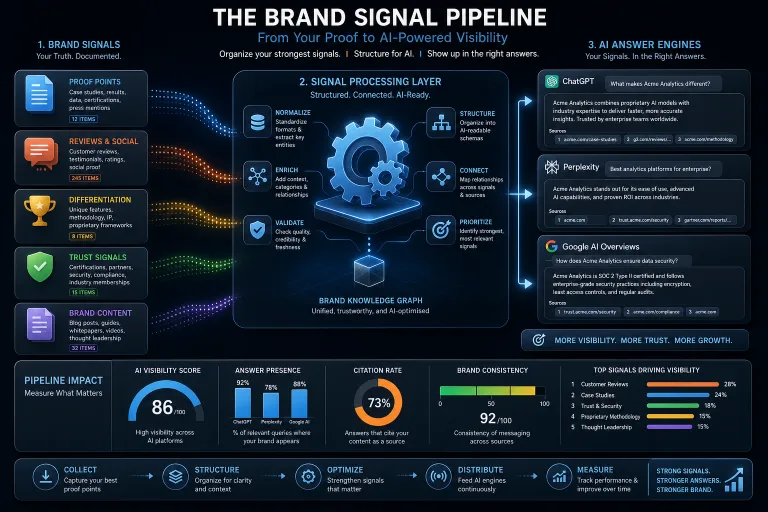
- Citation share — how often your source appears in ChatGPT, Perplexity, and Gemini answers for target queries. Measured manually or through specialized AI SERP monitoring tools.
- Traffic from AI sources — referral traffic from chatgpt.com, perplexity.ai, copilot.microsoft.com and similar. Set up as a separate segment in Google Analytics.
- Target query coverage — the percentage of target questions for which your material appears in AI answers. Goal: 60% or higher for key topics.
- Update velocity — the average age of key materials. Goal: no more than 6 months for priority content.
- Topic coverage — the number of target questions a material answers compared to competitors.
What to Avoid: Three Common Mistakes
Mistake 1: Sacrificing the human experience for the bot. AI search optimization is an addition, not a replacement. An article that’s perfectly structured for a bot but unbearable for a human to read won’t earn links or citations. Balance is the key.
Mistake 2: Ignoring classic SEO. AI search and traditional search don’t replace each other. They coexist. Materials well-optimized for Google Search also have an advantage in AI results, especially in Gemini.
Mistake 3: One-time optimization. AI engines constantly change their algorithms and sources. AI search optimization isn’t a project — it’s a process. Without regular updates and monitoring, results erode quickly.
Checklist: Article Audit for AI Search
- The article opens with a clear definition in the first paragraph — no preamble
- Each section has a descriptive H2/H3 heading that reflects a specific question
- Key facts are presented in tables or bulleted lists
- The FAQ block contains 3–5 questions phrased the way users ask them
- Schema.org markup has been added (Article, FAQPage, or HowTo)
- A visible update date is shown and is no older than 6 months for priority materials
- A check via ChatGPT/Perplexity confirms the source appears in the answer for the target query
The Future: Content as Data, Not as Text
The trend experts are observing points to a gradual shift: content is increasingly treated by algorithms as a set of extractable data points rather than a cohesive work. For editorial teams, this isn’t a threat — it’s an opportunity. Those who systematically structure their content, add metadata, and maintain freshness will earn a disproportionately larger share of citations in AI answers. Those who continue to rely solely on aesthetics and storytelling will gradually lose visibility — not because their content got worse, but because the algorithm won’t “see” it.
Key takeaway: aesthetics and structure aren’t competitors — they’re layers. Good content for the AI search era is material that’s enjoyable for a human to read and easy for an algorithm to parse. Editorial teams that master both layers will gain the advantage in the new discovery landscape.
FAQ
Do I need to rewrite all existing articles for AI search?
No. Start with priority materials that drive the most traffic or answer key audience questions. Add definitions, FAQ blocks, tables, and Schema.org markup. A full rewrite isn’t necessary — what’s needed is a structural layer.
What tools help track citability in AI answers?
Specialized platforms like Profound, Otterly.ai, and AthenaHQ monitor the appearance of your brand and sources in ChatGPT, Perplexity, and Gemini answers. To start, you can use manual queries to AI engines for target questions and log the results in a spreadsheet.
Does page design affect visibility in AI search?
Not directly. AI engines extract text and structured data, not visual design. However, it has an indirect effect: good UX increases time on page, citability, and backlinks, which strengthens the source’s authority.
How often should articles be updated to maintain visibility in AI answers?
Priority materials — once a quarter; secondary materials — once every six months. The key is updating dates, statistics, product links, and any information that can become outdated. AI engines treat freshness as a binary filter.
How does AI search optimization differ from classic SEO?
Classic SEO focuses on rankings in search results and clickability. AI search optimization focuses on fact extractability and citability in synthesized answers. Structure, metadata, and data completeness matter more than keyword density and backlinks.