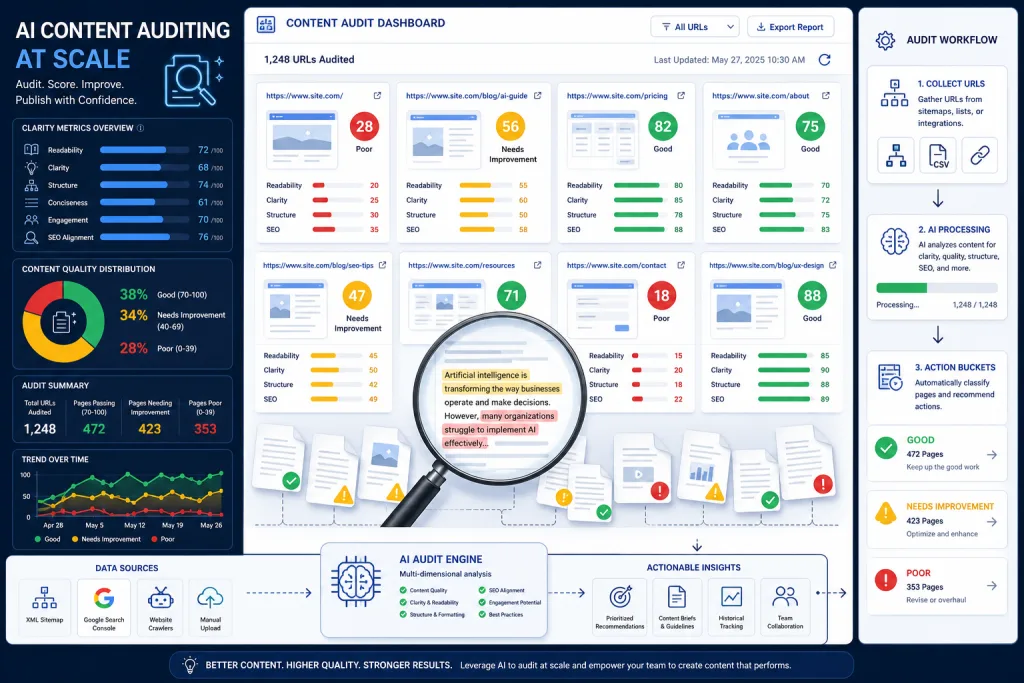
In July 2026, consultant Aaron Hutchinson uploaded 1,600 UK creative agency websites into an AI tool and got a shocking result: 56% don’t clearly explain what they do, 78% don’t define their audience, and 47% don’t describe the problem they solve. This is in an industry that sells clarity to clients as its core product. The tool didn’t just scan the pages—it evaluated each one against a strategic framework: what it does, for whom, what problem it solves, and whether it differs from others. The result was a digitized map of facelessness at scale, which is impossible to obtain manually. For editorial teams and content teams, the conclusion is straightforward: if professional communicators fail a basic clarity test, what can be said about corporate blogs, knowledge bases, and portfolios of thousands of pages? And most importantly, the same AI that identified the problem can become the tool to solve it at scale. An AI content portfolio audit is a mass automated check of website pages for clarity, differentiation, audience fit, and strategic coherence. Instead of manually proofreading hundreds of articles, the editorial team uploads URLs or texts into an LLM with a system prompt that evaluates each piece against fixed criteria and receives scoring with specific recommendations. The editor only works with what the AI flagged as problematic.
What is an AI Content Audit and How Does it Differ from an SEO Audit
An SEO audit answers the question, “Can they find us?” An AI audit answers the question, “Do they understand us?” These are different tasks requiring different tools.
A traditional SEO audit checks technical parameters: indexing, load speed, heading structure, meta tags, internal links, and keywords. It is optimized for search bots and algorithms.
An AI audit checks semantic quality: clarity of value proposition, audience definition, uniqueness of position, coherence of argumentation, and presence of evidence. It is optimized for the reader and for AI answer engines—ChatGPT, Perplexity, Gemini—that cite content and rephrase it for users.
Ideally, both audits complement each other. But it is the AI audit that reveals what SEO tools cannot see: when 200 blog articles say the same thing in different words, when a knowledge base doesn’t answer the user’s actual question, or when landing pages copy each other without adding value.
Why Manual Audits Fail at Scale
A five-person editorial team managing a blog of 300+ articles and a knowledge base of 500+ pages physically cannot reread all content regularly. A manual audit takes weeks, costs a lot, and is already outdated by the time it’s finished.
The problems of scale are obvious when you do the math. Volume: 500 pages × 10 minutes reading time = 83 hours of continuous work for one editor. Subjectivity: different editors evaluate the same page differently—what seems “clear enough” to one may seem vague to another. Inconsistency: criteria “drift” from page to page, especially if the audit stretches over weeks. Obsolescence rate: content changes faster than the audit concludes. Cost: a senior editor’s hour is the most expensive unit in content operations.
An AI audit doesn’t replace editorial judgment, but it does the first pass: it flags problematic pages, assigns a score, and groups materials by problem type. Humans only work with what the AI flagged as critical.
What Exactly Does AI Check in Your Content
Based on the framework Hutchinson used for agencies, we can identify five key parameters for editorial content:
1. Topic Clarity. Is it clear from the first paragraph what the page is about? Does it contain a direct answer to the query that brought the reader there? An article that starts with general reflections and gets to the point by the fifth paragraph fails this criterion.
2. Audience Definition. Who is the text written for? Are examples, terminology, and context relevant to the target reader? An article “about AI for business” without specifying what kind and size of business is a typical failure.
3. Position Uniqueness. Does the material differ from hundreds of similar articles in search results? Is there an original argument, data, or point of view? If an article can be replaced by ten others without losing meaning, it is not unique.
4. Problem-Solution. Does the page describe a specific problem and offer a solution? Or is it informational text for the sake of text, which doesn’t help the reader take the next step?
5. Portfolio Coherence. How is this page connected to adjacent materials? Is there topic duplication? Is there logical internal linking? Ten articles with overlapping topics and no cross-links is a common diagnosis.
Each parameter is scored on a 0–2 scale, and the total score (maximum 10) shows which pages require priority rework.
How to Build an AI Audit: Step-by-Step Workflow
Step 1. Collecting URLs and Preparing the Corpus
Collect all URLs of content pages: blog, knowledge base, landing pages, evergreen materials. For large sites, use an XML sitemap or scraping. The output should be a CSV with the URL, page title, meta description, and full text. Without the full text, the audit will be superficial—the AI must see the entire page, not just the title and snippet.
Step 2. Developing the Evaluation Prompt
The system prompt is the core of the AI audit. It should contain: the role (“You are a senior editor with 15 years of experience in content strategy”), the task (“Evaluate each page against 5 criteria”), the scale (“0 – absent, 1 – partially, 2 – fully”), the output format (structured JSON with fields for each criterion, total score, and recommendation), and context (description of the target audience, brand tone, strategic priorities). Without context, the AI will evaluate “in general” rather than in relation to your editorial team.
Step 3. Batch Processing
Upload pages in batches of 20–50 depending on context window limits. For portfolios over 500 pages, use an API with an automatic queue. For smaller volumes, NotebookLM or batch uploading in Claude/GPT is sufficient. Important: each page is evaluated independently so that the score of one does not affect the score of another.
Step 4. Aggregation and Visualization
Consolidate the results into a dashboard: score distribution, top 50 problematic pages, clusters of similar problems. For example: “120 pages without a clear definition of the target reader” or “45 articles with duplicate topics in the AI tools cluster.” Aggregation turns a set of individual scores into a strategic map.
Step 5. Prioritization and Remediation Plan
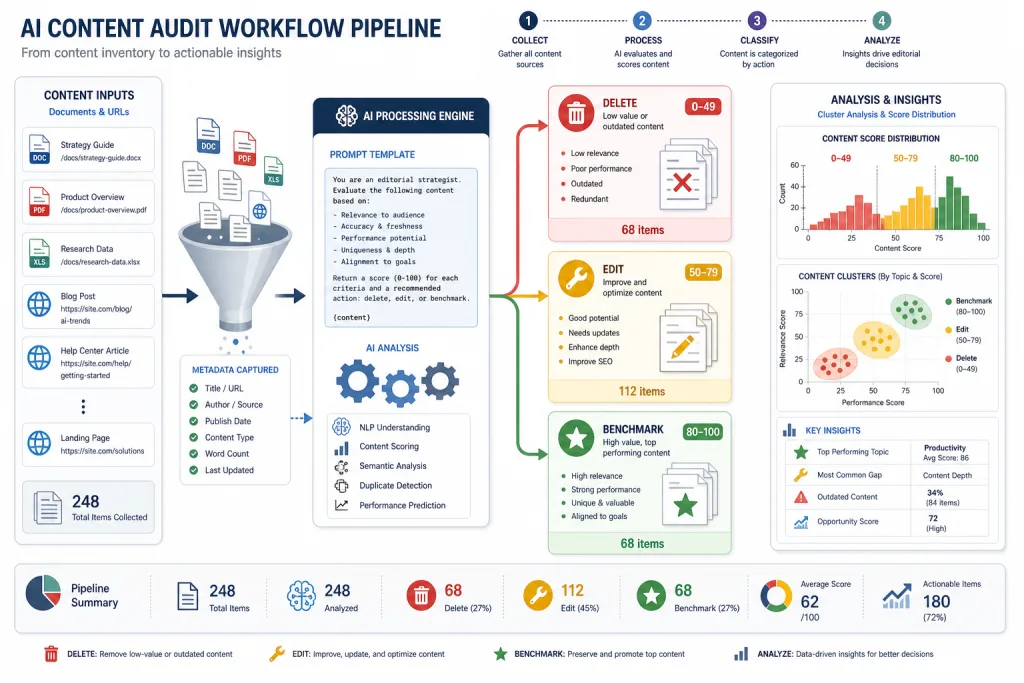
Don’t try to fix everything at once. Divide the pages into three buckets: red (score below 3 out of 10—rewrite or delete), yellow (4–6—make targeted improvements), and green (7+—keep, use as a benchmark).
Prompt System for Mass Page Analysis
A basic template for the evaluation prompt that you can adapt to your content:
You are a content strategist and senior editor. Your task is to evaluate the page against 5 criteria.
Criteria:
- CLARITY: Is it clear from the first 2 paragraphs what the page is about and what benefit the reader will get?
- AUDIENCE: Is the target audience defined through examples, tone, and terminology?
- UNIQUENESS: Is there an original argument, data, or point of view that competitors don’t have?
- PROBLEM-SOLUTION: Is a specific problem described and a solution proposed?
- COHERENCE: Is the material connected to other pages in the portfolio? Is there any duplication?
Scale: 0 – absent, 1 – partially, 2 – fully.
Maximum: 10 points.
Return JSON:
{
“url”: “…”,
“scores”: {“clarity”: 0-2, “audience”: 0-2, “uniqueness”: 0-2, “problemsolution”: 0-2, “coherence”: 0-2},
“total”: 0-10,
“mainissue”: “brief description of the main issue”,
“recommendation”: “one specific action”
}
Adapt the criteria to your content type. For a knowledge base, add “answer completeness” and “version relevance.” For landing pages, add “call to action” and “proof.” For a blog, add “research depth” and “readability.”
Metrics and Scoring: How to Digitize Content Clarity
An AI audit provides three levels of metrics, each solving its own task.
Individual level—the score of each page. It shows exactly where the problem is and what type it is. A page with a score of 3 out of 10 and the main issue “audience not defined” is a specific task for an editor, not an abstract “needs improvement.”
Cluster level—the average score across thematic groups. If all articles in the “AI for editorial teams” cluster have a low score for “uniqueness,” it’s a signal that the cluster doesn’t need targeted edits, but a conceptual review. Perhaps all ten articles say the same thing in different words.
Portfolio level—the distribution of scores. If the median across the portfolio is 4 out of 10, it’s a systemic problem, not just individual pages. If the median is 8, but there’s a tail of 30 pages with a score of 2, it’s a targeted task that can be solved in one sprint.
What to Do with the Results: Prioritizing Fixes
The results of an AI audit should turn into an editorial plan. Here is how it works in practice.
Deletion over rework. If a page has a score of 0–2 and gets no traffic from search and AI engines—delete it or merge it with a related article. Reworking a weak page is often more expensive than creating a new one from scratch, and deletion improves the average quality of the portfolio and removes noise from the index.
Update program. Pages with a score of 4–6 and existing traffic are candidates for updates. The AI audit has already suggested what exactly to improve: add examples, clarify the audience, strengthen the argument. This isn’t a rewrite, but targeted surgery—replace a paragraph, add a data block, rewrite the intro.
Benchmark library. Pages with a score of 8+ become benchmarks. Use them as few-shot examples in prompts for creating new content—this increases the quality of future materials without additional team training efforts.
Gap map. If the AI audit shows that in a cluster of 30 articles, none have a clear problem description—this is a gap in strategy, not execution. You don’t need an editor, but a content strategist who will determine what topics should even be in this cluster.
Risks and Limitations of AI Audits
An AI audit is a powerful but imperfect tool. It’s important to understand its boundaries.
False positives. An LLM might under-score a page written for a narrow expert audience because it doesn’t understand the industry context. An article for DevOps engineers might seem “too technical and incomprehensible” to the AI, although it’s perfect for the target reader. Always manually check pages with unexpectedly low scores before deciding to delete them.
Brand blindness. AI evaluates text but doesn’t see the brand context, company history, or audience relationships. A page that seems “ununique” might work because it’s read out of trust in the author or publication. The score is a signal, not a verdict.
Prompt dependency. The quality of the audit is 80% determined by the quality of the system prompt. A bad prompt yields meaningless scores that look convincing but don’t reflect real problems. Test the prompt on 10–20 pages with known issues and known quality before running it on the full portfolio.
Cost at scale. Auditing 1,000 pages via API costs from $50 to $200 depending on the model and page length. For regular audits (quarterly), this needs to be factored into the content operations budget as a recurring expense.
Doesn’t replace qualitative assessment. An AI audit is triage, not a diagnosis. It shows where to look for problems, but the final decision on whether to rewrite or delete a page is made by an editor who sees context the AI doesn’t.
Practice: Integration into Content Operations
An AI audit is most effective when built into the regular cycle of content operations, rather than performed as a one-off project. Recommended rhythm: once a quarter—full portfolio audit, score updates, red bucket review; once a month—audit of new content created during the period; before a campaign launch—audit of the page cluster related to the campaign.
For teams using a content calendar with AI integration, audit results can automatically generate update tasks in a task tracker. A page with a score of 4 and the recommendation “add practical examples” turns into a ticket with a deadline and responsible editor—without manual transfer.
Key principle: an AI audit is not a one-time check, but a health monitoring system for the content portfolio. The more pages you manage, the more important an automated first pass is, saving hours of editorial time for work that requires human judgment.
Checklist: Launching an AI Content Portfolio Audit
- Compiled a complete list of content page URLs in a CSV with texts and metadata
- System prompt tested on 10–20 pages with known issues and benchmarks
- Defined 5–7 evaluation criteria adapted to the content type (blog, knowledge base, landing pages)
- Configured batch processing via API or a tool with queue support
- Results consolidated into a dashboard with score distribution and problem clustering
- Pages divided into red, yellow, and green buckets with an action plan
- Assigned a responsible editor to check pages with unexpectedly low scores
FAQ
Which LLM model is best for an AI content audit?
For portfolios up to 100 pages, Claude Sonnet or GPT-4o via web interface with batch upload works well. For over 100 pages, use an API: Claude Haiku for the first pass (faster and cheaper), Sonnet for detailed analysis of problematic pages. Gemini 1.5 Pro is suitable if you need a large context—you can upload 50–100 pages at a time.
How does an AI audit differ from AI content detection?
AI detection determines whether a text was written by a human or a machine. An AI audit evaluates the semantic quality of a page—clarity, differentiation, audience fit. These are different tasks with different tools: a detector looks for synthetic text, an auditor looks for weak content regardless of who wrote it.
Can an AI audit be used for competitors’ content?
Yes, and this is one of the most valuable applications. Upload 50–100 competitor pages into the same prompt and compare the scoring with your portfolio. This will show where you are stronger, where you are weaker, and which topics competitors cover better. The key is to use the identical prompt for a fair comparison.
How often should an AI audit be conducted?
At least once a quarter for the full portfolio. For actively growing blogs (10+ new articles per month)—monthly for new content. Before major campaigns or redesigns—conduct an ad-hoc audit of the affected clusters.
What if the AI audit shows low scores across the entire portfolio?
This is a signal of a systemic problem, not individual pages. Don’t try to fix everything at once. Start with the cluster that has the highest traffic, create a benchmark page with a score of 8+, and use it as a template to update the rest. Delete pages with a score of 0–2 without traffic—this will immediately raise the average quality of the portfolio.