What is “AI Dumping” and Why 85% is Not a Victory
According to CoSchedule, 85% of content marketers already use AI for content creation. At first glance, this is a sign of market maturity. In reality, it’s an alarming signal. When a tool is widely available and the barrier to entry is minimal, the result inevitably averages out. Content that used to be distinguished by the author’s style, depth of research, or unique structure is now reduced to similar structures, similar arguments, and similar conclusions. This phenomenon is “AI dumping” (from the word dump) — the mass production of average content that is technically competent but lacks differentiating features.
At the same time, the Financial Times notes an opposite trend: books written by humans are becoming a premium product. Independent publishers, such as Microcosm Publishing, refuse to use AI even for spell-checking and fact-checking, labeling “100% human-made” as a competitive advantage. This is not nostalgia — it is a market reaction to saturation. When a baseline level of quality becomes universally accessible, value shifts to what AI cannot reproduce: primary data, expert experience, unique access.
For editorial boards and content teams, the question is not whether to use AI or not. The question is exactly where the tool amplifies your differentiation and where it destroys it.
The Mechanics of Averaging: How AI Creates a “Commodity Shelf”
LLMs are trained on publicly available data and strive for the statistically most likely continuation. This means that when asked “how to choose a CRM for a small business,” the model will output a structure, arguments, and even examples that are highly likely to match the answer of another model or another user. The result is content that looks professional but contains no recognizable authorial voice or unique texture.
The problem is that “professional-looking” content still passes basic quality filters. It is structured, grammatically correct, and answers the question. But it is not memorable. For SEO, this means falling into the average cluster of results, where no page has a sufficient signal of authority. For AI search, it means a lack of citation, because answer engines look for unique fragments, not compilations of publicly available facts.
Framework: Two Zones of AI Application in the Editorial Office
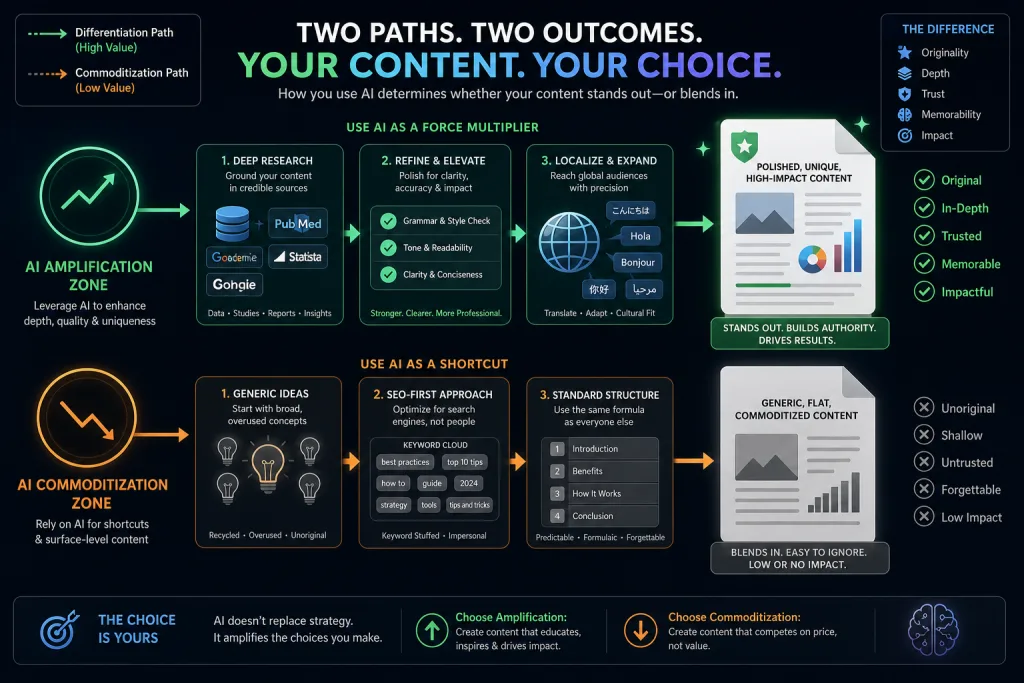
To avoid dumping, editorial boards need to clearly divide AI application into two zones: amplification and commoditization.
Amplification Zone (AI Amplification Zone)
Here, AI works with material that already contains human uniqueness — primary data, expert interviews, authorial analysis. The task of AI is not to generate content, but to speed up processing, structuring, and formatting.
- Research and fact-gathering: AI analyzes large arrays of data, interview transcripts, reports, highlighting key points and connections that a human might miss.
- Localization and adaptation: AI translates and adapts long content into 20+ languages, maintaining terminological accuracy through glossaries and system prompts.
- Structuring and formatting: AI transforms scattered notes into a structured draft, observing the editorial style guide.
- Fact-checking and verification: AI checks claims against sources, identifies logical inconsistencies, and potential hallucinations.
Commoditization Zone (AI Commoditization Zone)
Here, AI is used as a replacement for human thought. The result is content indistinguishable from thousands of other AI generations.
- Generating topics and ideas from public sources: AI suggests topics based on trends and competitors, creating identical lists for everyone.
- Writing SEO-optimized texts by formula: AI writes articles using a standard structure (H1, H2, H3, FAQ), optimized for keywords, but without unique texture.
- Creating conclusions and analytics without primary data: AI generates “analytics” based on publicly available reports, creating the illusion of expertise without real insight.
Practice: How to Build a Prompt System to Preserve Originality
A prompt system is not one large system prompt, but a set of linked instructions that determine how AI works with your material. The goal is not to “make the text better,” but to preserve the unique texture and authorial voice at every stage.
1. Prompt Map: Separating Texture and Generation
Create a document that clearly separates what AI can generate and what it cannot. For example:
- Can generate: article structures, meta descriptions, headline variations, rephrasing of complex parts for clarity.
- Cannot generate: key arguments, expert assessments, facts, quotes, conclusions.
2. System Prompts with Texture Injection
Instead of requesting “write an article about X,” use a prompt that loads primary texture into the model: an interview transcript, your own research data, expert notes. The AI’s task is to structure and format, not to invent content.
Example prompt structure:
You are an analytical editor. Your task is to structure the provided material into an article according to the publication’s style.
Material: [insert transcript/notes/data]
Rules:
- Do not add facts that are not in the material.
- Do not invent quotes.
- Preserve the author’s intonation.
- Structure by sections: introduction, context, analysis, conclusions.
3. Originality Checkpoints
Build mandatory checks into the workflow:
- Averaging check: after generation, compare the result with the top 3 results in Google on the topic. If the structure and arguments match by more than 60% — rework it.
- Texture uniqueness check: every key argument must have a source that is not in the top 10 Google results.
- Authorial voice check: the text must contain at least one assessment or conclusion that is not a statistically obvious continuation of the premises.
Cases: Where AI Amplifies, and Where It Destroys
Amplification: Research + AI = Unique Analysis
The editorial board conducted 15 expert interviews with CMOs of major brands about the impact of AI on marketing budgets. AI was used for transcription, clustering answers, identifying non-obvious connections, and structuring the draft. The result was an article with unique primary data that competitors do not have. AI sped up the process 4 times, but did not create a single key argument.
Destruction: AI as a Replacement for Thought
The editorial board uses AI to write SEO articles for the query “best CRMs for small business.” Prompt: “Write an article about the best CRMs for small business, 1500 words, optimized for SEO.” The result is an article indistinguishable from 50 other AI generations on the same topic. No primary data, no expert assessments, no unique structure. This is pure dumping.
Editorial Guardrails: What to Ban and What to Allow
To prevent drift into the commoditization zone, editorial boards need clear operational guardrails:
- Ban “generation from scratch”: AI should not create content from an empty prompt. There must always be incoming material — notes, transcripts, data.
- Ban AI fact-checking without verification: AI can suggest sources, but final confirmation is up to the human.
- Mandatory origin labeling: every piece of content must have a tag: “AI generated,” “AI edited,” “human created.”
- Role separation: the expert author creates the texture, AI structures it, the human editor checks for originality and voice.
How to Measure Differentiation: Metrics Beyond Text Uniqueness
Standard uniqueness metrics (anti-plagiarism scores) are useless against AI content — the text will be 100% “unique,” but at the same time absolutely unoriginal in content. Other metrics are needed:
- Primary Data Index: the share of facts, data, and quotes in the article obtained from primary sources (interviews, own research, exclusive data). Goal — no less than 30%.
- Differentiation Index: comparing the structure and key arguments of the article with the top 3 competitors on the topic. Goal — less than 40% structural match.
- AI Citation Index: the frequency of your content being cited in ChatGPT, Perplexity, Gemini answers for relevant queries. Goal — growth in the share of citations in the thematic cluster.
Premium Trend: Why “Written by Humans” is Becoming a Marker of Quality
The trend noted by the Financial Times is not a rejection of AI, but a re-evaluation of where the human factor creates value. Microcosm Publishing refuses AI even for spell-checking because they see the risk of “mission creep” — the gradual expansion of AI use beyond the originally intended tasks. “Hallucinations are not typos,” says Jason Rosenbaum of Microcosm. “They are authoritatively sounding fabrications. That’s a completely different editorial task.”
For content teams, the takeaway is twofold:
-
Don’t label AI as evil. AI is a powerful tool for the amplification zone. Abandoning it entirely is a luxury available only to narrow niches.
-
Label the “human” as premium. If your content contains primary data, expert assessments, or unique access — emphasize it. In a world saturated with AI content, the “human” becomes a competitive advantage, not a hygienic minimum.
Practical Checklist: How to Avoid AI Dumping
Checklist: Preventing AI Dumping in the Editorial Office
- Divide AI application into “amplification zone” and “commoditization zone” in the editorial style.
- Ban generating content “from scratch” — there must always be incoming material (notes, transcripts, data).
- Build in an “averaging” check: comparison with top 3 competitors in structure and arguments.
- Set a minimum threshold for primary data (at least 30% of texture from exclusive sources).
- Separate roles: the expert author creates the texture, AI structures it, the human editor checks originality.
- Label the origin of each fragment: “AI generated,” “AI edited,” “human created.”
Conclusion: AI as an Amplifier, Not a Replacement
85% of marketers use AI — this is a fact. But mass adoption does not equal mass quality. When a tool is available to everyone, it ceases to be a competitive advantage. The competitive advantage becomes what the tool cannot reproduce: primary data, expert experience, unique access, and authorial voice.
Editorial boards do not need to abandon AI, but to clearly define where it amplifies these unique assets and where it destroys them, creating commodity content indistinguishable from thousands of others. The “dumping” framework is a practical tool for this separation.
FAQ
What is AI content dumping?
AI dumping is the mass production of content using AI that is technically competent but lacks differentiating features. The result is content indistinguishable from thousands of other AI generations, which is not memorable and is not cited.
Why do 85% of marketers use AI, but the result averages out?
Because the mass adoption of an accessible tool lowers the barrier to entry and leads to identical structures, arguments, and conclusions. When everyone uses the same tool in the same way, the result inevitably averages out.
How to measure the originality of AI content?
Standard text uniqueness metrics are useless. Needed: primary data index (share of exclusive data), differentiation index (comparing structure with competitors), and AI engine citation index.
Should you completely abandon AI in the editorial office?
No. AI is a powerful tool for the amplification zone: research, localization, structuring. Abandoning it entirely is a luxury available to narrow niches. The key is in separating the zones of application.
What is the “amplification zone” and “commoditization zone” in AI application?
The amplification zone is where AI works with already unique material (primary data, interviews), speeding up processing. The commoditization zone is where AI replaces human thought, generating content “from scratch” without unique texture.