
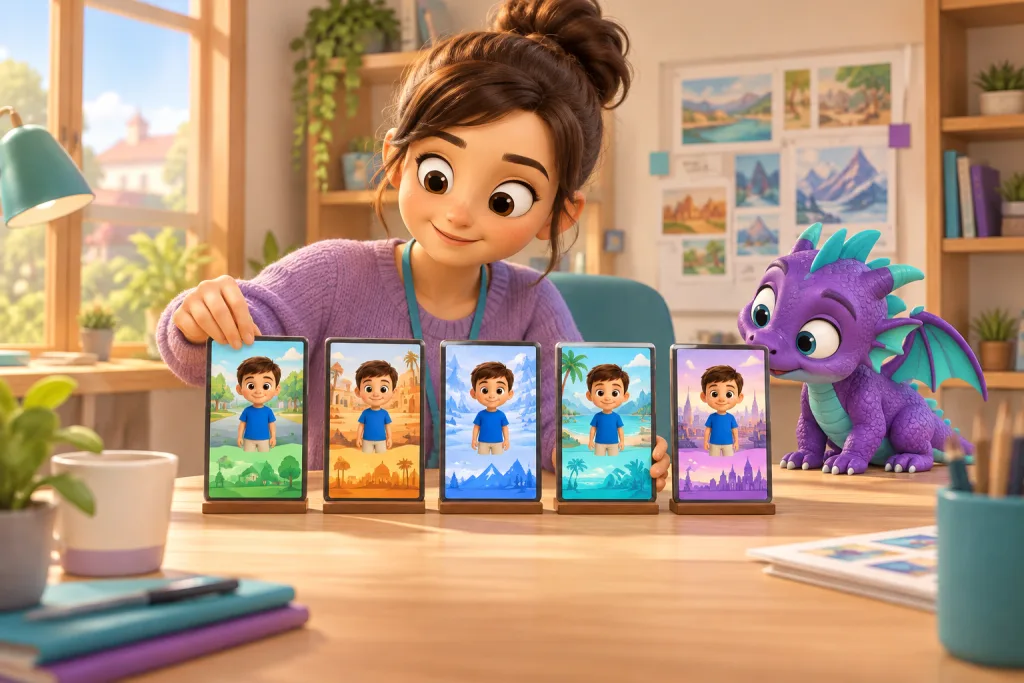
When an animated series launches simultaneously across five markets, the bottleneck is almost never the animation itself. It’s localization. The original episode might be ready on Monday, but five language versions — dubbing, subtitles, metadata, cover art — can stretch into three weeks of back-and-forth between departments. The difference between a studio that publishes episodes within 72 hours and one that takes three weeks isn’t budget. It’s pipeline architecture.
A localization pipeline is a set of interconnected steps that take a finished master episode and transform it into versions ready for publication on each target market. When this pipeline works, the same episode goes live in Russia, Latin America, Southeast Asia, the Middle East, and India within a single release window — and each version feels native to its audience. When it doesn’t, the studio loses the momentum that drives recommendations, ad revenue, and trial subscriptions.
Here’s what this pipeline looks like in practice, what slows it down, and what decisions a production team can make today to compress the cycle.
What Makes Voiceover Localization a Bottleneck
Most studios treat localization as a final stage — something that happens after an episode is “done.” But in a multi-market release, localization touches nearly every production step. The script needs to be translated before voice recording begins. Recording requires a dubbing director who understands the character’s tone in the original language. The mix requires separate audio stems so dialogue can be replaced without touching music and sound effects. Rendering requires frames without baked-in text so subtitles and on-screen text can be localized.
When these requirements arrive at the end, the team discovers them as problems. The animator learns that lip sync doesn’t work with the Japanese dub because mouth shapes were tied to Russian syllables. The sound engineer finds that the dialogue stem is baked into the master mix and can’t be isolated. The marketing team discovers that the episode title in Portuguese is twelve characters longer than the design allows.
A pipeline built around localization flips this. Requirements are defined before the first frame is drawn.
Pipeline Architecture: From Master Track to Five Language Versions
The foundation of an efficient pipeline is a single master episode that spawns multiple localized versions through parallel branches, not sequential reworks. Here’s how it works.
The master episode is produced with clean audio stems: dialogue, music, and effects are separated. Video is rendered without baked-in text. On-screen text and titles are handled as separate layers. The script is exported with timecodes matching the animation timeline.
From this master, each language branch proceeds in parallel. Translation adapts the script to cultural context and lip-sync timing. The dubbing director records voice actors in the target language, working with locked video. The mixer replaces the dialogue stem while preserving music and effects. Subtitles are generated from the translated script with timecode alignment. Metadata, titles, and cover art are localized for each platform.
The keyword is parallelism. All five language versions move forward simultaneously, not one after another.
Subtitles vs. Dubbing: When to Choose What
Not every market requires full dubbing, and not every format justifies its cost. The decision between subtitles and dubbing is a production and commercial question, not just a preference.
Dubbing delivers higher emotional engagement. When a character speaks the viewer’s language, the connection is instant. For children’s animation, dubbing is often mandatory — young viewers can’t read subtitles fast enough. Indian animation studios like PowerKids built their YouTube strategy on multilingual dubbing precisely because it boosts retention among regional audiences.
Subtitles are faster, cheaper, and work well in markets where audiences are accustomed to them. In Southeast Asia, subtitled content from Japan and Korea has amassed huge audiences on mobile platforms. For short vertical micro-dramas — which increasingly cross borders — subtitles often make the first international version viable, with dubbing added once demand is proven.
The practical approach: dubbing where it drives measurable retention or subscription conversion, subtitles where speed matters more, and hybrid models — subtitles plus dubbing of key scenes — for testing new markets before committing to full dubbing.
How Automation Speeds Up Rendering Language Versions
This is where production technology earns its place. Rendering five language versions used to mean five separate passes, each tied to its own project file. A modern pipeline automates this.
The master project contains variables for language elements: dialogue audio, on-screen text layers, title cards, metadata. The render management system — whether a commercial tool or a custom script built around the studio’s existing software — launches each language variant as a batch job. Instead of an artist opening the project, swapping audio and text, and rendering manually, the system pulls the right assets for each language and renders all versions overnight.
This doesn’t replace the artist. It eliminates the repetitive manual work that introduces errors. The artist’s role shifts to correctly setting up the master and reviewing the output, not babysitting each render.
For studios working with AI-assisted production — as some Indian animation companies have begun doing to cut costs without flooding platforms with cheap clips — the principle is the same. Technology serves the pipeline. It doesn’t replace creative decisions.
Quality Control: Where Humans Are Irreplaceable
Automation handles repetition. Quality requires judgment. Every localized version needs human review at specific checkpoints.
The dubbing director checks whether the vocal delivery matches the character’s emotional arc. A native speaker reviews subtitle translation for cultural accuracy and reading speed. The mix engineer confirms that dialogue sits correctly in the audio bed and that no musical reference is masked. A render reviewer checks for text overflow, font rendering issues, and lip-sync drift.
These checks are quick — minutes per version — but they must happen before a version is approved for distribution. Skipping them means discovering problems after release, when the cost of fixing them is ten times higher and the viewer has already formed their first impression.
Release Timing and the Monetization Window
Why does speed matter? Because the release window is where monetization happens.
When an animated series launches simultaneously across five markets, it captures platform recommendation algorithms at the same time. Viewers in one market generate watch time that signals relevance to the platform, which then amplifies reach in other markets through trends and discovery features. A synchronized release creates a feedback loop that staggered releases can’t replicate.
Localization delays break this loop. The Russian version launches on time, but the Latin American version is published two weeks later — by then, the algorithm has already categorized the content, and the late release starts from zero.
For short-form animation, the window is even narrower. Webtoon’s decision to add a short-form animation track alongside premium anime reflects the same logic: demand is growing, production capacity is tight, and studios that can deliver finished localized content fastest will own the format.
Mistakes That Slow Down International Market Entry
The most common pipeline failures are predictable.
Baking dialogue into the master mix. When dialogue can’t be isolated, every language version requires a full remix. Solution: separate audio stems from day one.
Hardcoding text into rendered frames. When on-screen text is part of the rendered video, it can’t be translated without re-rendering. Solution: text as overlay layers, rendered separately or composited in post-production.
Starting translation after picture lock. When the script isn’t translated until animation is complete, dubbing starts weeks later. Solution: translate in parallel with animation, using the locked storyboard as the source.
Treating localization as one task instead of five parallel ones. When one language version is completed before the next begins, cycle time multiplies by the number of markets. Solution: launch all branches simultaneously from a shared master.
Ignoring metadata and cover art. When titles, descriptions, and cover art aren’t localized, discovery suffers even if the content itself is perfectly dubbed. Solution: include metadata in the localization pipeline from the very start.
What This Changes for the Content Team
A localization pipeline isn’t a tool you can buy. It’s a set of decisions about how production is organized. Studios that publish across five markets in a single week aren’t the ones with the biggest budgets. They’re the ones who decided early on that localization is a production requirement, not a post-production afterthought.
When the pipeline works, the creative team spends time on the episode — on characters, pacing, visual gags — not on reworking renders because a text layer ended up in the wrong place. The marketing team launches with confidence because all versions are ready on the same day. The distribution team can negotiate synchronized releases with platforms because the studio can actually deliver them.
For content owners entering international markets, the pipeline is the foundation. Everything else — the monetization model, platform strategy, audience development — is built on whether localized versions arrive on time and feel native. The technology exists to make this possible. The decisions make it happen.
Checklist: How to Prepare an Episode for Parallel Localization
- Split audio into stems: dialogue, music, effects — before animation begins
- Move all on-screen text to separate layers; don’t render it into frames
- Export the script with timecodes matching the animation timeline
- Start translation in parallel with animation, using the locked storyboard
- Set up the render system with language variables for batch processing
- Define quality control checkpoints for each language version: voiceover, subtitles, mix, render
- Localize metadata, titles, and cover art simultaneously with the content
FAQ
How many language versions can realistically be launched simultaneously?
It depends on the market and format. For short-form animation on mobile platforms, three to five language versions is a workable range. The key constraint isn’t the number — it’s parallelism: all versions must move simultaneously from a shared master, not sequentially.
Subtitles are faster and cheaper — they’re ideal for testing demand in a new market. Dubbing delivers higher retention, especially in children’s animation. A hybrid approach — subtitles plus dubbing of key scenes — works well as a test before committing to full dubbing.
How do you measure whether a localization pipeline is working?
The primary metric is the time from master episode completion to publication of the final language version. Studios with an efficient pipeline compress this window from two to three weeks down to 48–72 hours. The secondary metric is the number of post-release fixes, which should trend toward zero.
Can short vertical animation be localized the same way as feature-length content?
The principles are the same, but the timing is tighter. The vertical format and short runtime mean the release window is narrower and the viewer is less tolerant of delays. The pipeline must be tuned for short episodes: rapid translation, parallel dubbing, automated rendering.