
The 45% Lift Case Study and What’s Behind It
Localizing ad creatives for YouTube Connected TV isn’t just about translating text or swapping subtitles. When Cars24 launched localized creatives via DV360 on YouTube CTV, efficiency jumped by 45%. The number might seem like magic, but it’s the result of specific operational work: splitting the creative into layers, adapting scenes, selecting the right voice, and readjusting ad frequency for large-screen viewing behavior.
For content teams and advertisers working with international audiences, this case study is valuable not as a textbook example, but as an actionable framework. 45% is neither a standard nor a promise. It’s the result you get when localization is built as a system rather than a final touch before launch. In this article, we’ll break down which decisions drive this lift, which creative layers actually impact results, and how to replicate this logic in your own campaign.
Why Translating a Creative Isn’t Localization
The biggest mistake teams make is assuming a localized creative differs from the original only in language. In practice, translation accounts for no more than 15–20% of the work. The rest is context adaptation: visual imagery, pacing, humor, social references, screen format, and even the colors of UI elements and pointer arrows in the edit.
On YouTube CTV, this difference is felt more sharply than on mobile. Viewers watch on a larger screen, audio is usually on, and attention is held longer—but any unnatural element, like a fake dubbing accent, an out-of-place joke, or an untranslated technical term, is immediately obvious. A creative that works as warm recommendation-style advertising in its original market can look like a cheap insert once translated. That’s why the 45% lift comes not from translation, but from adapting every layer to local viewer expectations.
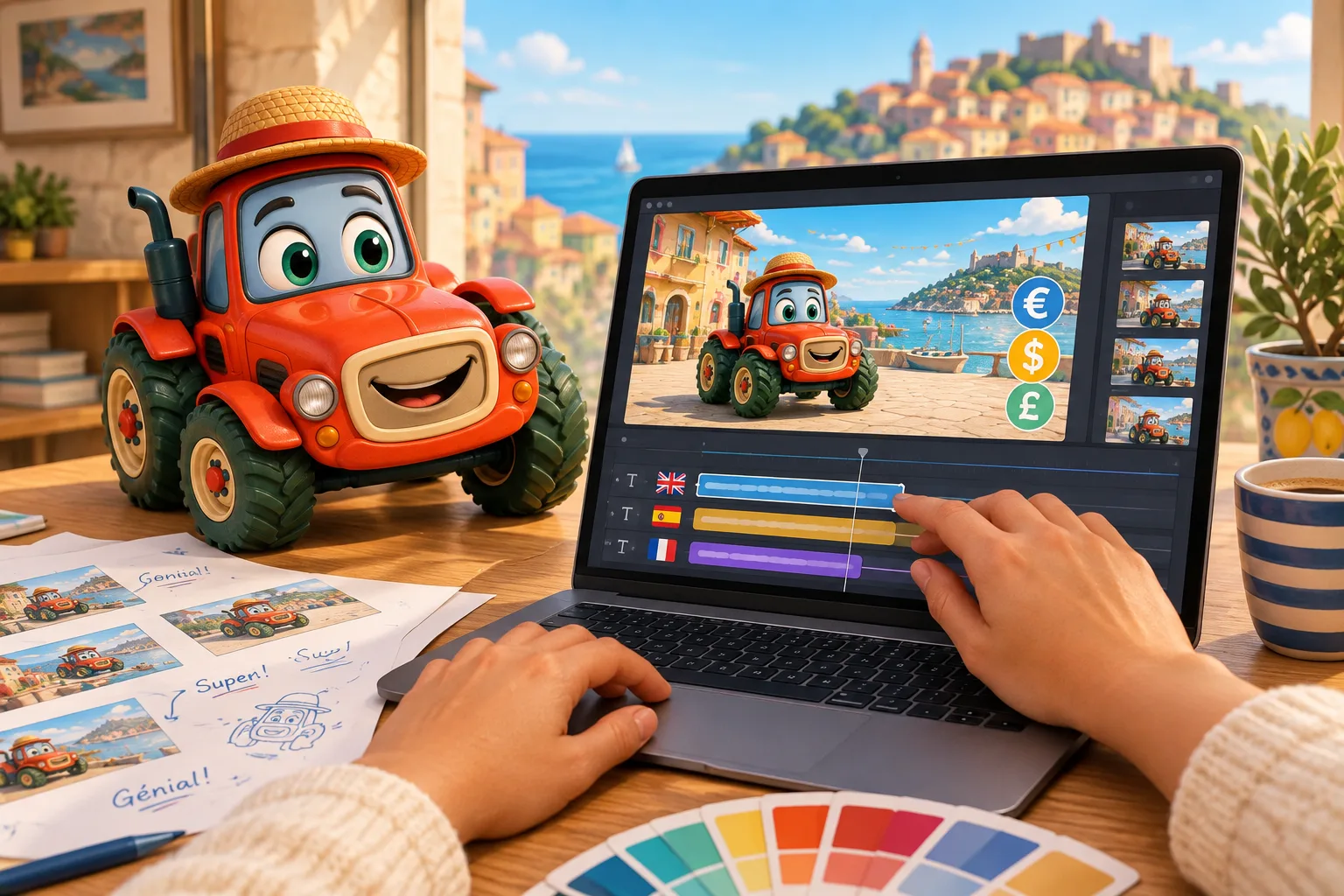
Structure of a Localized Campaign: What to Change and What to Keep
To make localization scalable, creatives are assembled from layers. This lets you change what depends on the market while preserving what makes the brand. There are typically five layers.
The first is the script framework. It defines the problem, the promise, and the resolution. On most markets, the framework stays the same: if an ad is built around “sell your car in one day,” that idea works in both India and Brazil. What changes are the details—the transaction model, document references, local trust signals.
The second is voice and audio. Voiceover, timbre, pacing, music bed. On CTV, audio matters more than on mobile: viewers hear more detail, and fake dubbing erodes trust. Some markets only respond to local voices with recognizable accents; others are fine with clean, neutral pronunciation.
The third is visual context. Backgrounds, street scenes, wardrobe, cars, road signs, currency. These elements aren’t always critical to the meaning, but they’re what makes an ad feel “local.” A creative where someone gets into a right-hand-drive car looks out of place in a country with left-hand traffic.
The fourth is text and graphics. Titles, prices, call-to-action, buttons, legal phrasing. This layer requires adaptation, not just translation: currency, date format, service name, mandatory disclaimers. On CTV, text is read from three to four meters away, so fonts and contrast need to be larger than on mobile.
The fifth is editing pace and the structure of the first few seconds. Different markets have different expectations for pacing: some viewers are ready for fast delivery, others expect a slower intro and more context. This layer is often underestimated, yet it directly affects retention in the first 10–15 seconds, which determines whether the viewer sees the rest.
Audio and Voice: The Difference Between Dubbing and Subtitles on the Big Screen
On CTV, choosing between dubbing and subtitles isn’t a budget question—it’s a perception question. Subtitles work when the original voice is part of the brand: a recognizable actor, a specific timbre, a musical number. In all other cases, dubbing provides a more natural immersion, especially if viewers are watching together and don’t want to read the screen.
It’s important to understand that dubbing for CTV isn’t the same resource as for mobile ads. On a large screen, you hear noises, pauses, breathing. If a recording was done in a rush, it’s unnoticeable on headphones but obvious on a home soundbar. That’s why CTV versions need a separate voiceover session, separate directorial control, and ideally separate voice actors for main roles and supporting lines. It costs more, but this is where the difference between a “translated” and a “localized” version comes from.
Cultural Script Adaptation: Where the 45% Actually Comes From
The efficiency lift in the Cars24 case didn’t come from making the ad “prettier.” It came from making the creative recognizable to the local viewer. Cultural adaptation works on three levels.
The first level is recognizable details. Local documents, local transaction methods, local buyer fears. In India, it’s vehicle history checks and trust in the dealer; in Brazil, concerns about legal cleanliness and payment methods. A script that accounts for these fears is perceived as “understanding,” not as “foreign advertising translated for us.”
The second level is rhetoric. On some markets, direct selling works better: “buy now, price valid today.” On others, soft recommendation: “here’s how we solved this problem.” On CTV, where the viewer isn’t in scrolling mode, a hard direct pitch can trigger rejection because it too blatantly breaks the viewing context.
The third level is casting and character types. Faces, clothing, age of characters, family scenes. A creative where a family sits at dinner might feel warm in one culture and artificial in another. Casting isn’t about political correctness—it’s about authenticity. Viewers instantly read “one of us” vs. “an outsider,” and this affects retention more than the offer text.
Ad Frequency and Screen Format: How CTV Changes the Creative
On YouTube CTV, viewer behavior differs from mobile. Sessions are longer, switching between videos is slower, and ad frequency is felt more acutely. If you run the same creative that works on mobile at five to six impressions per week on CTV with the same frequency, the viewer will notice the repetition by the third impression.
This changes the approach to a localized campaign. First, you need a larger pool of creatives: not one localized video per market, but three to five versions with different intros and different hero scenes. Second, frequency is set lower: 2–3 impressions per week per unique user is often enough. Third, consistency matters: different versions of the same message, not different messages, so the brand doesn’t get diluted.
Metrics That Confirm the Value of Localization
45% is an aggregate lift, but behind it are specific metrics. When localizing for CTV, look at four groups of indicators.
The first is retention and completion. Compare 0–15 seconds, 15–30 seconds, and full completion between the original and localized versions. If localization works, the first 15 seconds improve the most: the viewer quickly understands the ad is “for them.”
The second is click-through and transitions. On CTV, clicks are rarer, but view-through conversions and site visits after an impression matter. Compare these across markets and creative versions.
The third is cost per result. CPM on CTV is higher than on mobile, so the efficiency lift should be in conversions, not impressions. The 45% lift in the case study is about efficiency, not reach.
The fourth is creative fatigue. Localized versions usually live longer because there are fewer repetitions per viewer and more variants. If one localized version burns out faster than the original, it’s a sign the adaptation was superficial.
Regional Priorities: Where Localization Pays Off Faster
Not all markets are equally sensitive to localization. From practice: the lift is stronger in regions with pronounced linguistic and cultural contrast—South Asia, Southeast Asia, Latin America. In Western Europe, the difference between a localized and a simply translated version is smaller, but still noticeable on retention metrics.
ROI also depends on production cost. Expensive markets with expensive media—the US, the UK—require more careful adaptation because mistakes cost more. Emerging mobile markets deliver a higher lift per unit of localization investment because viewers are less accustomed to high-quality localized advertising and react more sharply to something “familiar.”
For content teams, this means: don’t localize all markets equally. First, identify priority regions by the ratio of expected lift to adaptation cost, then invest more in the first three to four markets, while the rest get basic localization.
Mistakes That Bring the Lift to Zero
Most often, the lift doesn’t appear not because localization is weak, but because it was done on the wrong layers. Typical failures: full dubbing, but the visual context remains foreign; an adapted scene, but the same editing pace that doesn’t fit the market; translated text, but graphics aren’t redrawn—currency, date, disclaimer. The opposite also happens: localization is overcomplicated, the creative loses rhythm and becomes “too local,” losing brand recognition.
The second common mistake is launching a localized version with mobile campaign frequency. On CTV, this causes rapid fatigue, and the viewer starts perceiving the ad as intrusive. The third is ignoring audio: cheap, rushed dubbing is obvious on a home soundbar and nullifies all visual adaptation.
Practical Checklist for a Localized CTV Campaign
- Split the creative into five layers—script framework, audio, visual context, graphics, editing pace—and determine which layer changes on each market.
- Plan a separate voiceover session for CTV; don’t reuse the mobile audio track without checking it on a large screen.
- Adapt graphics for screen format: fonts, contrast, currency, dates, disclaimers must be readable from viewing distance.
- Prepare 3–5 creative versions per market to reduce ad frequency and avoid fatigue on CTV.
- Compare localized and original versions by the first 15 seconds of retention, not just final CTR.
- Prioritize markets by the ratio of expected lift to adaptation cost; don’t localize all equally deeply.
- Check casting and character types for authenticity for the local viewer—this affects retention more than the offer text.
FAQ
Does every market need dubbing for YouTube CTV?
Not always. Dubbing is needed when the original voice doesn’t carry brand value and the viewer is in a setting where reading subtitles is inconvenient. If the original voiceover is part of the brand, you can keep it with quality subtitles. The decision is made by market and format, not by budget.
On CTV, sessions are longer, switching is slower, and repetition is more noticeable. A frequency that’s normal for a mobile campaign causes fatigue by the third or fourth impression on CTV. That’s why localized campaigns run with lower frequency and a larger pool of versions.
What drives the main efficiency lift—translation or adaptation?
The lift comes from adaptation: script details, visual context, voice, pacing, casting. Translation is just one layer. If you limit yourself to translation only, the localized version often performs no better than the original.
Which markets should be localized first for a CTV campaign?
First—markets with pronounced cultural and linguistic contrast and acceptable adaptation costs: South and Southeast Asia, Latin America. In Western Europe, the lift is smaller but still noticeable on retention metrics. The final choice depends on media costs and expected lift.
How many creative versions are needed per market for CTV?
At least three, ideally five. Different intros and hero scenes, one message. This reduces fatigue and lets you rotate versions within a single campaign without losing brand recognition.