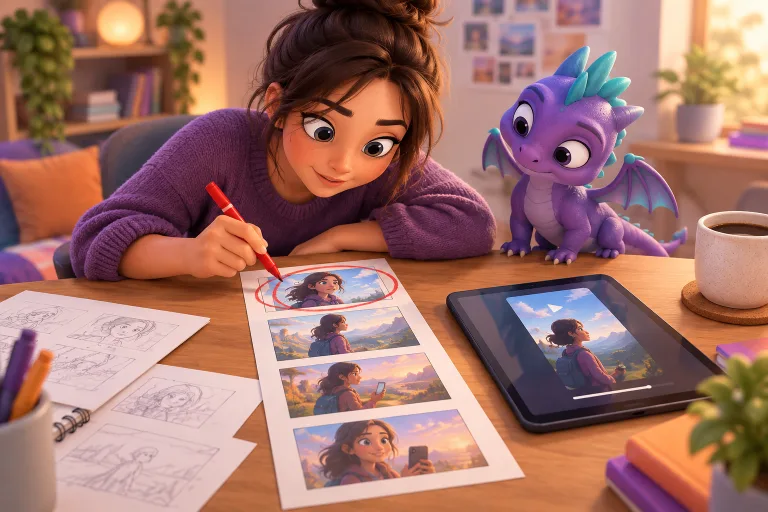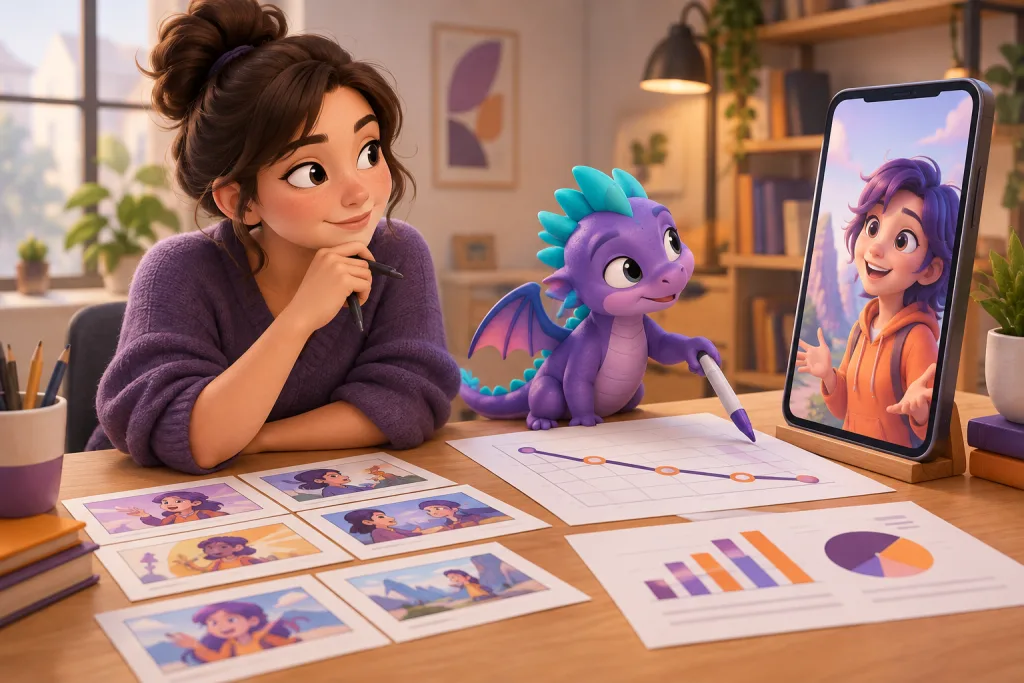
Every team running ad campaigns for mobile content faces the same phenomenon: a creative that delivered installs at $0.80 yesterday costs $2.50 today, and $4.00 next week. Nothing changed — same platform, same audience, same offer. What changed is the viewer’s response. The creative “tired.” Understanding why one creative burns out in three days while another lasts a month is the difference between a campaign that scales and one that burns budget with no return.
Creative fatigue isn’t a platform problem or an algorithm problem. It’s a repetition problem: the viewer has seen this visual pattern, this hook, and this transition enough times to stop responding. The higher the impression frequency, the faster this moment arrives. But fatigue speed depends not only on frequency — it depends on the creative’s depth, its emotional anchor, and how different it is from other ads in the same category.
What Creative Fatigue Is and How to Spot It
Creative fatigue is a decline in audience response to an ad under unchanged placement conditions. In practice, it looks like this: CTR drops, CPI rises, and impression frequency increases. If you see frequency exceeding 3–4 impressions per unique user and CPI grown 30–40% from its starting value — the creative is fatigued.
But there are subtler signals that appear before CPI starts rising. The first — declining click-through rate with stable impressions. The creative is still being shown, but viewers have stopped responding. The second — rising skip rate, if the platform tracks it. The third — declining watch time for video ads. These metrics lead CPI growth by several days, and tracking them keeps you from waiting until the creative starts burning budget.
It’s important to understand: creative fatigue isn’t a quality problem. A great creative fatigues too. The difference is that a great creative fatigues in two weeks, while a weak one fatigues in two days. The team’s goal isn’t to avoid fatigue (impossible) but to anticipate it and manage it.
Why Some Creatives Live Longer Than Others
A creative’s lifecycle depends on three factors: emotional depth, visual variability, and competitive density in the category.
Emotional depth is how strongly the creative triggers a sustained emotional response. A creative built on a single visual shock (a character doing something unexpected) fatigues quickly because the viewer gets used to the shock after the second or third viewing. A creative built on a story — a character faces a problem, tries to solve it, and the viewer wants to know how it ends — lives longer because each viewing reminds the viewer of the emotional anchor that hooked them.
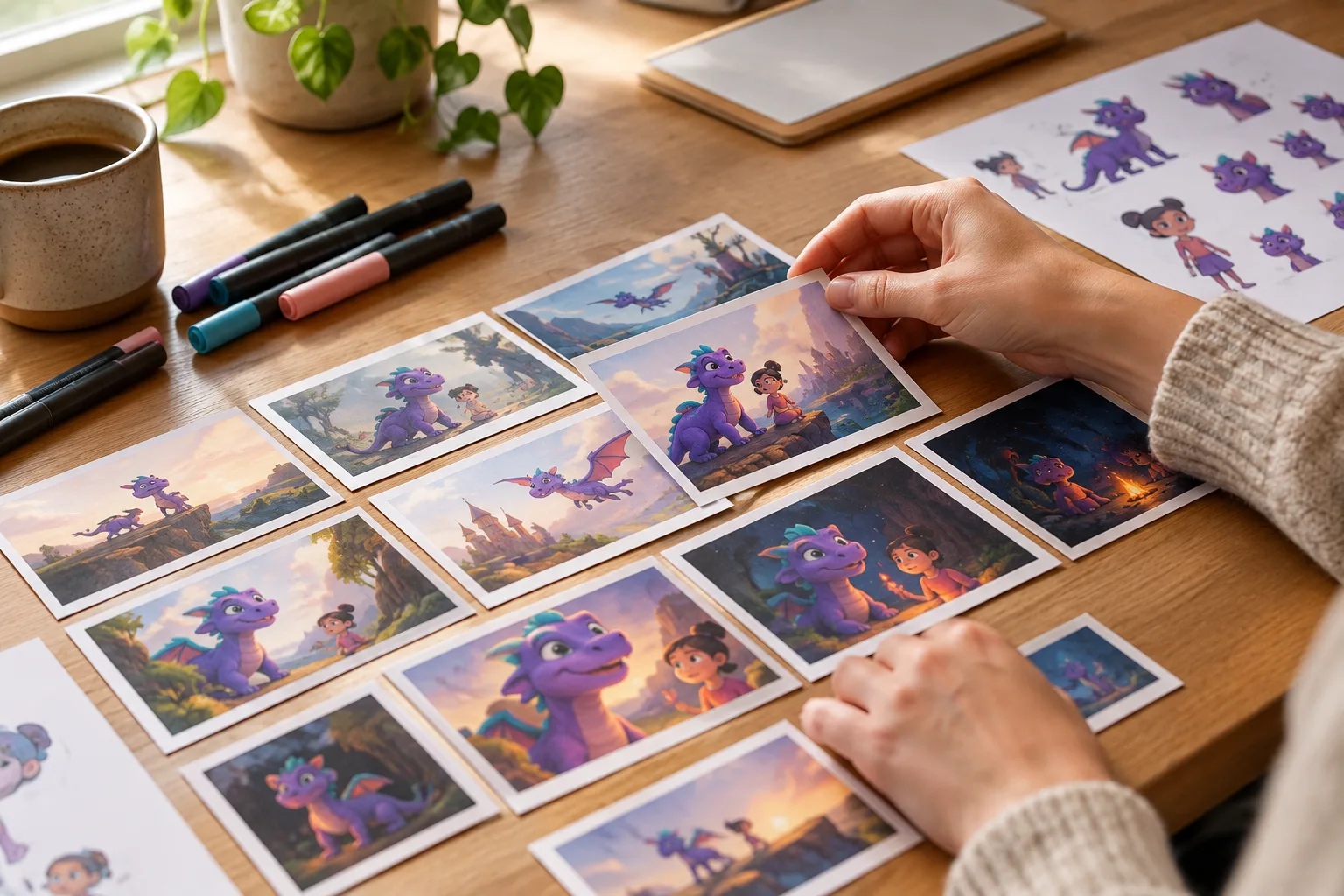
Visual variability means the creative has multiple points that can be changed without losing meaning. If a creative is a single scene, it can’t be variably refreshed. If it’s three to four scenes with different visual contexts, you can reorder them, swap one scene, and get a “new” creative for both the algorithm and the viewer.
Competitive density determines how quickly viewers tire of a pattern. If you launch a creative in a category where 50 other ads use the same visual device (problem–solution–product), viewers tire of the pattern as a whole, not your creative specifically. Even a great creative lives shorter in such cases because it competes not with other creatives but with format fatigue.
How to Extend a Creative’s Lifecycle
Extending a lifecycle isn’t about forcing a fatigued creative to work again. It’s systematic work creating variations that the algorithm and viewer perceive as new. Four approaches work.
Scene Variations
If a creative has multiple scenes, the simplest strategy is to reorder or replace one scene. For example, if the creative opens with a problem and ends with a solution, you can start with the solution and circle back to the problem via flashback. This changes the visual pattern for the algorithm but preserves the emotional anchor for the viewer.
Localization
Localizing a creative isn’t just translating text. It’s adapting visual elements: swapping props, changing UI colors, adjusting a character’s expressions to cultural norms. A creative localized for the Japanese market should look like it was made for the Japanese market, not translated from English. This extends the lifecycle because each localized variant is perceived by the algorithm as new material and by the viewer as relevant.
For example, if the original creative uses a thumbs-up gesture, for Middle Eastern markets that gesture might be replaced with a more neutral one. This isn’t just translation — it’s cultural adaptation that makes the creative more relevant and extends its lifecycle in a new market.
Format Repackaging
If a creative worked as a 30-second spot, it can be repackaged into a 15-second version with a faster pace. Or expanded to a 60-second version with additional scenes. This isn’t just trimming or lengthening — it’s changing rhythm and information density. The 15-second version needs a more aggressive hook in the first 3 seconds, while the 60-second version needs a deeper story with an additional emotional layer.
Angle Change
If a creative is built around one character, you can create a version from another character’s perspective. For example, if the original shows a hero solving a problem, the new version can show the same hero through a friend’s or antagonist’s eyes. This creates a new story but uses the same production assets, saving budget and time.
Operational Model: When to Launch Variations
The main question teams ask isn’t “how to create variations” but “when to launch them.” Launch too early and you kill a creative that could still work. Launch too late and you lose budget on fatigued material.
The working rule: the first variation should be ready to launch when frequency reaches 2.5–3 per unique user. This doesn’t mean launching immediately — it means being ready. If CPI starts rising at frequency 3, launch the variation. If CPI stays stable, wait.
The second variation is prepared at frequency 4–5. The third at 6–7. By then the original is usually exhausted and you switch to variations entirely. Important: variations don’t replace the original — they run in parallel. The algorithm distributes traffic among them, and you see which performs better.
How to Measure Variation Success
Variation success is measured not by absolute CPI but by the CPI-to-LTV ratio. If a variation brings installs at $2.00 and user LTV is $4.00, the variation works. If the original brought installs at $0.80 but user LTV was $1.00, the original was worse despite the lower CPI.
This is counterintuitive, but that’s how performance marketing works for content products. A cheap install is useless if the user doesn’t stick around. So when evaluating variations, look at traffic quality, not just cost. A variation that brings more expensive installs but higher-quality users is a success.
The Production Connection
Managing creative fatigue isn’t just a marketing task. It’s a production task. If the production team knows a creative will be used in 10–15 variations, they design it differently: more scenes, modular structure, the ability to swap individual elements without reassembling the entire spot.
This means the storyboard must account for variability points from the start. If you know scene 3 can be replaced with scene 3B, you design scene 3 as a standalone module, not part of a continuous flow. This takes discipline at the storyboard stage but saves weeks of work during variation production.
A modular approach to storyboarding also simplifies localization. If each scene is a standalone module, a localized version can swap individual modules without reassembling the whole creative. This is especially important for teams working across 5–10 markets simultaneously.
Common Mistakes in Managing Creative Fatigue
The first and most common mistake — waiting until CPI rises to start making variations. By the time CPI grows, the creative has already fatigued, and you need 3–5 days to produce a variation, during which you lose budget. The right approach is having variations ready before they’re needed.
The second mistake — creating variations too similar to the original. If a variation differs only in text or button color, the algorithm and viewer perceive it as the same creative. A variation must differ visually: a different scene, angle, character, or scene order.
The third mistake — launching all variations at once. If you launch 5 variations simultaneously, the algorithm splits traffic among them, and you get no clean data on which performs best. The right approach is launching variations sequentially or in small groups so each gets enough impressions for evaluation.
Practical Checklist: Managing a Creative’s Lifecycle
Checklist: Managing a Creative’s Lifecycle
- Set frequency thresholds (2.5–3 for the first variation, 4–5 for the second, 6–7 for the third) and track them daily.
- Prepare the first variation before launching the original creative, so you don’t lose days on production when it starts fatiguing.
- Design creatives as modular structures: each scene should be a standalone element that can be swapped without reassembling the entire spot.
- Check leading fatigue signals (CTR, skip rate, watch time) before CPI starts rising.
- Evaluate variations by CPI-to-LTV ratio, not absolute CPI: an expensive install of a quality user beats a cheap install of an untargeted one.
- Localize creatives with cultural adaptation of visual elements, not just text translation.
- Launch variations sequentially or in small groups to get clean performance data for each.
What to Do When All Variations Are Exhausted
Even with perfect variation management, a moment comes when a creative is fully exhausted. All variations fatigued, frequency high, CPI rising. This isn’t a crisis — it’s a natural cycle. At this point the team should switch to a new creative using different visual patterns and a different emotional anchor.
It’s important to understand that a “new creative” isn’t necessarily a new story. It can be the same story told from a different angle or in a different format. For example, if the original was a 30-second spot with linear narration, the new creative can be a 15-second spot with reverse chronology. Or the same character in a new situation that reveals a different side of their personality.
The key rule: a new creative must differ from the exhausted one not in details but in visual pattern. If the viewer sees the same visual pattern, they respond to it as fatigued even if details changed. So switching to a new creative means changing the visual language, not just swapping scenes.
FAQ
How many variations does one creative need?
For most campaigns, 3–5 variations suffice. The number depends on competitive density in the category: the more competitors using similar patterns, the faster fatigue sets in and the more variations you need.
How often should creatives be refreshed?
In mobile entertainment, a creative typically lives 7–14 days. In highly competitive categories, 3–5 days. Track impression frequency and leading signals (CTR, skip rate) to pinpoint the refresh moment.
What if all variations fatigue at the same time?
Switch to a new creative with a different visual pattern. Variations extend a lifecycle but not indefinitely. When all variations are exhausted, you need a new visual language.
What budget should be allocated for variation production?
If a creative is designed as a modular structure, variation production costs 15–25% of the original’s cost. If the creative isn’t modular, variations cost as much as the original, making the variation strategy economically unviable.
Should every variation be localized?
Yes, if the campaign operates across multiple markets. Localizing each variation extends its lifecycle in every market because the algorithm perceives the localized version as new material.