The AI video generation market has passed the point where a single universal model is a sensible strategy for content teams. In 2026, the catalog of video models on platforms like OpenRouter includes dozens of options—from lightweight open-weights models to commercial systems with native audio. MiniMax H3, Grok Imagine Video, and Veo 3.1 Lite represent three different architectural approaches, each optimized for its own scenario. Teams that continue to use one model for all tasks overpay for generation where a quick draft is needed and lose quality where controlled editing is required.
The practical takeaway for editorial and video production teams: a multi-model stack is not a luxury, but an operational necessity. Different tasks—advertising, e-commerce, explainer videos, shorts, localized versions—require different trade-offs between speed, cost, control, and quality. In this article, we’ll break down how to build a model selection framework and integrate multiple providers into a unified production pipeline.
Why the Video Model Market Has Fragmented
Back in 2024, most content teams worked with one or two video generation models. The choice was simple: an expensive, high-quality model for important projects and a cheap one for drafts. By 2026, the landscape has changed for three reasons.
First, models specialized in specific operations have emerged. MiniMax H3 is not just a generator, but a tool for instruction-guided edits and video-to-video motion transfer. Grok Imagine Video is optimized for speed: 1–15 seconds of video in seconds of generation. Veo 3.1 Lite is for high-volume production with minimal cost per clip. These models do not compete directly—they occupy different niches in the production pipeline.
Second, the variety of formats has grown. Short vertical videos for TikTok and Reels, horizontal explainer videos for YouTube, square formats for in-app ads—each requires its own aspect ratio, duration, and quality. Grok Imagine Video supports seven aspect ratios out of the box (1:1, 16:9, 9:16, 4:3, 3:4, 3:2, 2:3), eliminating the need for additional cropping and reassembly.
Third, the economics of generation have become more transparent. Credit systems, pay-per-second models, and API pricing allow precise calculation of the cost per content unit. When a team produces 500 ad variations a month, the difference between $0.50 and $0.05 per clip turns into $225 in monthly savings—on just one content type.
Three Models, Three Strategies: MiniMax H3, Grok Imagine, Veo 3.1 Lite
#
MiniMax H3: Controlled Editing and Motion Transfer
MiniMax H3 is a lightweight open-weights model from MiniMax designed for precise multimodal editing. Its key distinction is not generating from scratch, but the controlled transformation of existing content. Instruction-guided edits allow changing individual scene elements via text description without recreating the entire clip. Video-to-video motion transfer applies motion from one video to another visual material—useful for brand restyling and adapting creatives for different products.
For content teams, MiniMax H3 solves a problem previously handled manually in video editors: localized adaptation of creatives. Instead of reshooting or full regeneration, the team takes the source clip, gives an instruction like “replace the background with an office scene, keeping the camera movement”—and gets the result in one iteration. Text and brand rendering within the model means logos and text elements don’t need to be overlaid post-factum.
Practical scenario: an e-commerce team produces 20 product variations per month. Instead of 20 separate generations from scratch, they create one base clip with product movement and use MiniMax H3 to swap the background, product color, and text inserts. The time to produce one variation drops from 40 minutes to 8.
#
Grok Imagine Video: Speed and Format Flexibility
Grok Imagine Video by SpaceXAI is a fast text-, image-, and reference-conditioned generator. Short clips from 1 to 15 seconds, 24 fps, 480p or 720p, seven aspect ratios. This is a model for iterative generation where the final polish isn’t valuable, but the speed of getting a draft to evaluate a concept is.
For shorts teams and ad producers, Grok Imagine Video works as a “quick prototype.” The producer describes a scene, gets a 5-second clip in seconds, evaluates composition and movement, adjusts the prompt—and repeats. Once the concept is approved, the final version can be generated on a heavier model or refined in MiniMax H3.
The key metric is time from idea to approved concept. In a traditional single-model workflow, this takes 30–45 minutes per iteration (generation + evaluation + prompt adjustment). With Grok Imagine Video, it’s 5–10 minutes. For teams testing 10–15 concepts before choosing the final one, this cuts pre-production from a full workday to two hours.
#
Veo 3.1 Lite: High-Volume Production with Minimal Cost
Veo 3.1 Lite is Google’s most economical model for high-volume generation. It doesn’t claim maximum quality or advanced editing—its job is to produce many acceptable clips cheaply. This is the model for content operations where volume matters more than polish: mass ad variation generation for A/B testing, filling playlists with short inserts, creating background videos for social posts.
For performance marketing, Veo 3.1 Lite changes the math of creative A/B testing. Instead of 3–5 ad variations shot by a production team, the marketer generates 50 variations with different visual concepts for the same budget. The distribution platform determines the winners, and the team refines only the top 3 on a higher-quality model.
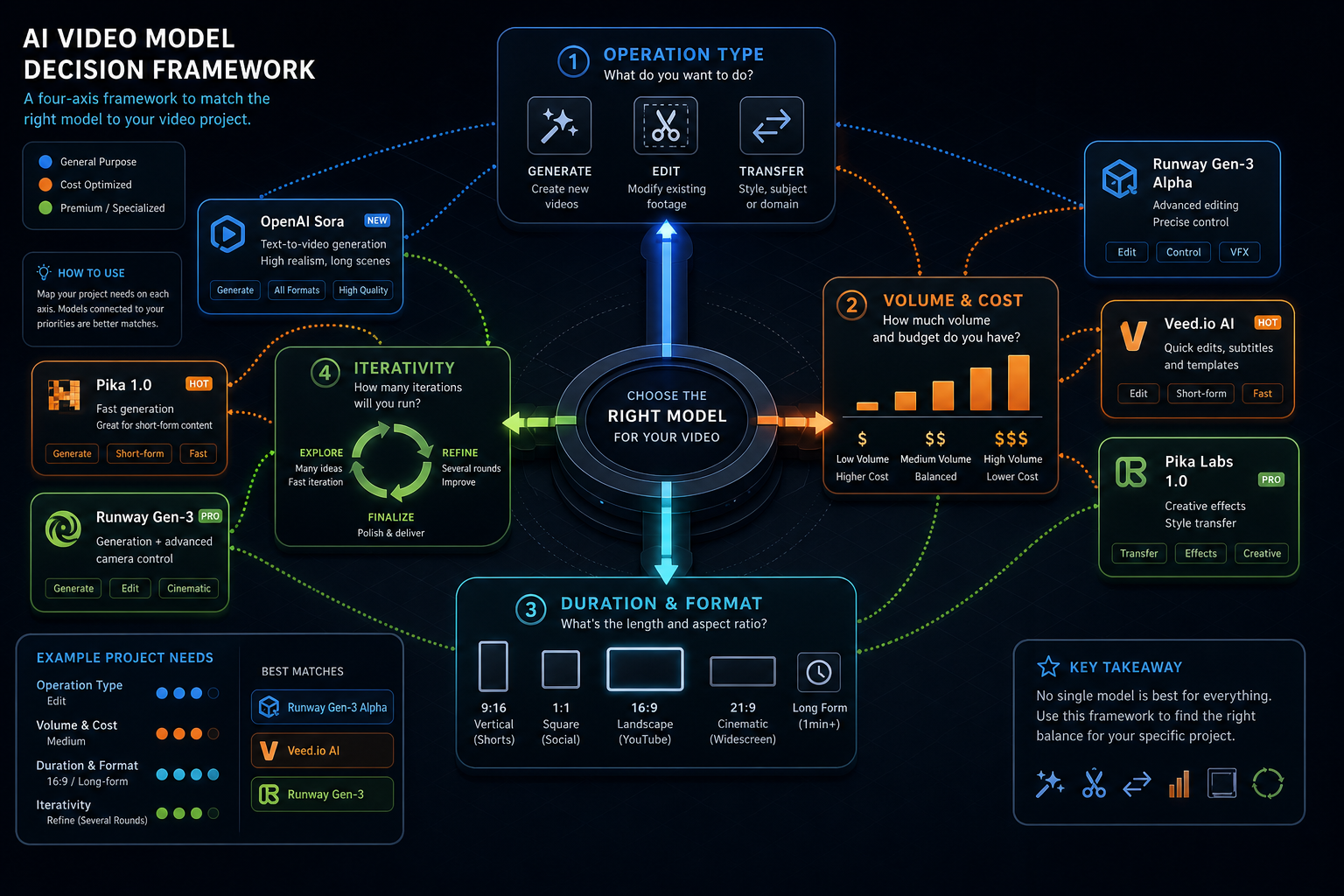
The Model Selection Framework: Four Axes
To prevent the team from choosing a model intuitively every time, a formalized framework is needed. Four axes by which each task is evaluated:
Axis 1: Operation Type. Generation from scratch, editing existing video, motion transfer, restyling. If the task is editing or adaptation, MiniMax H3 is objectively stronger. If it’s generation from scratch, the choice between Grok Imagine and Veo 3.1 Lite depends on the remaining axes.
Axis 2: Volume and Cost. How many clips need to be produced and what is the budget per unit? For 5 clips a month, cost is almost irrelevant—choose by quality. For 500 clips a month, a $0.45 difference per clip between models is $225/month, making Veo 3.1 Lite the obvious choice.
Axis 3: Duration and Format. Shorts (9:16, 5–15 sec)—Grok Imagine Video with native aspect ratio support. Explainer videos (16:9, 30+ sec)—composite approach: Grok for storyboarding, Veo 3.1 Lite or a heavier model for final scenes. Ads (various formats)—depends on the distribution platform.
Axis 4: Iterativity. Need to quickly iterate through concepts? Grok Imagine Video. Need one precise generation with control? MiniMax H3. Need a mass launch of variations? Veo 3.1 Lite.
Building a Multi-Model Pipeline
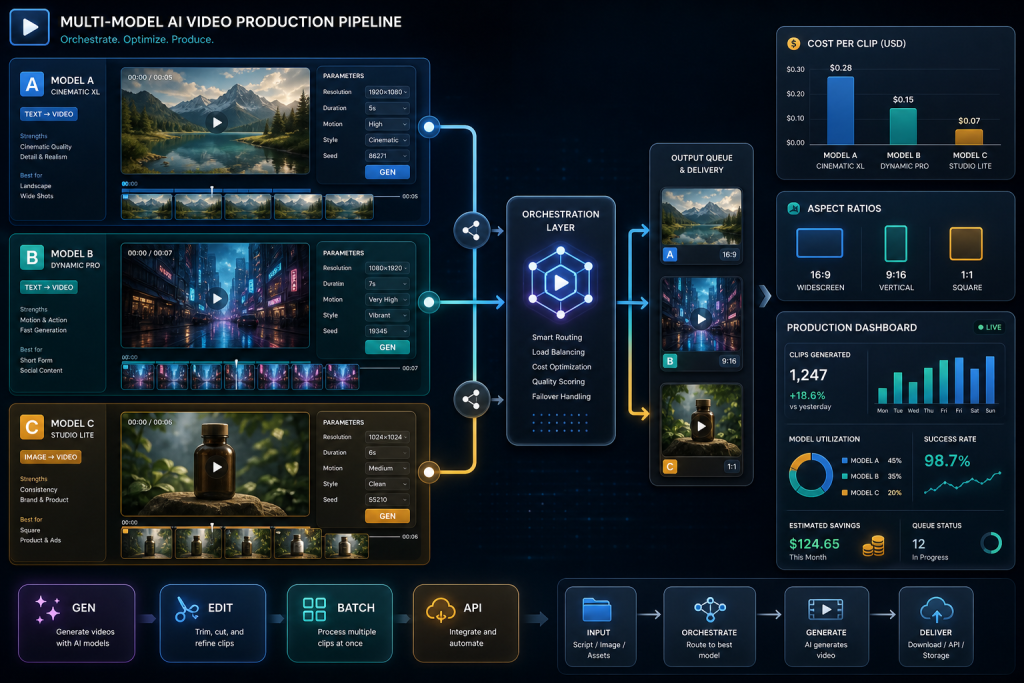
A multi-model stack is not just “using three different models.” It’s a production pipeline where models are connected in a sequence of operations. Here’s what a typical workflow for an ad creative looks like:
Stage 1 — Concepting. A producer or copywriter writes 5–10 script variations using an LLM (Claude or ChatGPT for structured scripts). Each script is 3–5 sentences describing a visual scene.
Stage 2 — Quick Prototype. Each script is run through Grok Imagine Video. The result is 5-second clips in the required aspect ratio. The team evaluates composition, movement, and overall direction. 70% of concepts are filtered out.
Stage 3 — Refined Generation. The remaining 2–3 concepts are run through a higher-quality model—either the full version of Veo, Runway, or another heavy model. This yields 10–15-second clips with better quality.
Stage 4 — Adaptation. MiniMax H3 is used to create variations of the final clip: different backgrounds, text inserts, localized versions. Instruction-guided editing allows changing specific elements without full regeneration.
Stage 5 — Mass Production. If the creative goes into A/B testing, Veo 3.1 Lite generates 20–30 variations with minimal changes (color, text, angle) for the distribution platform.
This pipeline cuts the time from concept to launch from 3–5 days to 8–10 hours and reduces the production cost of a single ad package by 60–70%.
API Integration and Orchestration
Platforms like OpenRouter and Makify AI solve the key problem of a multi-model stack—integration. Instead of subscribing to each service separately and switching between interfaces, the team uses a unified API layer.
Makify AI, for example, unifies 30+ image and video models under a single credit system with a commercial license on all paid plans. For content teams, this means: one contract, one billing, one set of legal terms—regardless of which model generates a specific clip. Batch generation via API allows automating mass production: a script sends 50 prompts, receives 50 clips, and saves them to cloud storage.
OpenRouter provides a catalog of video models with transparent per-generation pricing. The team can write an orchestration script that automatically selects a model based on task parameters: if duration < 5 sec and a quick draft is needed—Grok Imagine; if motion transfer is needed—MiniMax H3; if volume > 100 clips—Veo 3.1 Lite.
Practical implementation: a Python script with a simple routing rule that accepts a JSON task description (operation type, duration, format, volume) and routes the request to the right API. For teams producing over 100 videos a month, such automation saves 15–20 hours of manual switching between tools.
Localization and Dubbing in a Multi-Model Stack
The multi-model approach is especially effective for localized video content. The traditional video localization process: script translation → voiceover re-recording → video reassembly for the new language. With an AI stack, this process becomes modular.
MiniMax H3 with native audiovisual output allows generating localized versions with synchronized audio. Text inserts and brand elements are rendered inside the model—no need to separately overlay localized text in a video editor. For teams publishing in 5–10 languages, this eliminates the most labor-intensive stage of localization.
Grok Imagine Video with its support for seven aspect ratios is useful for platform localization: the same content is adapted for YouTube (16:9), TikTok (9:16), Instagram (1:1 or 4:5) without reassembly. A prompt in the source language generates a clip, a prompt in the target language—a localized version with the same visual style.
For dubbing, the multi-model stack is combined with AI speech generation. The script is translated by an LLM, the voiceover is generated by a TTS model (ElevenLabs, PlayHT, or similar), and the video is adapted via MiniMax H3. The full localization cycle of a single 60-second video into 5 languages takes 2–3 hours instead of 2–3 days.
Quality, Originality, and Governance
The multi-model stack creates new challenges for content governance. When clips come from three different models, it’s harder to track provenance, check for originality, and maintain a unified visual standard.
Style Consistency. Different models have different visual “signatures.” Grok Imagine Video might produce more “plastic” textures, while MiniMax H3 is more realistic when editing. The team needs a style guide for prompts: fixed descriptions of lighting, color palette, and detail level added to every prompt regardless of the model.
Provenance Tracking. Every generated clip must have metadata: which model, which prompt, which iteration, which source (if video-to-video). This is critical for commercial content where licensing questions may arise. Platforms like Makify AI with commercial licenses on all paid plans partially solve this, but an internal tracking system is still necessary.
Visual Content Fact-Checking. AI video can generate plausible but factually incorrect scenes—especially when it comes to products, interfaces, or technical processes. For explainer videos and educational content, a verification stage is needed: an expert checks whether the visual representation matches reality. This is particularly important for B2B content, where a mistake in product visualization can cost a client’s trust.
Watermarks and Transparency. Platforms require varying degrees of AI-origin disclosure. Google requires SynthID for AI generation, other platforms require text disclosures. A multi-model stack must account for the requirements of each distribution platform and automatically add the necessary markers.
Performance Metrics for a Multi-Model Stack
To justify investing in multiple models instead of one, specific metrics are needed. A baseline set for content teams:
Cost per published clip — the total cost of producing one published clip, including generation, edits, localization. In a multi-model stack, this metric should decrease by 40–60% compared to a single-model approach by matching the optimal model to the task.
Time from brief to publish — the time from receiving a brief to publishing the finished video. Target reduction: from 3–5 days to 1–2 days for standard projects.
Concept survival rate — the percentage of concepts that make it from draft to publication. In a multi-model stack with rapid prototyping on Grok Imagine Video, this metric should grow: the team filters out weak concepts earlier, before investing in high-quality generation.
Localization cost ratio — the cost of localization as a percentage of the original production cost. With MiniMax H3 and AI dubbing, the target value is 15–25% instead of 80–120% with the traditional approach.
Model utilization balance — the distribution of generations across models. If 90% of generations go through one model, the multi-model stack isn’t working. A healthy distribution: 40–50% on the lightweight model (Veo 3.1 Lite), 30–35% on the fast one (Grok Imagine), 20–30% on the controlled one (MiniMax H3).
Practical Scenarios for Different Types of Teams
#
Editorial Teams with a YouTube Channel
YouTube teams producing explainer videos and long-form content benefit the most from a composite approach. Grok Imagine Video—for storyboarding and testing visual concepts. Veo 3.1 Lite—for generating background inserts and B-roll. MiniMax H3—for adapting the final video to different topics (swapping on-screen text, replacing charts and diagrams).
For YouTube Shorts, the pipeline is simpler: Grok Imagine Video generates 5–15-second clips in 9:16, the team adds subtitles and music. The production time for one Short is 20–30 minutes instead of 2–3 hours with manual editing.
#
Performance Marketing Teams
Paid advertising teams are the main beneficiaries of Veo 3.1 Lite. Mass generation of creative variations for A/B testing becomes a routine operation. The marketer describes 20 variations in a spreadsheet, a script runs them through the API, gets 20 clips, and uploads them to the ad platform. Winners are refined in MiniMax H3 with brand-specific elements.
#
E-commerce Content Teams
E-commerce teams use MiniMax H3 as their primary tool. A base product clip is generated once, then adapted for different categories, seasons, and promos via instruction-guided editing. For a catalog of 500 products, this means 500 base clips and thousands of adaptations—without the need to shoot each variation separately.
Checklist: Implementing a Multi-Model AI Video Stack
- Identify the types of video tasks in your team (ads, explainer videos, shorts, localization) and map each to a model based on the four axes of the framework
- Connect a unified API layer (OpenRouter, Makify AI, or a custom orchestrator) to route requests between models
- Create a style guide for prompts with fixed parameters for lighting, palette, and detail—unified across all models
- Set up a metadata system for each clip: model, prompt, iteration, source, license status
- Test the pipeline on one project: concepting on Grok → final generation → adaptation on MiniMax H3 → mass production on Veo 3.1 Lite
- Measure cost per published clip and time from brief to publish before and after implementing the multi-model stack
- Add a visual content fact-checking stage for B2B and educational materials—AI video can generate plausible but incorrect scenes
Risks and Limitations
The multi-model stack is not without risks. The first is vendor lock-in at the API aggregator level. If OpenRouter or Makify AI change pricing or discontinue support for a model, the team loses part of the pipeline. Mitigation: documented prompts and the ability to switch to the model provider’s direct API.
The second risk is a divergence in quality between models. A client or viewer might notice that different videos in a series look “different.” Mitigation: a style guide for prompts and final color grading in a single editor for all clips regardless of the source model.
The third risk is orchestration complexity. The more models in the stack, the more points of failure. The team needs an engineer or technical producer to maintain routing logic and handle API errors. For small teams (2–3 people), the orchestration overhead might outweigh the benefits—in this case, two models instead of three are sufficient.
FAQ
Why use multiple video models if one seems good enough?
Different models are optimized for different tasks: MiniMax H3—for editing and adaptation, Grok Imagine Video—for rapid prototyping, Veo 3.1 Lite—for mass generation. Using one model for all tasks leads to overpaying for generation on simple tasks and lacking control on complex ones. A multi-model stack reduces cost per published clip by 40–60%.
How to choose an API aggregator for a multi-model stack?
Key criteria: the number of supported video models, transparent per-generation pricing, batch generation availability, a commercial license for generated content, and documentation quality. OpenRouter is suitable for teams with technical expertise, Makify AI—for teams needing a unified credit system and commercial licenses out of the box.
Can a multi-model stack be used for video localization?
Yes, and it’s one of the main scenarios. MiniMax H3 with instruction-guided editing allows changing text inserts and backgrounds without full regeneration. Native audiovisual output synchronizes audio with the modified scene. Combined with LLM script translation and AI dubbing, the full localization cycle of a 60-second video into 5 languages takes 2–3 hours.
How to ensure a consistent visual style when using different models?
Create a style guide for prompts with fixed parameters: lighting description, color palette, detail level, textures. Add these parameters to every prompt regardless of the model. Additionally, apply final color grading in a single video editor for all clips—this smooths out visual differences between models.
What metrics prove that a multi-model stack is working?
Four key metrics: cost per published clip (reduction by 40–60%), time from brief to publish (reduction from 3–5 days to 1–2), localization cost ratio (15–25% instead of 80–120%), and model utilization balance (40–50% on the lightweight model, 30–35% on the fast one, 20–30% on the controlled one). If 90% of generations go through one model—the stack isn’t working.