
The bottom line in three minutes
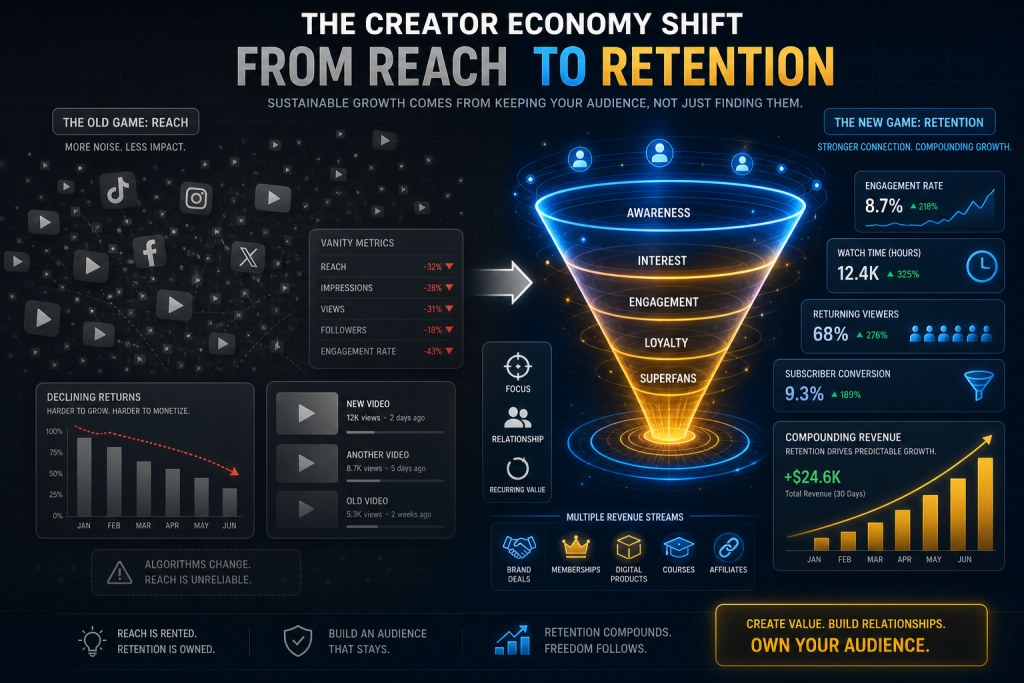
The creator economy is growing rapidly: according to a Grand View Research forecast, the market will reach $1.35 trillion by 2033 with a CAGR of 23.3%. But the paradox is that for most creators, revenues do not grow proportionally to the audience. Platforms are changing the rules: reach is getting cheaper, and attention is getting more expensive. Algorithms increasingly reward not reach, but retention, watch depth, and return visits.
This means that a creator with 100,000 subscribers getting random views might earn less than a creator with 10,000 loyal viewers who watch every video to the end and return for more. Viral spikes no longer create predictable monetization. The “just get reach” strategy is outdated.
In this article, we’ll break down exactly how monetization rules are changing, which behavioral signals platforms value most, and how to rebuild your revenue funnel—from ad shares to your own products.
What changed: from reach to retention
For a long time, the formula was simple: a large audience = predictable visibility = predictable income. A creator with a million subscribers could count on a steady stream of ad money and brand deals. This connection worked because platforms distributed content primarily based on reach and virality.
Now everything is different. Platforms increasingly redistribute the feed in favor of content that holds attention, rather than just spreading. The signals that matter have become behavioral:
- Watch time — how many minutes the viewer spent on the content.
- Watch depth — did they watch to the end or leave at the 15th second.
- Return rate — does the viewer come back to the same creator.
- Series engagement — do they consume multiple videos/posts in one session.
This changes the economics of the creator model. Audiences built on random viral spikes will find it increasingly difficult to maintain reach. And creators with a smaller but engaged base will start earning more consistently.
Why reach has gotten cheaper
Reach has gotten cheaper for several reasons:
- Content saturation. Over 500 hours of video are uploaded to YouTube every minute. The competition for attention is colossal.
- Algorithmic shifts. Platforms optimize not for the number of impressions, but for the total time a user spends on the platform.
- Fragmentation of attention. Viewers switch between Shorts, Reels, TikTok, podcasts, and articles in a matter of minutes.
- Devaluation of superficial metrics. Brands and advertisers have learned to distinguish inflated views from real impact.
The result: a million views from the recommendation feed can bring less income than 50,000 views from subscribers who watch to the end, comment, and return.
Behavioral signals platforms value
Let’s look at the key metrics that algorithms use when distributing traffic and monetization.
Watch Time
YouTube and similar platforms have long moved away from pay-per-click. The main signal is total watch time. A 20-minute video that 60% of viewers watch to the end will be pushed higher by the algorithm than a one-minute clip with 90% completion but zero return rate.
Watch Depth
Depth is the proportion of content the viewer actually consumed. If the average viewer leaves at 10% of the video, the platform considers the content weak, even if it gained a million impressions in the first hours.
Return Rate
Platforms track whether a viewer returns to a creator. If a viewer watched one video and never returned, that’s a signal the content attracted them by chance. If a viewer returns regularly, the algorithm boosts the creator’s priority in the feed.
Cross-engagement
When a viewer watches several videos from the same creator in a session, this is the strongest signal of loyalty. Platforms use it for recommendations: “If you like this creator, here’s more of their content.”
How to rebuild your content strategy
1. Series instead of one-off hits
Instead of hunting for a viral video, create series. Series build the habit of returning. A viewer who came for the first episode is more likely to return for the second if the format is predictable and interesting.
Practical example: a creator launches a weekly series “Trend Breakdown in Niche X”. Each video is 15–20 minutes, same structure, predictable schedule. After 8–10 episodes, a core of a loyal audience is formed.
2. The hook in the first 30 seconds
If a viewer leaves in the first 30 seconds, watch depth drops, and the algorithm penalizes the content. The first 30 seconds should provide:
- A promise of value (“In this video, we’ll break down three mistakes that cost you 30% of your conversion”).
- Contrast or intrigue.
- A clear topic—the viewer should understand what the content is about.
3. Internal transitions and playlists
Organize content into playlists and guide the viewer from one video to the next. This increases cross-engagement and total time on the platform—exactly what algorithms reward.
4. Content worth saving
Content that viewers save “for later” or forward to colleagues gets an additional algorithmic boost. This is content with long-term value: guides, breakdowns, tutorials, checklists.
Creator monetization funnel in 2026
The traditional monetization model looked like this: views → ad shares → brand deals. In 2026, this is not enough. According to Goldman Sachs, brand deals make up about 70% of creators’ revenues, but this model is fragile—ad budgets are cut during crises, and competition for deals is growing.
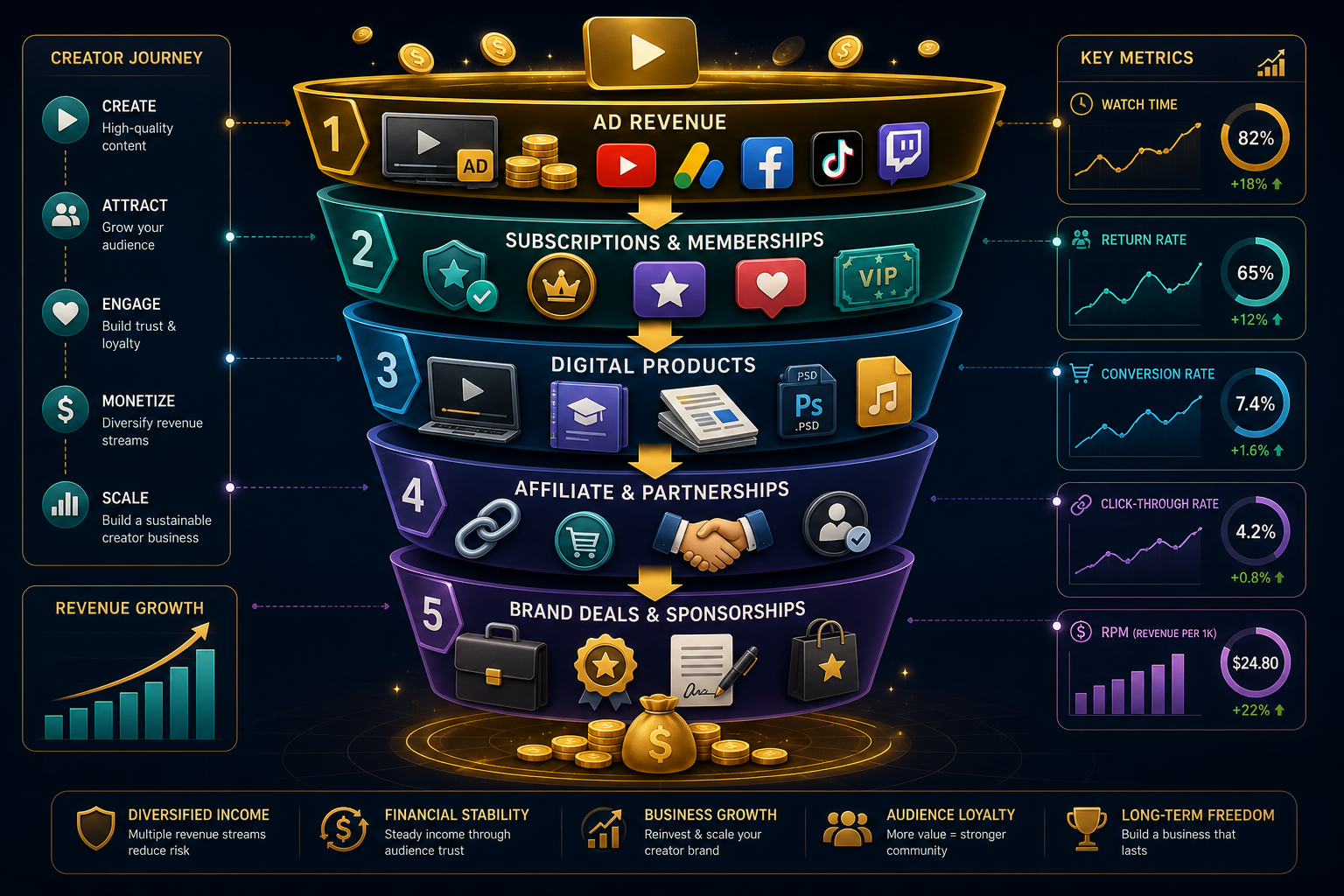
A modern monetization funnel should include several levels:
Level 1: Platform ad shares
The base layer is revenue from ad impressions on the platform (YouTube AdSense, Shorts monetization, Reels). It depends on watch depth and retention. The higher the watch time, the more ad inserts and the higher the RPM.
Level 2: Direct audience monetization
- Subscriptions and memberships — a recurring payment for exclusive content.
- Donations and Super Thanks — one-time tips from viewers.
- Paid closed communities (Telegram channels with paid subscriptions, Patreon, Boosty).
Level 3: Own products
- Online courses and educational programs.
- Templates, guides, checklists.
- Physical merch.
- SaaS tools (if the creator works in a technical niche).
Level 4: Affiliate programs
Affiliate links to tools, services, and products that the creator actually uses. This doesn’t require their own development and scales with audience growth.
Level 5: Brand deals and sponsorships
Brand deals remain an important channel, but now brands are looking for influence, not reach. A creator with 20,000 engaged subscribers in a narrow niche can get better terms than a creator with 200,000 random subscribers.
Practice: metrics to track
Many creators continue to focus on views and subscribers. But in 2026, these metrics are just the tip of the iceberg. Here’s what you need to track:
| Metric | What it shows | Why it’s important |
|---|---|---|
| Average View Duration | Average watch time | Main signal for the algorithm |
| Returning Viewers % | Percentage of returning viewers | Shows audience loyalty |
| Click-through Rate (CTR) | Thumbnail clickability | Affects initial reach |
| Revenue per 1,000 views (RPM) | Revenue per thousand views | Real monetization, not a vanity metric |
| Conversion to paid | Percentage of free audience that converted to paid | Funnel efficiency |
Mistakes that kill monetization
Mistake 1: Chasing trends instead of a niche
The creator jumps from topic to topic, trying to catch the wave. The algorithm doesn’t understand who to show the content to. An audience isn’t formed. Return rate is zero.
Mistake 2: Ignoring the first seconds
The content starts with a long intro, “hello everyone, my name is…” — the viewer leaves. Watch depth drops. The algorithm penalizes it.
Mistake 3: One revenue model
The creator relies only on ad shares. The platform changes the rules — income drops by 40% in a month. There is no safety cushion.
Mistake 4: Quantity over quality
The creator publishes 3 videos a day, but each is 2 minutes long without depth. The algorithm sees low retention and cuts reach. One strong video a week is better than five weak ones.
Outlook: where the creator economy is heading
According to a Grand View Research forecast, the creator economy market will grow from $310 billion in 2026 to $1.35 trillion by 2033. But market growth doesn’t mean automatic revenue growth for every creator. On the contrary — competition will intensify, and platforms will continue to redistribute traffic in favor of retention.
Key trends that will shape the market:
- AI tools will lower the barrier to entry for content creation, but will raise the requirements for quality and uniqueness.
- Direct monetization models (subscriptions, memberships, own products) will grow faster than ad shares.
- Community-oriented content will displace mass reach content — creators who build communities will gain an advantage.
- Retention economy — platforms will increasingly pay for retention, not for acquisition.
Checklist: how to rebuild your monetization strategy
- Audit current metrics: look at Average View Duration and Returning Viewers over the last 30 days
- Define your niche and series format — abandon chaotic topics
- Rewrite the first 30 seconds of each video: value promise + intrigue
- Launch at least one direct monetization channel (subscription, Boosty, Patreon)
- Create one own product: a mini-course, guide, template
- Add affiliate links to tools you actually use
- Track RPM and conversion to paid — not just views
Conclusion
The creator economy is growing, but the rules of the game are changing. Reach no longer equals income. Platforms pay for attention, retention, and loyalty — not for views in themselves. Creators who rebuild their strategy from “get reach” to “retain and monetize” will gain an advantage. Those who continue to chase viral spikes will find that reach is getting cheaper, and attention is getting more expensive.
FAQ
What does “reach is getting cheaper, and attention is getting more expensive” mean?
It has become easier to get impressions — there is a lot of content, algorithms actively recommend it. But retaining a viewer and making them return is increasingly difficult. Platforms pay for retention, not for impressions, so “cheap” reach brings less income.
What metrics are most important for monetization in 2026?
Average View Duration, Returning Viewers, RPM (revenue per thousand views), and conversion of the free audience to paid. These metrics more accurately reflect the real value of the audience than views and subscribers.
Should I give up brand deals?
No, brand deals remain an important channel (about 70% of creators’ revenues). But relying only on them is risky — ad budgets are cut during crises. Diversify: add subscriptions, your own products, and affiliate programs.
How will AI affect creator monetization?
AI lowers the barrier to entry — it will become easier to create content, competition will grow. But AI also helps analyze metrics, generate ideas, and automate routine tasks. Creators who use AI for quality, not for mass generation, will gain an advantage.
What to do if views are growing, but income is falling?
Check watch depth and return rate. Growing views with falling income usually means the content attracts random viewers who don’t stay. Rebuild your strategy around series, niche, and retention.