Why Brand Equity is the New AI Visibility Factor
A WARC study published in August 2026 states that long-term brand equity explains a significant portion of visibility in LLM responses. Brands with consistent proof points, strong reviews, and clear differentiation win in AI search. This means content teams can no longer rely solely on optimizing article structure and metadata—they must systematically embed brand signals into every piece of content.
The practical takeaway for editorial teams: a brand’s “AI availability” is a new KPI that requires not just the SEO team, but content operations. Brand signals must be machine-readable—meaning structured, repeatable, and specific enough for an LLM to recognize, compare, and cite them.
What is a “Machine-Readable Brand” in the Context of LLMs?
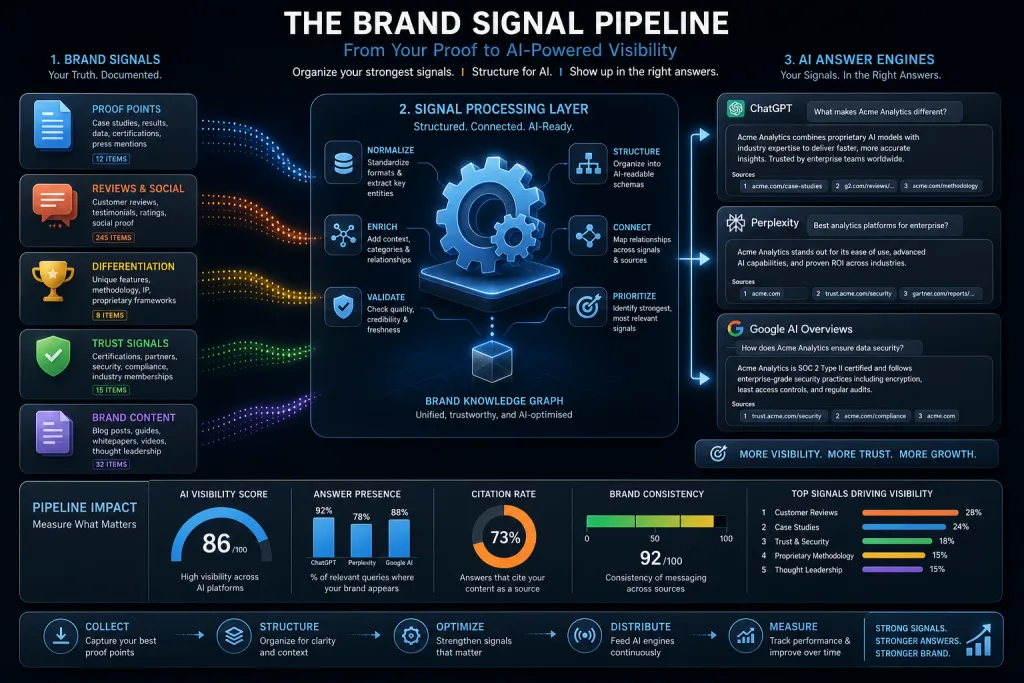
A machine-readable brand is a set of structured signals in content that an LLM can extract, match, and use in its responses. Unlike traditional branding aimed at human perception (visual style, tone, emotions), a machine-readable brand focuses on:
- Proof points — specific, verifiable facts: numbers, results, certifications, comparative data.
- Consistency of phrasing — repeating key messages using the exact same words across different pages.
- Differentiation — clear, unique statements that distinguish the brand from competitors.
- Authority signals — links to primary sources, expert quotes, research data.
LLMs don’t “see” logos or “feel” tone. They process text as tokens and look for patterns. If your brand is described in 100 different ways across 100 pages, the model won’t form a stable understanding. If those same 100 pages contain 5–7 consistent proof points using identical phrasing, the model will anchor them as brand attributes.
Proof Points: How Editorial Teams Embed Evidence in Content
Proof points are not marketing claims; they are verifiable facts with a source. Content teams often confuse marketing fluff (“best in the market”) with proof points (“ISO 27001 certified, 99.98% uptime in Q2 2026”). To an LLM, the latter is a signal, while the former is noise.
A practical approach to embedding proof points in long-form content:
- Create a proof point registry — a table of 10–20 key facts with sources, dates, and phrasing. This is a living document updated as new data emerges.
- Standardize phrasing — every proof point should have a canonical version that copywriters and AI assistants use verbatim.
- Distribute across the content portfolio — each proof point should appear on at least 5–10 relevant pages, not just on a single “facts” page.
- Provide context — a proof point without context is useless. “99.98% uptime” next to an infrastructure description is a signal. The same fact in the footer is noise.
AI tools can assist in the distribution phase: a prompt system can scan the content portfolio and identify pages where proof points are missing or phrased non-canonically.
Differentiation: Why LLMs Cite Unique Phrasing
LLMs are trained on massive text corpora and tend to cite phrasing that is frequent enough to become “knowledge” but specific enough to be unique. Generic content — “we offer quality business solutions” — is never cited because it carries no information. Specific content — “the platform processes 2.3 million transactions per day with sub-50ms latency” — gets cited because it contains unique data.
For content teams, this means revising editorial standards: every article must contain at least one differentiating argument that competitors lack. This could be:
- Proprietary data or research
- A unique methodology
- A comparison table with specific parameters
- An expert stance backed by experience
- A case study with measurable results
AI generation without differentiation is a direct path to invisibility. If your AI assistant generates text that could have been produced by any other model, the LLM will find no reason to cite it.
Signal Consistency: How to Maintain Unified Positioning Across 100+ Pages
The most challenging aspect of a machine-readable brand is consistency. When a 15-person content team produces 200+ articles a year, maintaining uniform phrasing for proof points and differentiation requires a system, not reliance on editorial memory.
Practical mechanisms:
- Brand glossary in the CMS — a structured list of canonical phrasing accessible to editors and AI assistants via API. During content generation, the prompt automatically includes relevant proof points.
- AI consistency audit — periodically running an LLM over the content portfolio to identify pages where the brand is described non-canonically. The result is a list of pages to edit.
- Content templates with built-in slots — article structures where proof points and differentiating arguments have predictable positions (e.g., a “Why it matters” block after the introduction).
- Editor review checklist — a checklist including verification of proof points, phrasing canonicality, and differentiation before publication.
Consistency doesn’t mean monotony. Articles can vary in style, depth, and format, but the brand’s key messages must sound the same. An LLM builds its understanding of a brand through the frequency and consistency of signals, not through phrasing variety.
Reviews and Comparisons as the New Interface Between Brand and AI
One of the key findings of the current AI search landscape: the content LLMs cite most often isn’t corporate blogs or landing pages, but third-party reviews, comparison articles, and curated recommendations. Publishers are becoming intermediaries not just between brands and consumers, but between brands and AI algorithms.
This shifts the content strategy for brands that historically relied on their own channels. If your brand isn’t mentioned in third-party reviews and comparisons, the LLM lacks external proof points to cite. Content teams must:
- Monitor third-party mentions — track where the brand appears (or doesn’t) in reviews, rankings, and comparisons.
- Proactively supply data — provide publishers with accurate specs, case studies, and proof points they can use in their content.
- Produce original comparative content — objective comparisons with competitors based on verifiable data, not marketing claims.
For affiliate and partner content teams, this means the quality and specificity of reviews directly impacts whether they become a citation source for AI responders. Generic reviews like “this product is great for small businesses” don’t get cited. Reviews with specific parameters, tests, and comparison tables do.
Practical Framework: Auditing Brand Signals in a Content Portfolio
A brand signal audit is a systematic review of a content portfolio for the presence, consistency, and specificity of proof points, differentiation, and authority signals. The workflow:
Step 1. Inventory proof points. Gather all key facts about the brand, product, or service into a single table. For each proof point, specify: phrasing, source, date, status (current/outdated).
Step 2. Coverage map. Go through the content portfolio and mark which pages feature each proof point. Use an AI tool for automated scanning — a prompt can identify pages with and without proof points.
Step 3. Consistency check. For each proof point, verify whether the canonical phrasing is used. Mark variations as “needs editing.” An AI audit can flag non-canonical phrasing automatically.
Step 4. Differentiation assessment. For each page, answer: does it contain at least one argument that competitors lack? If not, the page is a candidate for optimization.
Step 5. Prioritization. Rank pages by priority: high traffic + low proof point coverage = urgent fix. Low traffic + high coverage = can wait.
Step 6. Optimization and publishing. Make edits, update proof points, add differentiating arguments. After publishing, run a follow-up AI audit in 2–4 weeks.
Metrics: How to Measure Brand “AI Availability”
Brand AI availability isn’t an abstract concept; it’s a measurable set of metrics. Content teams can track:
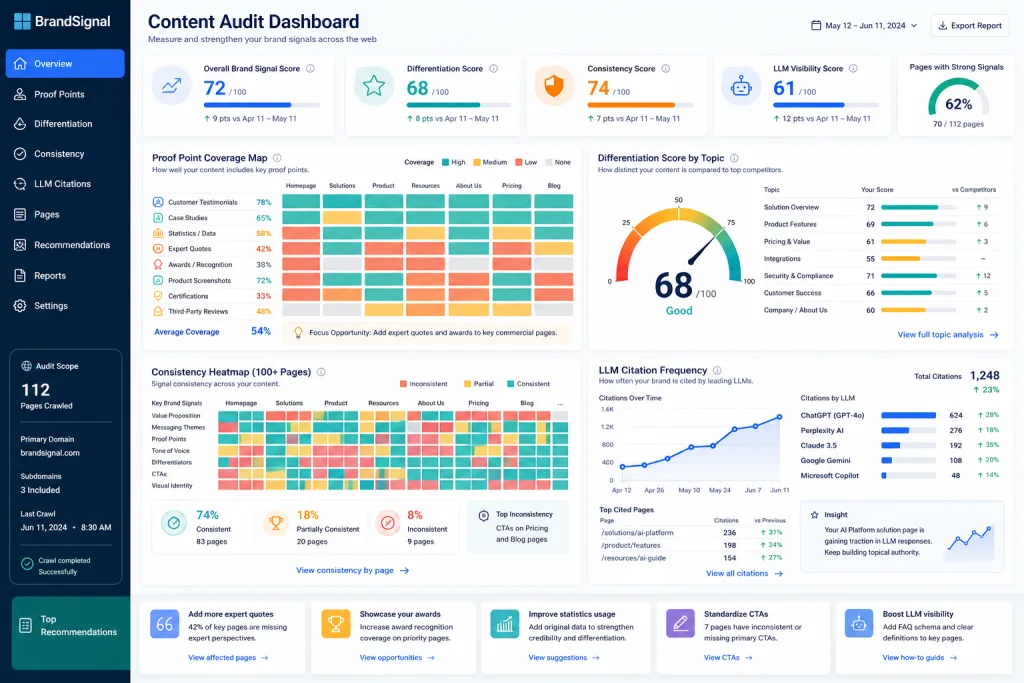
- Proof point coverage — the percentage of pages in the portfolio containing at least one canonical proof point. Goal: 80%+ for key sections.
- Consistency index — the share of pages where proof points are phrased canonically. Goal: 90%+.
- Differentiated page share — the percentage of pages with at least one unique argument. Goal: 60%+ (not every page needs to be unique, but key ones must be).
- Citation frequency in AI responses — how often the brand is mentioned in ChatGPT, Perplexity, and Gemini responses to key prompts. Measured via periodic prompt audits or specialized tools.
- Third-party mention share — the percentage of brand citations from third-party sources vs. owned media. A high share of third-party mentions indicates strong brand equity.
These metrics complement rather than replace traditional SEO tracking. Content teams need a dedicated AI availability dashboard showing how “machine-readable” the brand is for LLMs.
The Kadkon Perspective: What This Means for Affiliate and Partner Content Teams
For affiliate publishers and partner content teams, the shift toward machine-readable brands has direct economic implications. If your review content is cited in AI responses, you gain not only traffic (when the AI engine links back) but also a “virtual reference” — a mention that drives demand during the research phase. This is especially significant for niches with long decision cycles: B2B software, financial products, telecom services.
Practical takeaway: affiliate teams must invest in the quality and specificity of review content as much as in its volume. One detailed comparative review with tests and specific parameters can generate more AI citations than 20 generic articles. This changes the economics of content production: fewer materials, more depth, higher AI visibility.
Checklist: Auditing Machine-Readable Brand in Content
- Compiled a registry of 10–20 proof points with sources and canonical phrasing
- Each proof point appears on at least 5–10 relevant pages in the portfolio
- Conducted an AI consistency audit: identified and fixed non-canonical phrasing
- Every key page contains at least one differentiating argument absent from competitors
- Set up an AI availability dashboard: proof point coverage, consistency index, citation frequency
- Launched a monitoring process for third-party brand mentions in reviews and comparisons
FAQ
How do proof points differ from regular marketing claims?
Proof points are verifiable facts with a source: numbers, certifications, test results, comparative data. Marketing claims (“best,” “reliable”) carry no information for LLMs and aren’t cited. Proof points, on the other hand, give the model specific data to use in its response.
How often should the proof point registry be updated?
At least once a quarter, and immediately upon active product launches or data updates. Outdated proof points (e.g., last year’s data without updates) reduce the LLM’s trust in the content. Every update should be accompanied by an AI portfolio audit for consistency.
Should proof points be embedded in every article or only key ones?
Not every article requires proof points — for instance, news briefs or educational materials can do without them. But key pages (product, comparison, “about us”) should contain 3–5 proof points in canonical phrasing. The goal is 80%+ coverage for priority sections.
How does AI generation affect the consistency of brand signals?
Uncontrolled AI generation can destroy consistency: the model phrases proof points differently in each text. The solution is a system prompt with an embedded brand glossary that forces the use of canonical phrasing. Post-generation editorial review against the registry is mandatory.
Can brand AI availability be measured without paid tools?
Yes, basic measurement is possible through periodic prompt audits: run 20–30 key prompts in ChatGPT, Perplexity, and Gemini, and record brand and source mentions. For deeper analysis, use a RAG prototype or specialized LLM SEO platforms, but an initial audit can be done manually.