In August 2026, job postings appeared on Indeed that seem paradoxical: companies are hiring “SEO Content Writer/Editor (Edit AI-Generated Content)” at $25–28 per hour, noting that finalizing a single article takes 5–6 hours. Another posting—”Content Editor / Writer with Machine Learning Experience”—requires AI/ML expertise and also involves step-by-step editing of generated materials. These aren’t isolated cases: the market is forming a new role—the AI editor, whose task isn’t to write text, but to bring an AI draft to publishable quality within a predictable time and budget. But what exactly takes up these 5–6 hours? And can the cycle be shortened without sacrificing quality? Let’s break it down step by step.
What is AI Editing and How It Differs from Regular Editing
Classic editing works with human-written text: the author has already made decisions about structure, argumentation, tone, and sources. The editor checks logic, style, and facts, but doesn’t doubt basic coherence—it’s there by definition. AI editing works with model-generated text. The draft looks coherent, but there’s no intent behind this coherence: the model didn’t “decide” which argumentation to choose; it statistically completed the most probable sequence of tokens. This creates specific problems absent in human text: – Drifting facts: the model might insert a plausible but incorrect figure, name, or date that isn’t immediately obvious. – Generic tone: the text sounds “fine” but lacks voice or perspective. – Circular reasoning: a thesis is “proven” simply by restating it. – Misleading structure: headings look logical, but the sections fail to deliver on the promised topic. – Hallucinated citations: the model might reference a non-existent study or misattribute a real one. This is why AI editing isn’t cosmetic tweaking, but a full editorial cycle comparable in effort to writing an article from scratch.
Breaking Down the 5–6 Hour Cycle: Where the Time Goes
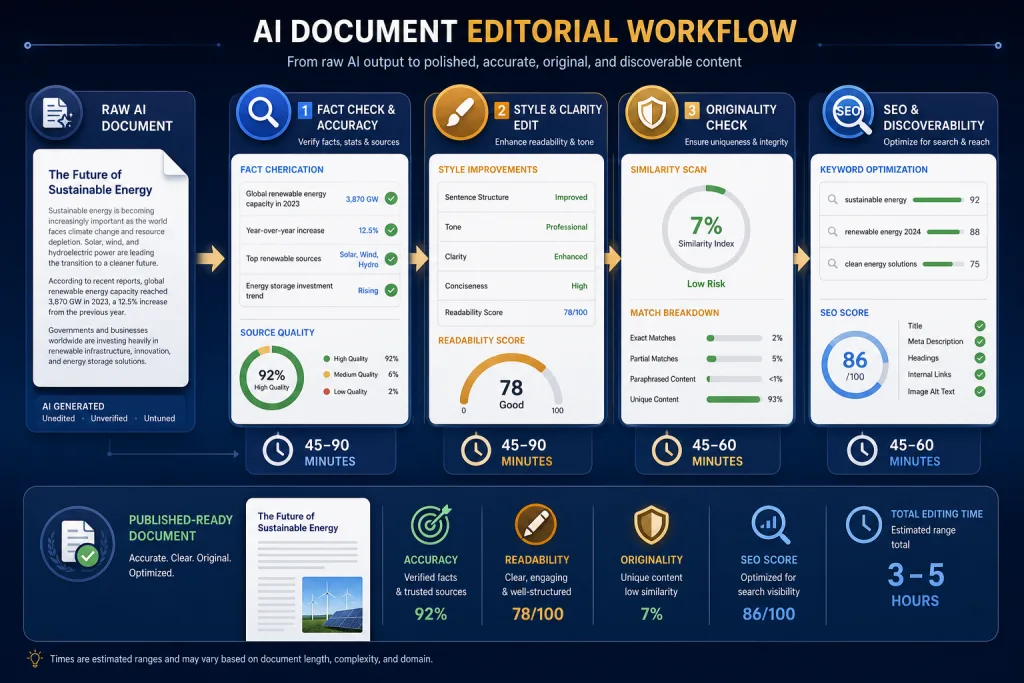
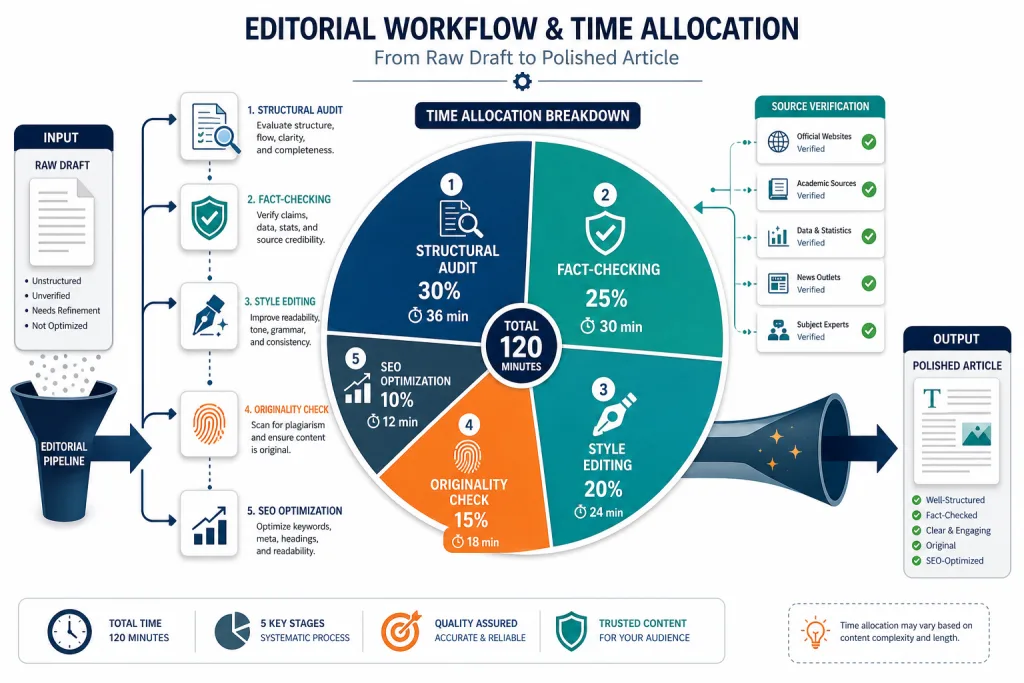
The job postings from August 2026 give a concrete starting point: 5–6 hours per article. Let’s break down how this time is distributed across stages and which ones can be optimized.
Stage 1: Structural Audit (45–60 minutes)
The editor reads the entire draft and evaluates: does the structure match the stated topic, are there logical gaps, do sections duplicate, is there enough depth in each block. At this stage, it often turns out the AI draft is superficial: the model “skirted” complex parts because it lacked sufficient context. What to do: compare the structure with the content brief before generation. If there was no brief, create a retrospective outline and mark where depth is missing.
Stage 2: Fact-Checking (90–120 minutes)
This is the most labor-intensive stage. Every claim, figure, quote, and link is checked against primary sources. Models are prone to “plausible inaccuracies”—for example, they might name the right company but the wrong year, or correctly describe a study but attribute it to the wrong author. Editorial practice shows that a 1500–2000 word article has 15–30 verifiable claims. If each requires 3–5 minutes of search and verification, that’s 45–150 minutes of pure fact-checking. What to do: use AI notebooks (NotebookLM and equivalents) to upload primary sources before generation—this reduces hallucinations by 60–80% and cuts fact-checking down to spot verification.
Stage 3: Style and Voice Editing (60–90 minutes)
AI text is usually written in “average corporate English”—grammatically correct, but without character. The editor rewrites introductory constructions, removes clichés (“in today’s fast-paced world”), adds specifics, and aligns the tone with brand guidelines. This stage is hard to automate because it requires editorial judgment: what to keep, what to rewrite, what to cut. What to do: use system prompts with style examples and banned constructions. This doesn’t eliminate manual editing, but reduces its volume.
Stage 4: Originality and AI Detection Check (30–45 minutes)
Even if the text is written by a human based on an AI draft, platforms might flag it as AI-generated. The editor checks: – Percentage of overlap with existing texts (plagiarism). – AI detector scores (understanding their limitations—a percentage score without an evidence base). – Presence of “machine” patterns: repetitive syntax, uniform paragraph lengths, excessive use of transitional phrases. What to do: don’t rely on a single detector. Use 2–3 tools and interpret the results as a signal, not a verdict.
Stage 5: SEO and Structural Optimization (30–45 minutes)
The final stage: checking headings, meta descriptions, internal linking, markup, and readability. If the article is intended for AI search, additional checks include: presence of clear definitions, structured lists, direct answers to likely queries. What to do: move SEO checks to a separate checklist to avoid mixing them with content editing.
Total: 4 hours 15 minutes — 6 hours
This varies depending on article length, topic complexity, and the quality of the initial draft. But the basic economics are clear: AI doesn’t reduce the editorial cycle to zero—it shifts costs from “writing” to “editing and verification.”
Why the Naive “Just Generate More” Approach Fails
Many content teams in 2025–2026 went through the exact same cycle of disappointment: 1. They adopt AI generation. 2. They increase volume 3–5 times. 3. They discover quality drops, fact-checking can’t keep up, and platforms start flagging content. 4. They scale volume back and introduce human-in-the-loop. The problem is that generation is the cheapest and fastest stage of the pipeline. The bottleneck is editing. If a team generates 50 articles a week but can only edit 10, 40 articles sit in drafts or are published raw. The second scenario is worse: raw AI content gets indexed, gets no traffic, dilutes E-E-A-T, and in the long run reduces trust in both the content and the platform.
How to Optimize the Editing Pipeline
Optimizing AI editing isn’t about “doing it faster,” but “doing less editing thanks to better input.” Here are specific levers.
1. Content briefs before generation
If the model only gets a topic and a keyword, it generates an average text. If it gets a brief with theses, sources, structure, and target audience—the draft requires 40–60% less editing. The brief should include: – The article’s goal and target query. – 3–5 key theses backed by sources. – Structure with expected depth for each section. – Style constraints (voice, tone, banned constructions). – Links to 3–5 primary sources to load into the context.
2. Prompt systems instead of one-off prompts
A one-off prompt “write an article about X” gives an unpredictable result. A system prompt with saved brand context, style, and structure gives a repeatable result that requires less editing. Teams that have implemented saved prompt personas reduce the style editing stage by 50–70%.
3. Role separation in the editing cycle
One mistake is assigning the entire cycle to one person. August 2026 job postings show companies hiring editors who do everything: fact-checking, style, SEO. But separating roles is more efficient: – Fact-checker verifies claims and sources. – Style editor works with voice and structure. – SEO optimizer checks technical aspects. This doesn’t mean you need three people per article. It means one person can go through the article in three passes, each with a different focus—instead of trying to “fix everything at once,” which leads to missed errors.
4. Templates for recurring content types
If a team regularly publishes similar materials (tool reviews, how-to guides, comparisons), structure templates cut the structural audit stage down to 10–15 minutes. The template fixes: mandatory sections, order, depth, types of sources.
5. Cumulative database of verified facts
Every time a fact-checker verifies a claim, the result can be saved to a shared database. For the next article on a related topic, the model receives already verified facts in context, reducing repeated fact-checking.
The Economics: When AI Editing Makes Sense
At a rate of $25–28 per hour and a 5–6 hour cycle per article, the cost of editing a single article is $125–168. If you add the cost of generation (tool subscriptions, API costs), the total cost per article is $130–180. For comparison: writing an article from scratch by a journalist in the US costs $200–500. That is, AI editing is cheaper, but not by an order of magnitude—about 30–50%. The real savings are achieved not on a single article, but at scale: at 100 articles per month, the savings amount to $7,000–32,000. But this only works if the editing pipeline can handle the volume. If a team generates 100 articles but can only edit 30, the savings are diluted, and 70 raw articles create a reputational risk.
Checklist: How to Shorten the AI Editing Cycle
- Create a content brief with theses and sources before generation, not after
- Load 3–5 primary sources into the model’s context (NotebookLM or equivalents) to reduce hallucinations
- Use a saved system prompt with style constraints and banned constructions
- Divide the editing cycle into three passes: facts → style → SEO, instead of “fixing everything at once”
- Create structure templates for recurring content types
- Maintain a cumulative database of verified facts for related topics
- Don’t publish unchecked AI drafts—raw content dilutes E-E-A-T
Risks and Limitations of AI Editing
The first risk is a false sense of readiness. An AI draft looks finished: literate, structured, with headings and conclusions. An editor not used to working with AI text might miss hidden problems—hallucinated facts, circular reasoning, lack of real depth. The second risk is detection and reputation. Even edited AI text can get a high AI detector score. As academic editorial practice shows, detectors provide a percentage score without an evidence base—there is no confidence interval or verifiable sources. This doesn’t mean the score should be ignored, but it shouldn’t be taken as a verdict either. The third risk is scaling without throughput. Teams increase generation without increasing editing capacity. The result is an accumulation of unpublished drafts or the publication of raw content. The fourth risk is content averaging. If all articles go through the same prompt and the same editing cycle, they start to sound the same. This reduces differentiation and makes content interchangeable—and interchangeable content is exactly what AI search synthesizes on its own, without citing the source.
Practical Takeaway: AI Editing Is an Editorial Process, Not Just “Text Correction”
The August 2026 job postings capture a new reality: the market recognizes that AI generation doesn’t replace editing, but changes its structure. 5–6 hours per article isn’t “a lot” or “a little,” it’s the real cost of bringing an AI draft to publishable quality. Teams that understand this economy and optimize inputs (briefs, prompt systems, verified sources) shorten the cycle to 2–3 hours. Teams that simply “generate more” get either a queue of unpublished drafts or a stream of raw content that doesn’t rank or get cited.
FAQ
Why does editing AI text take as much time as writing from scratch?
Because an AI draft looks finished, but has no intent behind the text. The editor must verify every claim, rebuild the argumentation, add depth and voice—this is comparable to authorial work. The difference is that the structure is already there, but its reliability is in question.
Can the AI editing cycle be reduced to 1–2 hours?
Yes, provided there is quality input: a content brief with theses, uploaded primary sources, a system prompt with style. In this case, the model generates a more accurate draft, and the editor spends time only on spot verification and style editing. Without these investments in input—no.
Should AI detectors be trusted during editing?
AI detectors give a percentage score without an evidence base—there is no confidence interval or verifiable sources. Use them as a signal, not a verdict. It’s better to check for specific patterns: repetitive syntax, uniform paragraph lengths, clichés.
What role does fact-checking play in AI editing?
Fact-checking is the most labor-intensive stage (90–120 minutes per article). Models are prone to plausible inaccuracies: the right company, but the wrong year; the right study, but the wrong author. Every claim, figure, and link is checked against primary sources.
Which is more cost-effective: AI generation with editing or writing from scratch?
At a rate of $25–28/hour and a 5–6 hour cycle, the cost of an AI article is $125–168. Writing from scratch in the US is $200–500. Saving 30–50% per article, but it is only realized with sufficient editing throughput. If the pipeline can’t handle the volume, the savings are diluted.