Why an Out-of-the-Box AI Tool is Just the “Internet Average”
Any AI content tool you just installed knows your company’s strategy about as well as a random intern on their first day. It doesn’t know your readers, doesn’t understand why you deliberately break “best practices” in certain sections, and has no historical data on which formats drive conversions. Without prior configuration, it produces the “internet average”—technically competent text that is strategically empty.
The problem doesn’t start when AI makes a mistake. Mistakes are expected. The problem starts when a content team accepts an unverified AI draft or audit as the final verdict and pushes it to production. This is where context ceases to be just a tool “feature” and becomes an editorial discipline—a set of repeatable habits that keep automation aligned with real business results.
Three Habits of Contextual AI Automation
For an AI tool to work not “on average” but for your strategy, three systemic habits are needed. They apply both to in-house workflows and to evaluating external partners.
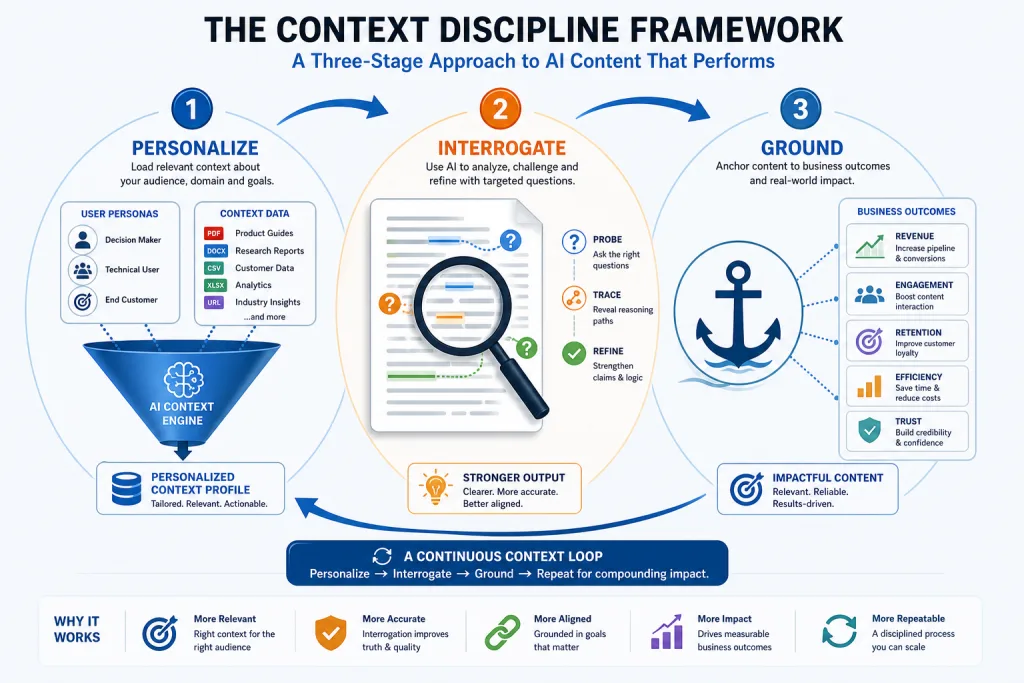
1. Personalize the Tool Before You Trust It
Out of the box, every AI tool is an averaged model of the internet. Before asking it anything that affects your budget or editorial plan, you need to invest time in loading context. This isn’t a one-time setup; it’s systematic work.
What to load into the system prompt or the tool’s knowledge base:
- Descriptions of target audiences and personas with their pain points
- Market dynamics and competitive positioning
- Historical content performance data—which topics, formats, and angles yielded the best results
- Editorial style guide with examples of “good” and “bad”
- Glossary of terms and forbidden phrasing
- Data on where you deliberately break platform standards and why
Without this layer of context, AI will optimize for universal “best practices” that may directly contradict your competitive strategy.
2. Interrogate the Reasoning, Not Just the Output
When an AI tool produces a draft article, a content portfolio audit, or a budget allocation recommendation, the content team usually looks at the final result. But the main risk is hidden in the reasoning.
The tool might produce a correct conclusion for the wrong reasons—and that’s a ticking time bomb. If you don’t understand why the AI recommends a particular angle or structure, you won’t be able to assess whether it applies to your context next time.
Reasoning interrogation practice:
- Ask the AI to explain its thought process: “Describe why you chose this particular structure and what data influenced it”
- Check whether the model relies on loaded context or universal templates
- Compare the reasoning with historical data: does it align with what worked before
- If the AI can’t explain its logic—it’s a signal that the output cannot go to production without manual review
3. Context is a Discipline, Not a Feature
Context cannot be “turned on” with a single button. It’s not a setting in the tool’s interface; it’s a team’s systemic habit. Every generation, every audit, every recommendation must pass through the filter: “Does the tool know our context and account for it?”
This habit requires organizational changes:
- Assigning a person responsible for contextual setup of AI tools
- Regularly updating loaded context as strategy changes
- Integrating a contextual verification checklist into the editorial workflow
- Documenting cases where AI produced a good result without context and analyzing whether it was a coincidence
How to Embed Contextual Discipline into the Editorial Workflow
Knowing the three habits is the first step. The second is integration into the daily content creation process. Contextual discipline only works when it’s built into the workflow, not existing as a separate “post-hoc check.”
The System Prompt as a Context Carrier
A system prompt isn’t just an instruction to “write in a certain style.” It’s the primary carrier of editorial context that turns a universal model into a specialized tool. The more structured and detailed the prompt, the less averaging in the output.
Structure of a contextual system prompt:
- Role and task of the model — who it is in the editorial process and what exactly it should do
- Audience description — who we’re writing for, their pain points, level of expertise
- Editorial style guide — style rules, forbidden phrasing, examples
- Strategic context — positioning, competitive landscape, unique angles
- Historical data — what worked before, metrics of successful content
- Constraints and guardrails — what the model shouldn’t do, facts to verify
- Output format — structure, length, mandatory elements
Each section must be specific. “Write for marketers” is weak context. “Write for content marketers in B2B companies with a team of 3-5 people who use AI tools but struggle with content averaging” is strong context.
The Knowledge Base as Dynamic Context
The system prompt has a limit. A knowledge base—RAG system or files loaded into the tool—solves the scale problem. It’s dynamic context that updates along with your strategy.
What to store in the AI tool’s knowledge base:
- Archive of published articles with performance metrics
- Original research and primary data on which content is built
- Competitive analysis and positioning tracking
- Reader feedback and article comments
- Internal documents: content strategy, editorial policy, glossary
The knowledge base makes the AI tool “remembering.” Without it, every generation starts from scratch, and the model relies on universal knowledge rather than your experience.
Reasoning Verification: How to Interrogate AI in the Newsroom
“Reasoning interrogation” is the least obvious of the three habits. Teams are used to checking facts in the output, but not the logic that led to it. Meanwhile, an unjustified conclusion is the main source of strategic errors in AI content.
When Checking Reasoning is Critical
Not every generation needs to be dissected. But there are situations where interrogation is mandatory:
- AI recommends a structure or angle that contradicts your usual practice
- The tool suggests cutting or expanding a section, and you don’t understand why
- An AI audit evaluates content as “weak” or “strong” without explaining the criteria
- The model suggests a topic or headline that seems off-brand for your editorial team
- AI generates factual claims not supported by loaded sources
How to Conduct an Interrogation
Use meta-prompts—queries that ask the model to explain its own reasoning. Examples:
- “Describe step-by-step how you arrived at this article structure. What factors did you consider?”
- “What data from the loaded context did you use, and what did you ignore?”
- “If you were writing for [a different audience], how would the structure change?”
- “What alternative structures did you consider and why did you reject them?”
Answers to these questions will show whether the model is working with your context or generating “by default.”
Integration into Content Operations: From Habit to Process
Contextual discipline won’t survive if it depends on an individual editor’s memory. It must be built into content operations—the system that manages the creation, verification, and publication of content.
Roles and Responsibilities
- AI Editor — responsible for contextual setup of tools, updating system prompts and knowledge bases
- Fact-checker — checks factual claims in AI outputs, especially those not supported by loaded sources
- Editorial Producer — ensures every AI draft passes through the contextual verification checklist before hitting production
- Content Strategist — determines what strategic data should be loaded into AI tools and how often to update
Workflow with Contextual Verification
The standard “generation → review → publication” workflow is insufficient. Contextual discipline requires an intermediate step:
- Generation — AI creates a draft based on the system prompt and knowledge base
- Contextual verification — the editor checks whether the output accounts for loaded context
- Reasoning interrogation — for non-standard or contradictory outputs—a request for the model’s reasoning
- Fact-checking — verification of factual claims
- Publication — only after passing all stages
Practice: Setting Up a Contextual AI Workflow from Scratch
If you’re starting from scratch or rebuilding an existing AI workflow, here’s a step-by-step process for implementing contextual discipline.
Step 1: Audit Existing Context
Gather everything your team knows about readers, the market, and strategy. This might be in employees’ heads, in disparate documents, in analytics. The task is to pull it into an explicit, structured format.
Step 2: Build the System Prompt
Based on the audit, create a system prompt using the structure described above. Don’t try to fit everything—select the most critical. A 2,000-3,000 token prompt with a clear structure works better than 8,000 tokens of unstructured text.
Step 3: Assemble the Knowledge Base
Load the archive of articles, research, style guide, and historical data into the tool or RAG system. Regularly update the base—stale context is worse than no context.
Step 4: Implement the Contextual Verification Checklist
Create a 5-7 point checklist that the editor goes through before accepting an AI draft. The checklist should be built into the CMS or content operations system, not lying in a separate document.
Step 5: Train the Team on the Three Habits
Explain to the team not only how to use the tool, but why contextual discipline is critical. Run a session analyzing “good” and “bad” examples—where AI produced an averaged result due to lack of context, and where contextual setup yielded a differentiated result.
Metrics: How to Measure if Contextual Setup is Working
Without metrics, contextual discipline quickly degrades into “we load context, but don’t know if it helps.” To prevent this, track the following indicators.
Share of Content Passing Contextual Verification
The percentage of AI generations where the editor confirmed that the output accounts for loaded context. Target value—80% and above. Below 60% means the system prompt or knowledge base isn’t working.
Share of Generations Requiring Reasoning Interrogation
The percentage of AI outputs where a request for the model’s reasoning was needed. A growing indicator may mean the tool is more frequently producing non-standard outputs—this isn’t necessarily bad, but requires analysis.
Share of Factual Errors in AI Content
The percentage of published content where factual errors were found after publication. Target value—close to zero. A growing indicator means the fact-checking layer isn’t coping.
Time from Generation to Publication
Contextual discipline adds steps to the workflow. Track by how much. If time grows without an increase in quality—the process needs optimization, possibly automating part of the checks.
Risks and How to Mitigate Them
Contextual discipline isn’t without risks. Here are the main ones and ways to mitigate them.
Risk 1: Outdated Context
Problem: The knowledge base or system prompt isn’t updated. AI generates based on outdated data.
Solution: Assign a responsible person and set a regular update cycle—e.g., once a month for the system prompt and continuously for the knowledge base.
Risk 2: Excessive Context
Problem: In an attempt to load “everything,” the team creates a 10,000-token prompt that the model can’t process effectively.
Solution: Structure and prioritize. Three clear sections of 500 tokens each are better than one unstructured block of 2,000.
Risk 3: False Trust in Reasoning
Problem: AI produces a plausible explanation that is actually a hallucination. The team trusts the “logical” reasoning and misses the error.
Solution: Reasoning interrogation isn’t a replacement for fact-checking, but a supplement. Facts in the reasoning must be checked as strictly as facts in the output.
Risk 4: Team Resistance
Problem: Editors perceive contextual discipline as unnecessary bureaucracy and bypass checklists.
Solution: Show with concrete examples how contextual setup saves time on edits and improves results. Build the checklist into the tool, don’t keep it separate.
Outlook: Context as a Competitive Advantage
In a world where everyone has access to the same AI models, context becomes the main differentiator. The model is a commodity. Context is not. Teams that systematically load, update, and verify context get content that doesn’t average out, but amplifies strategic positioning.
Contextual discipline isn’t a one-off project, but a constant practice. It requires investment in “unglamorous” setup hours before you ask an AI tool for anything that affects your budget or editorial plan. But it’s these investments that separate teams using AI as an advanced autocorrect from those using it as a strategic lever.
Checklist: Implementing Contextual Discipline for AI Tools
- The system prompt contains audience description, style guide, and strategic context, not just an instruction to “write in a certain style”
- The AI tool’s knowledge base is regularly updated with an archive of articles, primary data, and historical performance
- Every AI draft passes a check: does the output account for loaded context or generate “by default”
- For non-standard or contradictory outputs, the editor requests an explanation of the model’s reasoning
- A person is assigned to update context and regularly audit the system prompt
- The contextual verification checklist is built into the CMS or content operations system, not lying in a separate document
FAQ
How is contextual setup of an AI tool different from a regular system prompt?
A regular prompt is a task instruction: “write an article on such-and-such topic in such-and-such style.” Contextual setup is loading strategic data: audiences, historical performance, competitive positioning, guardrails. The prompt tells the model what to do; context tells it for whom and why.
How often should context in the AI tool’s knowledge base be updated?
The system prompt is sufficient to review once a month or when strategy changes. The knowledge base—continuously: new articles, research, and performance data should be added as they appear. Outdated context is worse than no context because it creates a false sense that the tool “knows” your context.
What to do if the AI tool ignores loaded context and produces an averaged result?
Check the structure of the system prompt: perhaps the context is unstructured or too large. Divide it into clear blocks. Make sure the knowledge base contains relevant data. If the problem persists, use a meta-prompt: ask the model to explain whether it considered the loaded context and why it ignored it.
Is it necessary to interrogate the reasoning of every AI generation?
No. Interrogation is mandatory for non-standard outputs contradicting your practice, and for factual claims without sources. For routine template-based generations, contextual verification is sufficient. Excessive interrogation slows down the workflow without added value.
How to measure the ROI of contextual setup for AI tools?
Track the share of content passing contextual verification (goal 80%+), the share of factual errors (goal near zero), and the time from generation to publication. Compare these metrics with the period before implementing contextual discipline. If the share of contextually verified content grows, and errors decrease—the setup is working.