Short Answer
Integrating AI into editorial teams producing long-form content is almost always hindered not by the quality of models or the set of tools, but by organizational readiness. When information becomes abundant, the scarce resource is editorial judgment: the ability to evaluate, verify, structure, and contextualize AI output. Teams that benefit from AI are not the ones who found the “best prompt,” but those who systematically reassembled workflows, roles, and knowledge management around a new logic of work.
This logic is described by the concept of the “economics of judgment”: value shifts from content generation to judgment about it. For content teams, this means that investing in AI literacy, repeatable processes, and knowledge bases yields more than another model subscription.
What the “Economics of Judgment” Means for Content
In the classic editorial model, value was created through expert authorship: a person gathered facts, built an argument, and wrote the text. AI doesn’t cancel this process, but it changes the balance. Generating the first draft, finding sources, paraphrasing, localization, formatting—all of this has become cheap and fast. What used to be a bottleneck now costs almost nothing.
Tasks remain that cannot be delegated to a model without losing quality:
- evaluating topic relevance and priorities for a specific audience;
- fact-checking and verifying sources, especially in specialized domains;
- distinguishing between a banal and an original angle;
- deciding what to publish and what not to;
- accountability for the final result to the reader and the brand.
This is editorial judgment. In the “economics of judgment,” it is a scarce resource, and its throughput determines how much quality content a team can actually produce.
Why Information Abundance Changes the Value of Judgment
The paradox is simple: the cheaper the generation, the more expensive the curation. When any author can get five introduction options, three article structures, and ten headlines in a minute, the bottleneck shifts from production to validation.
In practice, it looks like this: an editor who used to spend an hour fixing structure now spends that same hour fact-checking, assessing originality, and deciding whether the material meets editorial standards. Content volume grows, but the volume of quality judgment does not, because judgment does not scale linearly with model power.
Conclusion: investing in generation tools without investing in validation processes creates an illusion of scaling. The team produces more, but quality and originality drop because judgment is spread across a larger volume.
AI Literacy as a Professional Competency
AI literacy in an editorial team is not the ability to write prompts. It is the ability to understand how AI output is formed, where the model might hallucinate, what sources it processes, and where its structural limitations lie.
For a long-form content editor, this means several specific skills:
- reading the model: understanding that an LLM doesn’t “know” but predicts; that confident tone doesn’t equal accuracy;
- evaluating sources: distinguishing between a quote, a paraphrase, and generation; checking if a source even exists;
- recognizing patterns: seeing where the model outputs an averaged structure versus a specific, useful approach;
- contextualization: deciding whether the AI output fits a specific audience, domain, and format.
Teams that systematically develop these skills get editors who work with AI output like a draft from an intern: fast, but with mandatory validation. Teams that don’t do this get either blind trust or total distrust—both options kill ROI.
From Individual Execution to Standardized Workflows
AI makes repetitive patterns of editorial work visible. Most articles in a niche blog or knowledge base are built on a few typical structures: tool review, practical guide, case study, comparison of approaches. When these patterns become explicit, they can be standardized without losing professional judgment.
Standardization here is not templating in a bad sense. It is creating a repeatable workflow where:
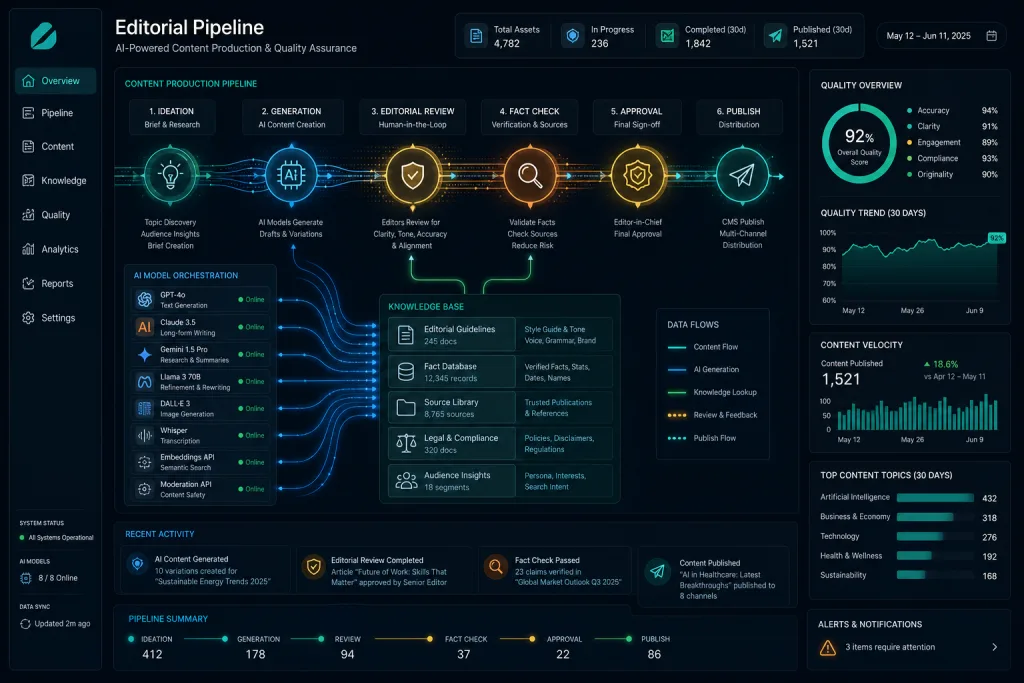
- briefing — a human defines the angle, audience, and quality criteria;
- generation — the model produces a structured draft based on given parameters;
- validation — the editor checks facts, originality, and compliance with the standard;
- assembly — the model or human assembles the final version with metadata, schema, links;
- publishing and monitoring — tracking visibility in search and AI answers.
Each step has a judgment checkpoint. The model accelerates steps 2 and 4; the human controls 1, 3, and 5. This isn’t a conveyor belt for speed’s sake—it’s a system that makes judgments explicit and repeatable.
Roles and Responsibilities in an AI Newsroom
When the workflow is standardized, roles are redistributed. This doesn’t mean firing authors—it means value shifts from “writing text” to tasks the model can’t perform reliably.
Strategy Editor determines which topics are worth producing, which angle is original, and which format fits. This is judgment about priorities, not words.
Fact-checker Validator checks AI output for factual accuracy, originality, and compliance with domain standards. In specialized niches, this role requires more expertise than writing.
AI Operator manages prompt systems, models, and pipelines. This is a technical role close to content operations: prompt versioning, model quality monitoring, CMS integration.
Expert Author adds what the model cannot: primary interviews, unique data, opinions that can’t be generated. In a mature AI newsroom, the expert author doesn’t write the whole text—they provide the judgment and insight that the model expands into a structure.
Knowledge Management as the Foundation of Maturity
The most underrated element of AI adoption is knowledge management. The model works better when given context: style guide, glossary, examples of good articles, typical structures, facts about the company and product. Without this, it generates average content that requires expensive editing.
Knowledge management in an AI newsroom includes:
- editorial standards base: style, tone, format, length and structure constraints;
- example library: best articles as a reference for prompts and quality assessment;
- domain glossary: terms, abbreviations, forbidden phrasing;
- fact sheets: verified data about the product, metrics, clients that the model shouldn’t generate;
- system prompts: versioned, testable instructions for standard tasks.
Teams that invest in this infrastructure get a model that works in their context, not an abstract one. This is the difference between “ChatGPT writes decently” and “our pipeline produces material that requires 20% editing instead of 80%.”
Practical Workflow Models for Long-form Content
Let’s consider three typical scenarios illustrating the transition from piecemeal AI use to an operational model.
Scenario 1: Knowledge Base
For a knowledge base with hundreds of articles, repeatability is maximal. The article structure is standard: definition, step-by-step guide, examples, FAQ. Here, an AI pipeline is maximally justified:
- briefing: the editor defines the topic and target page;
- generation: the model creates a structured draft based on a template with a fact sheet;
- validation: a fact-checker verifies technical claims;
- assembly: the model formats with metadata, schema, internal links;
- publishing: monitoring visibility in search and AI answers.
Judgment throughput is high here because the structure is predictable and facts are verifiable against a fixed set of sources.
Scenario 2: Analytical Long-read
For analytical material with a unique angle, judgment dominates. Here, AI is useful at the research and structuring stage, but not for final assembly:
- the expert author provides the thesis and data;
- the model helps structure and find gaps;
- the author refines the argument;
- the editor checks logic and originality;
- the model helps with formatting and metadata.
Here, AI’s ROI is not in speed, but in structuring quality. The author’s and editor’s judgment remains the main resource.
Scenario 3: Localization
For translating existing materials into new languages, AI radically changes the economics. But without knowledge management, the result is a literal translation lacking local context. A mature workflow includes a glossary, local fact-checking, and tone review by a native speaker.
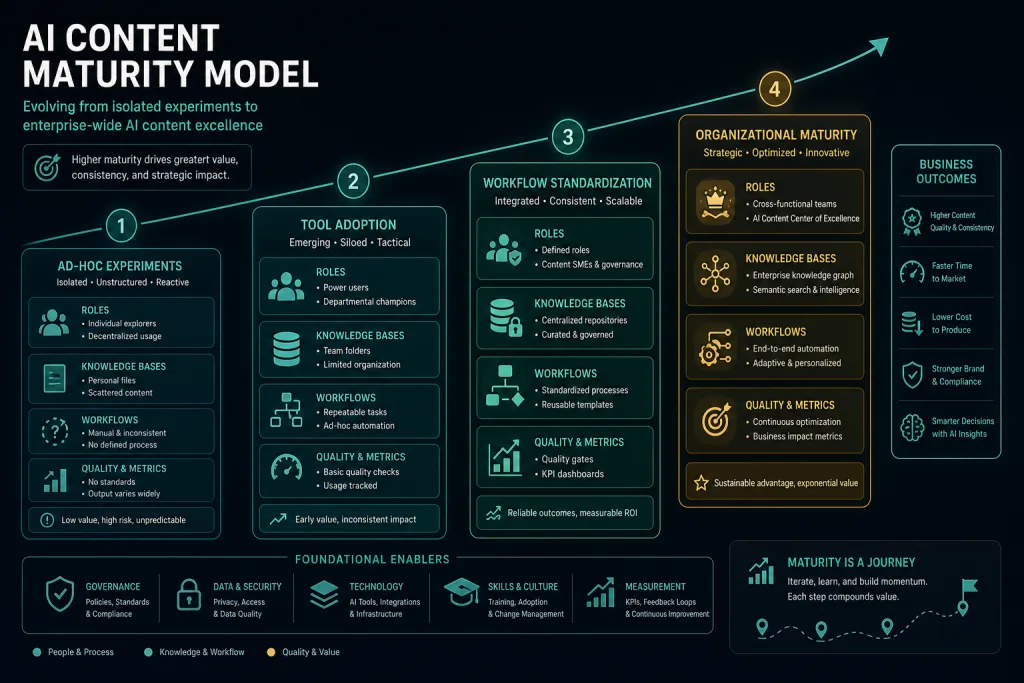
Metrics for AI Newsroom Maturity
How do you know a team is moving from piecemeal experiments to operational maturity? A few indicators:
- share of content through a standardized workflow — how much material goes through the pipeline rather than ad-hoc prompts;
- judgment time per content unit — how much editorial time is spent on validation compared to production;
- AI draft editing percentage — a pipeline quality metric; a high percentage means the prompt system or context is insufficient;
- quality repeatability — how stable the result is across different authors and editors;
- fact-checking error rate — how many AI claims require correction; a growing metric signals model or source drift.
These metrics don’t replace content metrics (traffic, engagement, conversion) but show whether the production process is healthy. Without them, scaling yields more content, but not more value.
Pitfalls of Organizational Adoption
The first pitfall is tool focus. The team buys subscriptions, tests models, looks for the “best tool,” but doesn’t change the workflow. Result: individual enthusiasts work faster, but the team as a whole doesn’t scale.
The second is delegation without validation. Management decides “AI now writes content” and cuts the editorial function. Without judgment, quality drops, originality vanishes, and within a quarter, visibility metrics worsen.
The third is over-automation. Trying to delegate everything to the model, including judgment about priorities and quality. The model has no accountability and doesn’t understand brand context. Automating generation without automating validation is a path to AI-slop.
The fourth is lack of knowledge management. The team uses models “as is,” without style guides, glossaries, and fact sheets. Every time, the model starts from scratch, and every time, the editor overpays for context.
How to Start the Transition
Transitioning from piecemeal experiments to an operational model doesn’t require large budgets. It requires consistency:
- Choose one content type — preferably a knowledge base or a blog with a standard structure. Don’t try to overhaul everything at once.
- Describe the workflow — steps, judgment checkpoints, roles. Make it explicit.
- Build a knowledge base for the model — style guide, examples, glossary, fact sheets. This is an investment with long-term ROI.
- Measure judgment time — how much editorial time goes into validation. This is the baseline metric for optimization.
- Iterate the prompt system — versioning, testing, comparing results. A prompt is code, not magic.
Checklist: Signs of Organizational AI Maturity in a Newsroom
- A workflow with judgment checkpoints is defined and documented for each content type
- Roles in the AI pipeline are distributed and described: who generates, who validates, who is accountable
- An editorial knowledge base exists: style guide, glossary, fact sheets, example library
- The prompt system is versioned and tested, not stored in individual employees’ heads
- Process quality metrics are tracked: editing percentage, fact-checking error rate, judgment time
- The team undergoes regular AI literacy training: not on prompts, but on model limitations and risks
- There is an accountability policy: who bears final responsibility for published AI-assisted content
Practical Conclusion
Content generation technology has outpaced the organizational readiness of most newsrooms. Models can write faster than teams can evaluate. This means competitive advantage is no longer in access to AI—it’s available to everyone—but in the ability to build a repeatable, managed process where human judgment guides generation, not vice versa.
Teams that treat AI adoption as an organizational project—with roles, processes, metrics, and knowledge management—get a scalable content conveyor. Teams that treat it as a tool get accelerated authors and the same editorial bottlenecks.
FAQ
How does AI literacy differ from the ability to write prompts?
Prompts are an input technique. AI literacy is understanding how the model forms output, where it can err, how to check sources, and where structural limitations lie. An editor with AI literacy works with model output critically, rather than trusting it by default.
Do we need to rewrite all workflows for AI at once?
No. Start with one content type with maximum repeatability—usually a knowledge base or a blog with a standard structure. Refine the workflow, metrics, and knowledge base on it, then scale to other formats. Trying to overhaul everything simultaneously creates chaos.
What metrics show that an AI pipeline is working?
Key metrics: AI draft editing percentage (low is a good sign), fact-checking error rate (consistently low), judgment time per content unit (doesn’t grow with volume), and quality repeatability across different authors. If these metrics are stable, the process is healthy.
Who is responsible for AI-assisted content?
Always a human—the editor or author who publishes the material. The model has no accountability and cannot bear it. The accountability policy must be explicit: it states who approved the publication and who performed the fact-checking. This is part of editorial governance, not a formality.
How to avoid AI-slop when scaling?
AI-slop occurs when generation outpaces validation. The solution is not less AI, but more structure: a standardized workflow with judgment checkpoints, a knowledge base for context, process quality metrics, and a policy that prevents publishing unverified AI output.