What is AI Localization for Long-Form Content and Why Editorial Teams Need It
AI localization of long-form content is not just translation. It is a process of cultural adaptation of editorial materials where generative models work in tandem with glossaries, prompt systems, and editorial guardrails, so that every language version reads as if written by a native speaker familiar with the local context. According to Ad Age, Vrbo uses generative AI to scale creative globally while ensuring local authenticity—and this approach applies not only to ad campaigns but also to long-form editorial pieces, knowledge base articles, and website content.
For editorial teams publishing in multiple languages, the problem is familiar: machine translation produces text that is formally correct but doesn’t sound right. Idioms are lost, local realities are ignored, and tone falls apart. AI localization solves this through a systematic approach: the model receives not only the source text but also context—who the reader is, which terms to use, what tone is appropriate, and which facts need additional verification.
Why Traditional Machine Translation No Longer Works for Long-Form Content
Traditional machine translation (Google Translate, DeepL) is optimized for sentences. Long-form editorial content is not just a set of sentences. It is a structure with arguments, links, context, tone, and cultural references. When you run a 3,000-word article through a translator, you get:
- Loss of coherence between paragraphs
- Literal translation of idioms and metaphors
- Ignorance of local facts (dates, names, laws, prices)
- A uniform tone not adapted to the audience
- Terminology errors, especially in niche topics
Generative AI solves each of these problems if given the right system of instructions.
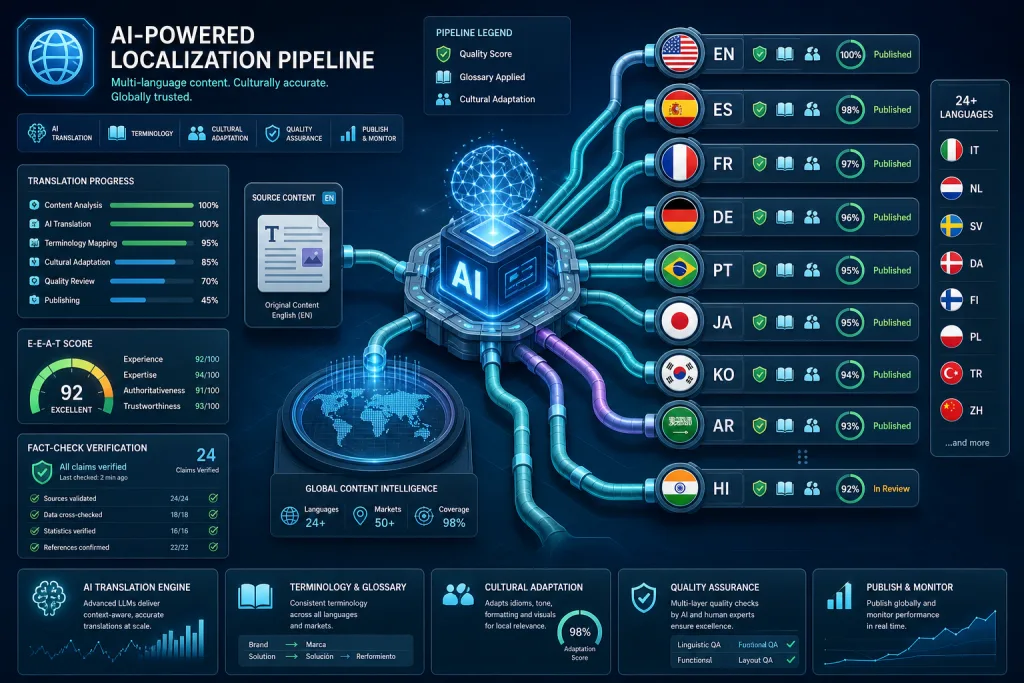
The Architecture of an AI Localization Pipeline
A working localization pipeline for long-form content consists of five layers. Each layer can be automated, but each requires editorial oversight.
Layer 1: Preparing the Source Material
Before AI begins localization, the source content needs to be structured. This means:
- Highlighting content blocks (headings, paragraphs, lists, tables, quotes)
- Marking terms that should not be translated (brand names, products, technical terms)
- Specifying the target audience for each language version
- Preparing a glossary of key terms with approved translations
The better the source is structured, the more accurate the localization. If an article is written with machine processing in mind—with clear headings, short paragraphs, and explicit definitions—AI works significantly more efficiently.
Layer 2: Prompt System for Cultural Adaptation
A localization prompt is not just an instruction to “translate to Spanish.” It is a system prompt that defines:
- Tone (formal, conversational, expert)
- Target audience (B2B editors, end-users, technical specialists)
- Style constraints (sentence length, use of active voice)
- Cultural constraints (avoiding certain comparisons, considering local norms)
- Formatting (dates, currencies, units of measurement)
The prompt system should be modular: a base prompt sets general rules, while language modules add instructions specific to each language. For example, for Japanese—indicating levels of politeness (keigo), for Arabic—text direction and formality, for German—the length of compound words.
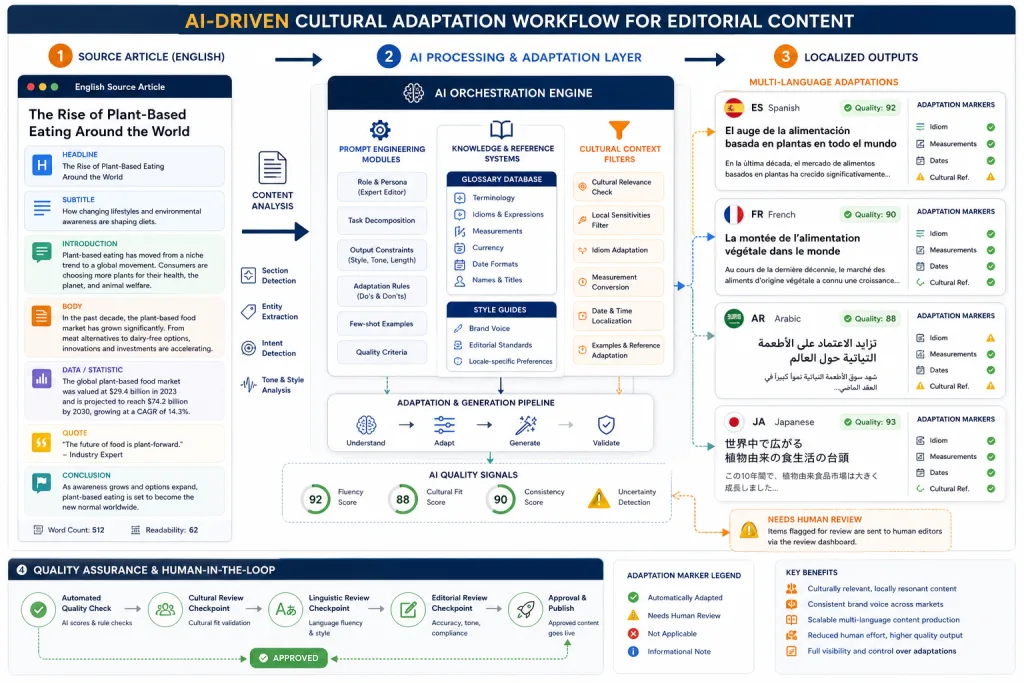
Layer 3: Generation and Post-Processing
At the generation stage, the model creates the localized version. But generation is just the beginning. Post-processing includes:
- Checking terminology against the glossary
- Fact validation (dates, names, numbers, links)
- Formatting checks (dates, currencies, units of measurement)
- Tone control (whether the version matches the target audience)
- Checking SEO elements (metadata, headings, alt texts)
For post-processing, you can use separate prompts or AI agents that check specific aspects. For example, one agent checks facts, another checks terminology, and a third checks tone.
Layer 4: Human-in-the-Loop Review
No AI localization pipeline should be without human review. But the review must be focused. A native-speaker editor does not check the entire text, but only:
- Cultural references and idioms
- Contextual nuances that AI cannot know
- Terminology outside the scope of the glossary
- Compliance with local editorial standards
This reduces review time by 60–80% compared to full translation editing.
Layer 5: Publishing and Monitoring
After review, the localized version is published. But the pipeline doesn’t end there. Monitoring includes:
- Tracking the visibility of localized pages in local search engines
- Checking citations by AI engines in different languages
- Collecting feedback from local audiences
- Updating the glossary based on new terms
The Glossary as the Foundation of Localization Quality
A glossary is not a dictionary. It is a managed document that contains:
- Approved translations of key terms
- Bans on certain phrasing
- Contextual explanations (when to use which option)
- Options for different tones
The glossary must be accessible to the AI model at the generation stage. This can be done via a RAG system: the model queries the glossary during generation and uses approved translations instead of its own assumptions.
Without a glossary, every localization is a lottery. The same term can be translated differently in different articles, destroying consistency and reader trust.
Fact-Checking Local Facts: Where AI Fails Most Often
AI models struggle with local facts because their training data is uneven. There is plenty of data for English, but little for Swahili or Hindi. This leads to systematic errors:
- Incorrect dates of local events
- Distorted names of local politicians and companies
- Errors in currencies and prices
- Incorrect references to local laws and regulations
- Ignoring regional differences (e.g., Spanish in Spain vs. Mexico vs. Argentina)
The solution is a RAG system with local sources. Before generation, the model gets access to a database of verified local facts: directories, official websites, editorial databases. If a fact is not found in the database, the model flags it for editor review.
Quality Metrics for AI Localization
To manage localization quality, you need to measure it. Here are five metrics worth tracking:
- Terminological consistency — the proportion of terms translated according to the glossary. Target: 95%+.
- Cultural adequacy — the proportion of cultural references adapted for the target audience. Measured by expert assessment.
- Fact-checking score — the proportion of facts confirmed by local sources. Target: 98%+.
- Tonal consistency — how well the tone of the localized version matches the target audience. Measured by comparison with reference texts.
- Local search visibility — the ranking of localized pages in local search engines and citations by AI engines.
How Vrbo Solves the Problem: Takeaways for Editorial Teams
The Vrbo case, described in Ad Age, shows that generative AI allows scaling creative globally while ensuring local authenticity. For editorial teams, this means:
- You can publish long-form content in 20+ languages without maintaining 20 editorial teams
- An AI pipeline with a glossary and prompt systems yields higher quality than traditional machine translation
- Human-in-the-loop review remains mandatory, but its volume is reduced several times over
- Localization becomes not a one-off project, but a continuous process in content operations
Key takeaway: AI localization is not about saving money on translators. It is about a systematic process where AI takes on the routine, and editors focus on cultural adaptation and fact-checking.
Integrating Localization into Content Operations
Localization shouldn’t be a separate process at the end of the pipeline. It must be integrated into content operations from the very beginning. This means:
- All target languages are considered when planning the content calendar
- Source articles are written with localization in mind (without excessive idioms, with clear structure)
- The glossary is updated with every new content release
- Localization quality metrics are included in the content team’s overall KPI system
- The AI pipeline is integrated with the CMS for automatic publishing of localized versions
When localization is integrated into content operations, the time from publishing the original to publishing localized versions is reduced from weeks to hours.
Risks and Limitations of AI Localization
AI localization is not a risk-free process. Here are the main risks to consider:
- Local fact hallucinations — the model may invent facts that are not in the source. Solution: RAG with verified sources.
- Tone averaging — all language versions start to sound the same. Solution: language modules in the prompt system.
- Loss of original nuances — the model may miss subtle references and subtexts. Solution: human-in-the-loop review of key fragments.
- Non-compliance with local regulations — content may violate local laws (e.g., advertising rules in Germany or content norms in the UAE). Solution: local legal audit before publishing.
- Dependence on glossary quality — if the glossary is incomplete or outdated, localization quality drops. Solution: regular audit and update of the glossary.
The Future: From Localization to Content Transcreation
The next step after localization is content transcreation. This is not just adapting to a language, but adapting to a format and platform. The same article can be localized into a long-form blog post, a series of social media posts, a podcast script, and a knowledge base structure—in every language. AI agents can automatically determine which format is needed for which audience and generate the appropriate versions.
This is no longer a fantasy. Teams building AI localization pipelines today will launch transcreation pipelines tomorrow—and content will reach every audience in the right format, in the right language, with the right tone.