What Are Guardrails and Why Editorial Teams Can’t Survive Without Them
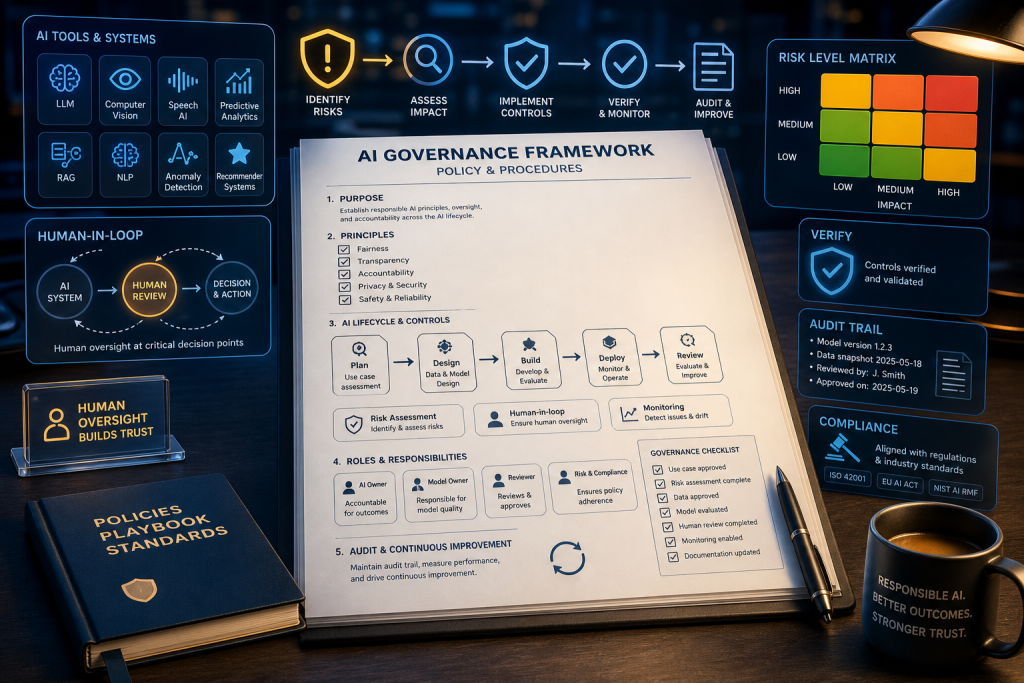
In the context of AI, guardrails are a set of rules, principles, and procedures that determine how a team can use generative models, where human intervention is mandatory, and who is responsible for the final result. In engineering, these are technical constraints built into the model. In editorial practice, these are policy guardrails: documents, checklists, and processes that don’t block AI but guide its use into a safe channel.
In July 2026, the Attorney-General’s Department of Australia publicly described its approach to implementing Copilot Chat and Google NotebookLM. The key principle sounds simple: AI complements work but does not automate it. No final product goes directly from AI. Users are required to check generated outputs for accuracy and “own the final result.” This is not a ban—it’s a guardrail.
For editorial teams, blog teams, and content operations, this approach is directly applicable. The problem isn’t that AI writes poorly. The problem is that without guardrails, the team doesn’t know where AI can be trusted, where control is needed, and who is responsible if something goes wrong. Guardrails close exactly this gap.
Policy Guardrails vs. Technical: What’s the Difference
Technical guardrails are restrictions at the API or platform level: content filters, token limits, system prompts, blocking certain topics. They are configured by the developer or provider. The editorial team rarely controls them directly.
Policy guardrails are rules that the team sets itself. They don’t require technical implementation but require discipline. Examples:
- “An AI draft must be proofread by a senior editor before publication.”
- “Facts, dates, numbers, and quotes from AI output are checked against the primary source, not the model’s wording.”
- “Prompts and versions are saved in a shared repository for audit.”
- “AI is not used to create legal or medical advice without expert review.”
It is policy guardrails that form editorial governance. They are simple, clear, and—most importantly—adaptable to the context of a specific team. The Australian Attorney-General’s Department called this “simple guidance that allows people to use their context to work with the tools.”
The Verification Principle: The “No Raw Outputs” Rule
The first and most important guardrail: nothing is published exactly as the AI generated it. This isn’t paranoia—it’s statistics. Language models hallucinate, and they do so confidently and plausibly. Studies show that factual errors in long AI texts occur in 5–15% of cases, depending on the topic and model.
Verification in the editorial process is divided into three levels:
- Fact-checking — every number, date, name, organization title, and quote is cross-referenced with the primary source. AI can “invent” a study that doesn’t exist or distort the conclusions of a real one. The editor looks for the original, not a retelling.
- Logical check — the argumentation is built consistently, conclusions follow from premises, and there are no contradictions between paragraphs. AI often “forgets” its own statements from the beginning of the text by the end.
- Stylistic check — the text matches the brand’s tone, doesn’t contain typical AI markers (excessive lists, cliches like “in today’s world,” “it’s important to note”), and sounds natural.
In practice, this means that an AI draft goes through at least two layers of verification: fact-checking and editing. Ideally, through three, if stylistic editing is added as a separate step.
Human-in-the-Loop: Where Humans Are Irreplaceable
The human-in-the-loop principle doesn’t mean the editor reads every AI text from beginning to end. That would be inefficient. It means a human makes decisions at critical points in the process:
- Before generation — the editor formulates the task, selects the source, and sets parameters (length, style, structure). The quality of the prompt determines 60–70% of the output quality.
- After generation — the editor evaluates whether the output can be used or needs to be regenerated with a refined prompt.
- Before publication — final check of facts, style, and compliance with editorial standards.
The Australian Attorney-General’s Department put it bluntly: “at this stage, we have no automated decision-making.” For an editorial team, this means: AI doesn’t decide what to publish. It doesn’t choose topics on its own. It doesn’t determine if a text is ready or not. A human is the only one who presses the “publish” button.
Responsibility for the Final Result
“Owning the final result” is a phrase from the Australian experience that is worth becoming a rule in every editorial team. It means: if there is an error in the published text, the editor is responsible, not the AI. Not the model provider. Not the author of the prompt. The editor who published the text.
This isn’t punishment—it’s the distribution of responsibility. When everyone knows the final decision is theirs, the attitude toward verification changes. It stops being a formality and becomes a professional standard.
In practice, this is formalized simply: every piece has a responsible editor. Their name or initials are recorded in the system. If the material was created using AI, this is noted in the internal system (not necessarily publicly), but responsibility is not delegated to the machine.
Logging and Auditing: Why the Creation Chain Matters
The Attorney-General’s Department emphasized another aspect: “we are obliged to keep a record of what we do. We have strict obligations regarding documentation.” For government bodies, this is a legal requirement. For editorial teams, it’s common sense and protection.
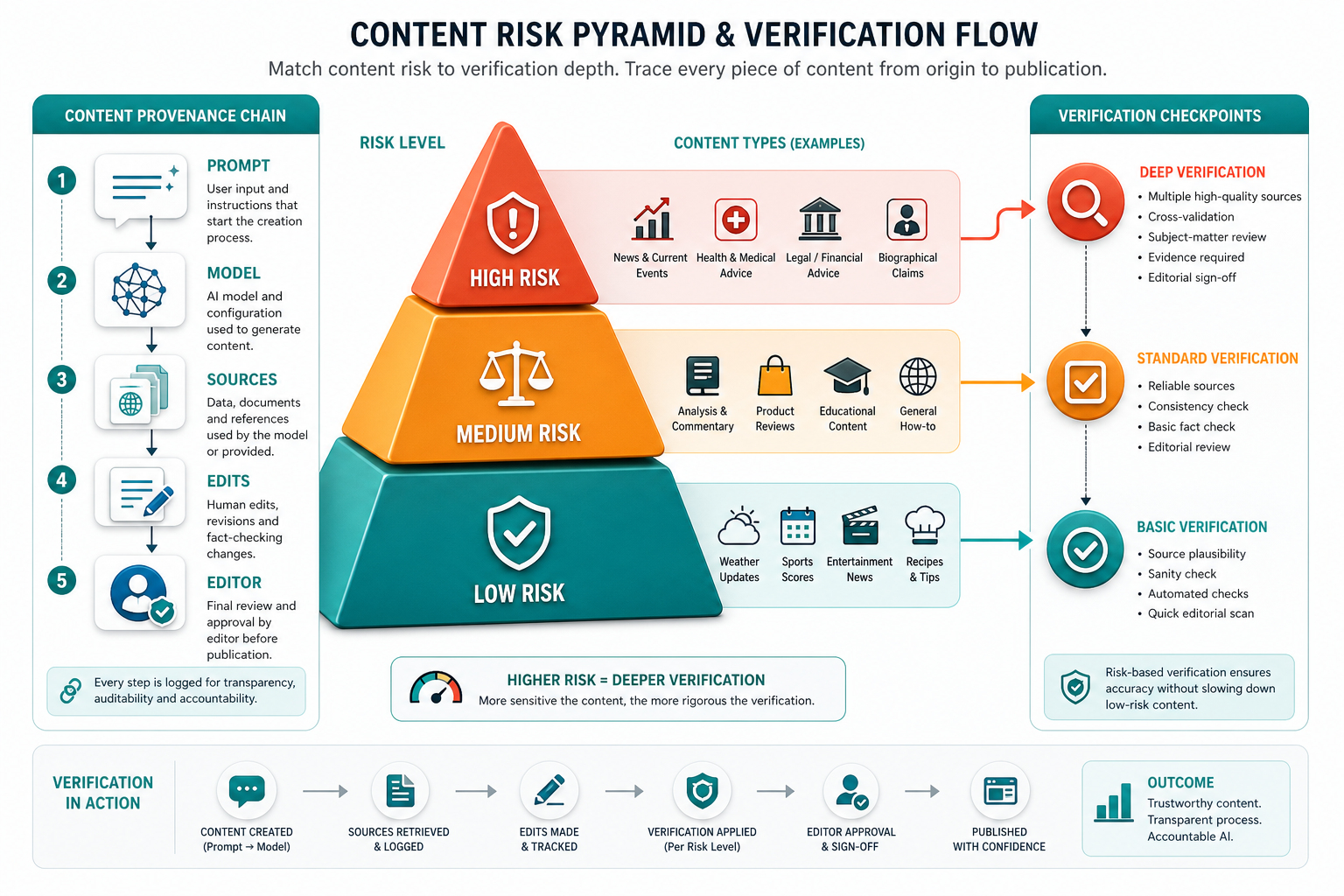
Content provenance is a record of how the material was produced:
- Which prompt was used.
- Which model and version generated the draft.
- Which sources were provided to the model.
- What edits the editor made.
- Who signed off on the final version.
Why is this necessary? First, in disputes over plagiarism or inaccuracy, you can show how the material was created. Second, when analyzing quality, you can track which prompts yield the best results. Third, when onboarding new employees, you use real examples, not abstract instructions.
Technically, this is solved simply: a shared spreadsheet or Notion database where the prompt, model, sources, and responsible person are recorded for each piece. The difficulty lies not in the tool, but in discipline.
Separating Tools by Risk Levels
Not all tasks are equally dangerous. Writing a product description is low risk. Creating a medical article is high risk. Editorial guardrails must account for this.
Low risk — product descriptions, meta descriptions, headlines, rephrasing, summaries of long texts. Here, AI can be used freely, with minimal proofreading.
Medium risk — blog posts, knowledge base articles, news reviews. Fact-checking and editing are mandatory. The prompt is saved. The responsible editor checks the output.
High risk — legal advice, medical recommendations, financial tips, materials with potentially harmful consequences. AI is used only for preparing the structure and gathering material. The final text is written by an expert. Every fact is checked twice.
This separation doesn’t need to be spelled out for every single piece of content. It’s enough to classify content types once and fix them in the editorial policy.
AI Editorial Policy Template: What to Include
The minimum document that covers the basic guardrails includes the following sections:
1. Scope. Which tools are allowed (Copilot, ChatGPT, Claude, NotebookLM), which are prohibited. Which models and versions are approved.
2. Risk levels. Classification of content types by risk level and corresponding verification procedures.
3. Verification principle. The rule: no raw outputs. Description of the three levels of verification—facts, logic, style.
4. Human-in-the-loop. Points where a human makes the decision. Who has the right to publish. Who is responsible for the final result.
5. Logging and auditing. What is recorded for each piece. Where prompts and versions are stored. How often an audit is conducted.
6. Confidentiality. What data cannot be uploaded to AI (users’ personal data, trade secrets, unpublished materials). This is especially important when using cloud models.
7. Training. How new employees are introduced to the policy. How often the rules are updated.
The document shouldn’t be long. Two to three pages are enough. The main thing is that it should be specific, not declarative.
Typical Mistakes When Implementing Guardrails
Mistake 1: Guardrails as a ban. The team writes a policy that bans AI or restricts its use so much that everyone continues working the old way, just secretly. Guardrails should guide, not block.
Mistake 2: Too abstract. “Use AI responsibly” is not a guardrail. “Check all numbers against the primary source before publication” is a guardrail. Specificity is the main quality.
Mistake 3: The document exists but isn’t used. The policy is written, put in Notion, and no one reads it. Solution: short onboarding for new employees, regular checks, and discussion at editorial stand-ups.
Mistake 4: No separation by risk. The same rules for a product description and a medical article are either redundant for the first or insufficient for the second. Classification by risk levels solves this problem.
Mistake 5: No one is responsible. The policy exists, but it’s unclear who monitors compliance. Appoint an AI policy owner—this could be the editor-in-chief, content operations manager, or a separate role in large teams.
Practice: How Guardrails Change Everyday Work
Imagine an editorial team that publishes 30 articles a week. Without guardrails: the author writes a prompt, gets the text, slightly edits it, publishes. The speed is high, but a month later, five articles with invented facts are discovered. Trust in the resource drops.
With guardrails: the author writes a prompt, gets a draft, runs it through fact-checking (10 minutes), passes it to the editor (5 minutes for editing), publishes. The speed drops by 20–30%, but every article goes through verification. A month later—zero incidents, reputation intact.
The numbers are arbitrary, but the principle is real. Guardrails are not a slowdown, they are insurance. You pay a small premium in speed to avoid paying a huge price in reputation.
The Australian Attorney-General’s Department called its approach “not rules, but guidelines.” This is an exact formulation for editorial teams. Guardrails don’t say “don’t use AI.” They say “use AI like this, and here’s what to check before you press the button.”
Checklist: 6 Steps to Editorial Guardrails
- Define the allowed AI tools and models, fix the list in the policy
- Classify content types into three risk levels—low, medium, high
- Write down the “no raw outputs” rule with three levels of verification—facts, logic, style
- Assign a responsible editor for each piece and record them in the system
- Set up content provenance logging—prompt, model, sources, edits
- Appoint an AI policy owner and conduct onboarding for the team
FAQ
How do guardrails differ from editorial policy?
Editorial policy describes content standards—style, tone, topics. Guardrails describe the rules for working with AI—what can be generated, how to check it, who is responsible. These are complementary documents: policy defines “what,” guardrails define “how with AI.”
Is it necessary to publicly indicate that a material was created using AI?
It depends on your editorial policy and jurisdiction. Internal labeling is mandatory for auditing. Public labeling is the team’s decision. Many publications indicate “this material was prepared using AI tools” at the end of the article or in metadata.
What data should not be uploaded to cloud AI models?
Users’ personal data (names, emails, phone numbers), trade secrets, unpublished research, confidential contracts. If data is not intended for public use, it cannot be sent to a model that might use it for training.
How long does it take to implement guardrails?
The minimum document can be written in one day. Real implementation—classifying content, training the team, setting up content provenance logging—takes 2–4 weeks, depending on the team’s size.
What to do if the team ignores guardrails?
Check if they are too restrictive. If rules block work, they will be bypassed. Simplify them, make them specific, and tie them to real process steps. Appoint a policy owner and conduct regular reviews at stand-ups.