Traditional SEO measures rankings in Google search results. But more and more users are getting answers directly from ChatGPT, Perplexity, Gemini, and Claude — without ever clicking through to a website. If your content doesn’t make it into these answers, it becomes invisible to a growing share of your audience. The problem is that standard SEO metrics — traffic, rankings, domain authority — don’t tell you whether AI is citing you at all.
A new study of the beauty sector revealed: a brand can have 10,000 media mentions and still barely exist in AI engine responses. At the same time, the study found that Reddit outranks Vogue and Allure as a citation source — meaning AI engines prefer community discussions over editorial articles. For content teams, this means the strategy of “publish quality content on your own site” no longer guarantees discoverability.
The solution is to implement a system of metrics specifically designed for AI search and rebuild your content strategy around the sources and formats that different LLMs prefer. Below is a practical breakdown of five key metrics, the differences between engines, and concrete steps for editorial teams.
What Is AI Search Visibility and How Is It Different from Traditional SEO
AI Visibility is the likelihood that your brand, product, or content will appear in the answer a language model generates in response to a user’s query. Unlike classic SEO, where you compete for a position in a list of ten links, AI search has no “results page” in the traditional sense. The model synthesizes an answer from its training data and the sources it considers relevant and authoritative.
Key differences from traditional SEO:
- No clicks by default. The user gets an answer in a chat and often doesn’t visit the source. Your “position” is a mention within the answer text, not a link in the search results.
- Sources matter more than links. AI engines cite not only websites but also forum discussions, reviews, retail listings, and databases. Your website is just one type of source among many.
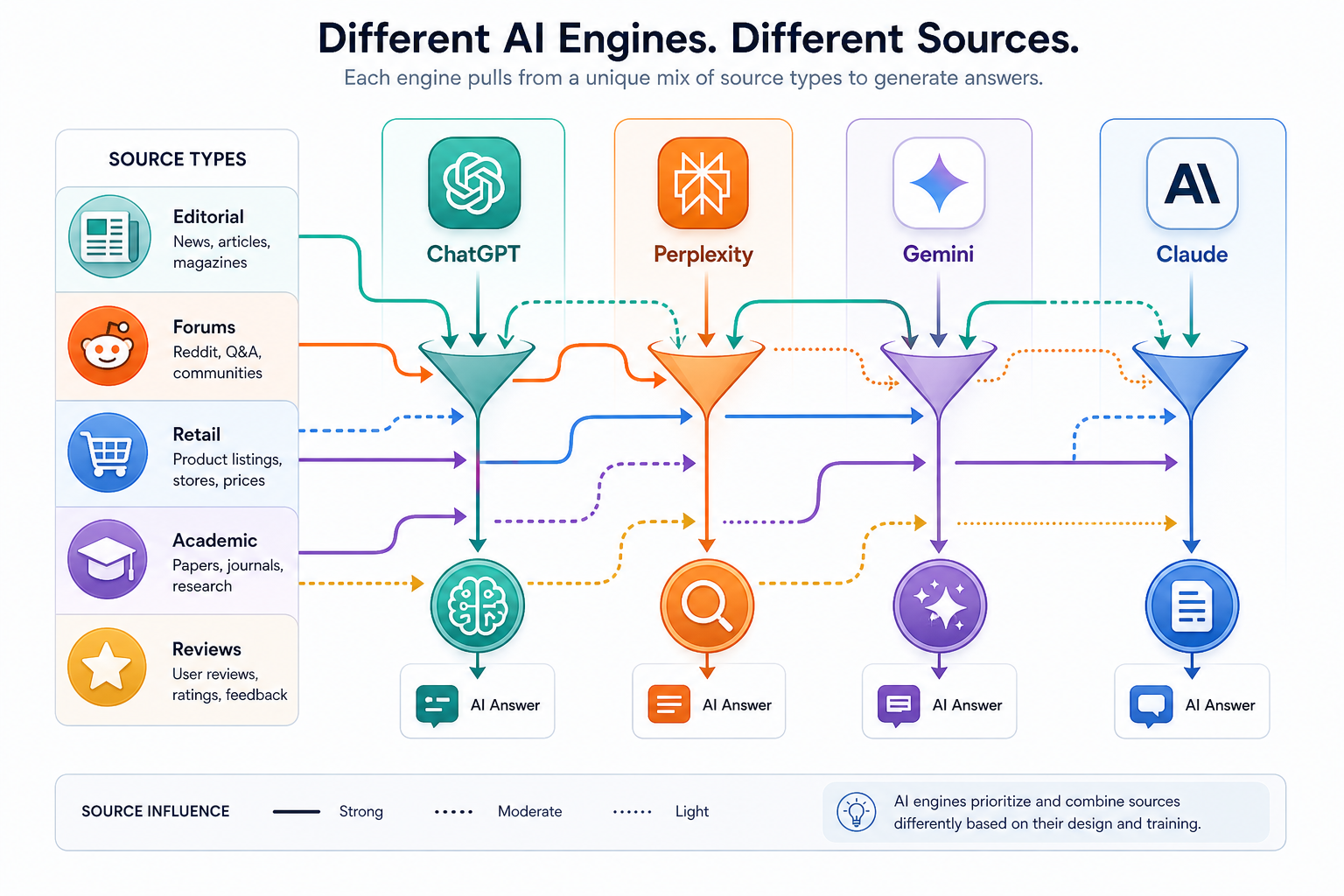
- Different engines, different preferences. Gemini relies on editorial sources and official directories. Perplexity emphasizes retail listings and community-driven platforms. Claude shows a different source selection pattern.
- A mention ≠ a recommendation. The fact that a brand is named in an answer doesn’t mean the AI recommends it. What matters is the context — positive, neutral, or negative.
Five Metrics for AI Answer Visibility
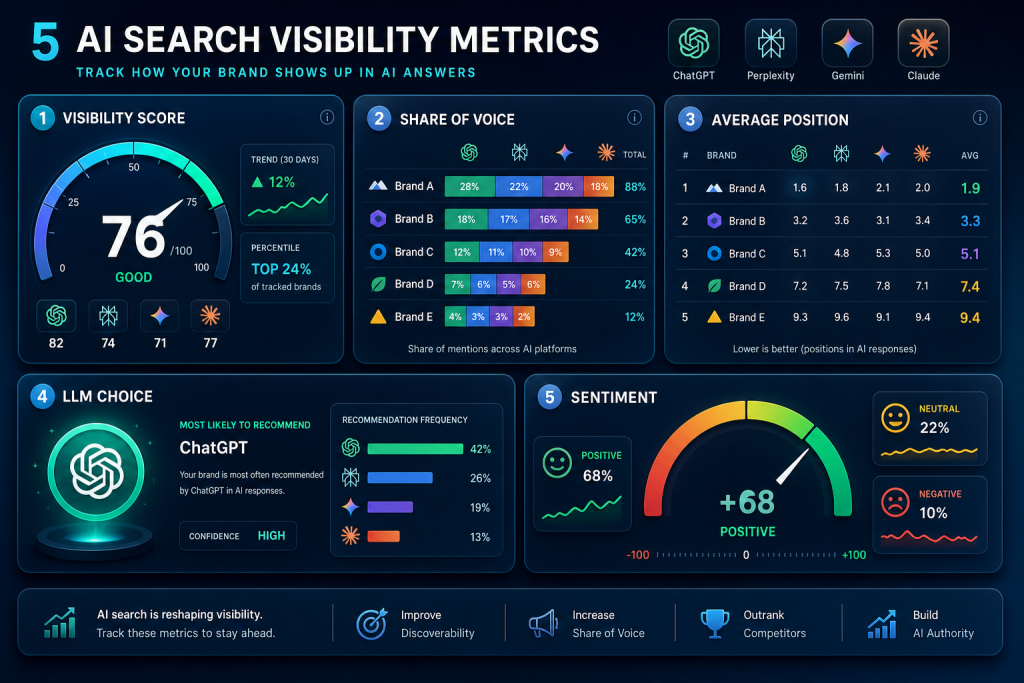
Researchers and AI search monitoring platforms have identified five metrics that together provide a complete picture. Each answers a separate question.
1. Visibility
The basic metric: does your brand or content appear in AI answers at all — across a sample of relevant queries. It’s measured as the share of queries where you’re mentioned at least once. If out of 100 queries you appeared in 12 answers, your Visibility Score is 12%.
2. Share of Voice
A relative metric: how often you’re mentioned compared to competitors for the same queries. If for the query “best CRMs for media” the AI named three products and yours is one of them, your Share of Voice for that query is 33%. Share of Voice shows not absolute presence but your competitive position within AI answers.
3. Average Position
Where exactly in the answer you’re mentioned. Being first in a list of five is not the same as being third. Models often structure answers in descending order of “confidence” or relevance. A position near the beginning of the answer correlates with the model considering you a top priority recommendation.
4. LLM Choice
Whether the AI engine recommends your brand when a user directly asks “which company should I choose” or “which tool should I use.” This is the most “conversion-oriented” metric: it shows whether the model turns you into a recommendation rather than just a mention.
5. Sentiment
How the AI characterizes your brand in answers — positively, neutrally, or negatively. You can have a high Visibility Score, but if the model describes you in the context of problems or complaints, it doesn’t do you any good. Sentiment needs to be tracked separately for each engine, because models can interpret the same data differently.
Why 10,000 Mentions Don’t Guarantee Presence in AI Answers
The beauty brand study revealed a paradox: high volume of media mentions correlates poorly with AI search visibility. Brands with thousands of press mentions were absent from AI engine answers for basic queries. The reasons:
- AI engines value authority and source diversity over volume. 100 mentions in one source type (e.g., press releases) are less valuable than 20 mentions across different types: editorial articles, forum discussions, reviews, expert analyses.
- Third-party voices matter more than your own. Earned media accounted for 44% of all cited sources in the study, while brands’ own content accounted for only 7%. AI engines are skeptical of self-description and prefer independent validation.
- Query format determines source selection. For “what is this brand” queries, the model looks for encyclopedic sources. For “should I buy” queries — reviews and discussions. For “where to buy” — retail listings.
Different Engines, Different Sources: How Gemini, Perplexity, and Claude Choose Citations
Each AI engine has its own source selection pattern. This is critical for content strategy: what works for one engine may not work for another.
Gemini combines editorial sources with official product information and authoritative directories. If your strategy is to publish in reputable outlets and maintain up-to-date Wikipedia pages and industry directory listings, that plays well for Gemini.
Perplexity places greater emphasis on retail listings and community-driven platforms. Having your product on Amazon, niche marketplaces, and active Reddit discussions boosts visibility in Perplexity.
Claude shows a different pattern — greater weight on academic and expert sources, less on commercial listings. For B2B content, this may mean that whitepapers, research, and expert articles matter more than product listings.
ChatGPT with web search combines approaches: it can cite both editorial sources and discussions, but the answer format depends on how the query is phrased.
Practical takeaway: don’t optimize content for just one engine. Create diversity in sources and formats to cover the preferences of all major models.
Reddit as the Top Citation Source: What This Means for Editorial Teams
The most surprising finding of the study: Reddit became the single most cited source across all analyzed AI answers — surpassing leading beauty publications, including Vogue and Allure. This doesn’t mean editorial articles aren’t important. It means community discussions have become a distinct class of authoritative sources for AI.
Why this is happening:
- Discussions contain real user experiences. Models are trained to identify patterns of “popular consensus.” If dozens of people on Reddit recommend a product with specific arguments, that’s a stronger signal than a “we’re great” message from the brand itself.
- Reddit threads are structured. Questions and answers, upvote systems, threaded discussions — this is a format that models can easily parse and interpret.
- Freshness. Active Reddit discussions are updated daily, while many editorial articles go stale.
For content teams, this means three things. First, monitoring mentions on Reddit and similar platforms becomes part of content operations. Second, brand experts participating in discussions (without spamming) can influence what models “see.” Third, content formats — Q&A, discussions, comparisons — gain additional value, because these are exactly the formats AI prefers to cite.
Earned Media vs. Owned Content: A New Balance
The 44% earned media to 7% owned content ratio in cited sources is a signal for editorial teams. If your content strategy is entirely built around your own website and blog, you’re covering only a fraction of what influences AI visibility.
What counts as “earned media” in the context of AI search:
- Editorial articles in reputable publications — still important, especially for Gemini and Claude.
- Expert quotes in third-party content — the model sees not just the brand name but the context of expertise.
- Forum discussions — Reddit, Quora, industry communities.
- Reviews and ratings — platforms like G2, Capterra, Trustpilot.
- Retail listings — Amazon, niche marketplaces, especially for Perplexity.
- Podcasts and video — YouTube content appears in more than 25% of AI assistant answers, according to Jellyfish.
The strategy: don’t replace owned content, but complement it with an ecosystem of sources. Your website is the foundation (E-E-A-T, authority, depth), but without external validation, AI engines may not notice it.
How Editorial Teams Can Optimize Content for AI Answers
Optimizing for AI search isn’t a separate task — it’s an extension of your existing content strategy. Here are concrete steps for editorial teams:
1. Structure content for citation. AI engines “pull” fragments from sources. Clear definitions, lists, comparison tables, brief takeaways at the beginning of sections — all of this increases the chance that the model will choose your fragment.
2. Create content that answers direct questions. Q&A formats, FAQ blocks, “how to choose” guides — these are the formats AI engines cite most often. Not because they “love” FAQs, but because the question-answer format matches how users phrase queries to models.
3. Publish expertise on external platforms. Guest articles, expert commentary, podcast appearances, Reddit AMAs — these create traces in sources that AI values higher than self-published content.
4. Keep content fresh. Outdated content is a risk. If your 2024 article contains stale data, the model may choose a more recent source from a competitor. Regular updates and marking the update date is a signal for AI.
5. Monitor mention sentiment. If AI engines cite negative reviews or complaints, your Visibility Score goes up, but Sentiment goes down. Monitoring sentiment in AI answers is a new task for content teams and PR.
Practical Checklist: Auditing Content Visibility in AI Search
Checklist: AI Search Content Visibility Audit
- Build a list of 30–50 key queries your audience uses to search for your product or topic — and run them through ChatGPT, Perplexity, Gemini, and Claude. Record where you appear and where you don’t.
- Measure your Visibility Score — the share of queries where your brand or content is mentioned at least once in the answer.
- Calculate Share of Voice — compare your mention frequency with 3–5 key competitors for the same queries.
- Check Average Position — in which answers you’re first, and in which you’re second or third in the recommendation list.
- Analyze Sentiment — how AI engines characterize your brand: positively, neutrally, or negatively.
- Identify the sources AI cites instead of you — Reddit, publications, reviews, retail listings — and assess whether you can strengthen your presence on those platforms.
- Add formats to your content plan that AI cites most often: Q&A, comparison tables, expert analyses, definitions with source citations.
Tools for Monitoring AI Visibility
The AI search monitoring market is still taking shape, but several approaches already exist:
- Manual audit via chat interfaces. Running queries through ChatGPT, Perplexity, Gemini, and Claude and recording results in a spreadsheet. Time-consuming, but gives an initial picture.
- AI search monitoring platforms. Specialized tools are emerging that automate query runs and aggregate Visibility, SOV, and Sentiment metrics across major engines.
- Reddit and forum mention tracking. Social monitoring with a filter for the platforms AI cites most often.
- Competitor cited source analysis. If a competitor appears in AI answers and you don’t — analyze which sources the model cites alongside them, and assess whether you can strengthen your presence in those same sources.
What Doesn’t Work in AI Search Optimization
Several common misconceptions:
- “Quality content on your site is enough.” No. Quality content is the baseline, but without external validation, AI engines may not see it. The 7% owned content in cited sources is proof.
- “You just need to publish more.” No. Publication volume correlates poorly with AI visibility. Source type diversity and authority matter more than quantity.
- “AI search is the same as SEO.” No. The metrics, tools, and ranking factors are different. Google rankings don’t guarantee mentions in ChatGPT.
- “It’s enough to optimize for one engine.” No. Different engines choose different sources. Your strategy should cover all major models.
Outlook: Where AI Search Is Heading in 2026–2027
AI search is evolving toward greater personalization and contextual awareness. This means the same query may produce different answers for different users — depending on their history, geography, and phrasing. For content teams, this complicates monitoring: you can’t measure Visibility Score once and consider it permanent.
At the same time, the role of community content is growing. If Reddit already surpasses leading publications as a citation source, we can expect other community platforms — industry forums, Discord communities, specialized Q&A sites — to gain weight as well. Editorial teams should expand monitoring beyond classic media.
And finally, AI agents. The launch of tools like Profound for end-to-end marketing means that part of the work around monitoring and optimizing visibility will be automated. But strategic decisions — which sources to develop, what content to create, how to manage sentiment — remain with editorial teams.
FAQ
How is Visibility Score different from regular SEO traffic?
Visibility Score measures the share of queries where your brand or content appears in AI answers — regardless of whether the user clicks through to your site. SEO traffic measures clicks from search results. These are different funnels: an AI answer can shape brand perception without a click.
How often should you conduct an AI visibility audit?
At least once a quarter, since models update and source selection patterns change. When launching a new product or a major content campaign — immediately after launch and again 2–4 weeks later.
Should you specifically create content for Reddit to improve AI visibility?
Directly creating “fake” discussions is a risk and a violation of platform rules. But having brand experts participate in relevant discussions, answer questions, and do AMAs is a legitimate strategy that can strengthen your presence in sources that AI cites.
Which engine matters most for content teams?
It depends on your audience. B2B content is more often searched via ChatGPT and Claude. Consumer content — via Perplexity and Gemini. It’s recommended to track all four major engines, but prioritize the one closest to your audience.
Can negative Sentiment in AI answers damage a brand?
Yes. A high Visibility Score with negative Sentiment means AI engines frequently mention you in a negative context. This can influence users who trust AI answers. Monitoring Sentiment is a new task for PR and content teams.